Radiology Second Opinion Service China: Independent Re-Read of Your CT MRI and PET-CT
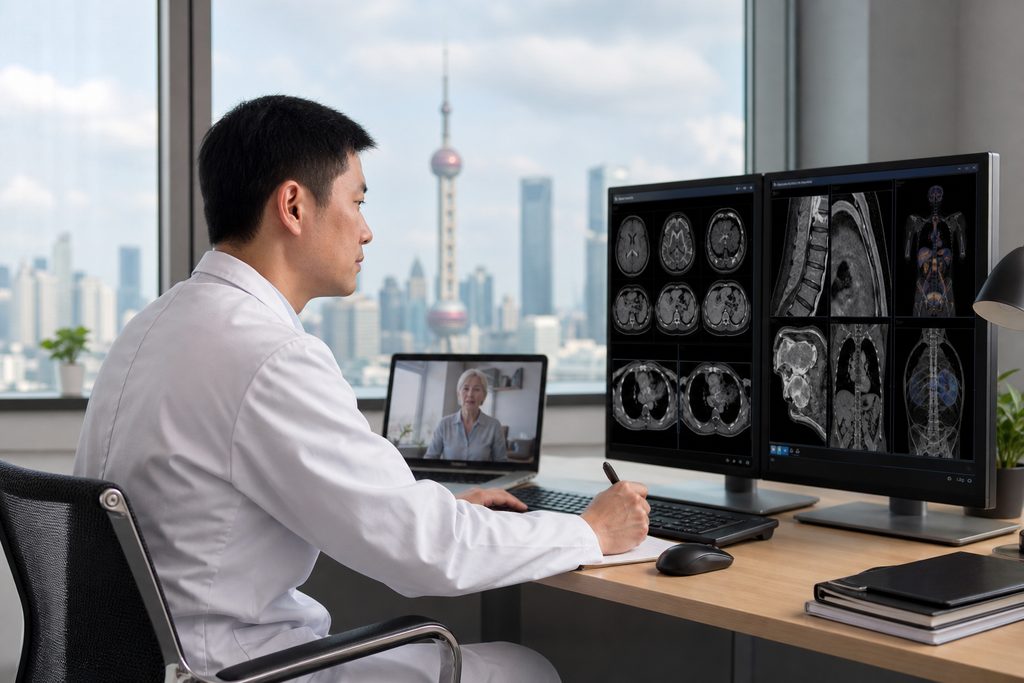
Key Takeaways
- Up to 30% of radiology interpretations contain clinically significant discrepancies when re-read by a subspecialist, according to peer-reviewed studies. A second set of eyes changes treatment plans.
- Chinese radiologists at top-tier hospitals read staggering volumes — a thoracic radiologist at a major cancer center may interpret over 15,000 chest CTs annually, developing pattern recognition that lower-volume peers simply cannot match.
- Language barriers and incompatible medical record systems make independent coordination nearly impossible for international patients. Raw DICOM files are not enough — contextual translation of both images and clinical history is required.
- You retain full control. A remote second opinion radiology China report is an educational tool for you and your treating physician. It is not a prescription, and no one will pressure you to travel.
The Problem: Your Scan Was Read Once, Fast, and Maybe Wrong
Radiology errors are not rare. They are documented. A landmark 2015 study in Radiology found a 30% discrepancy rate between initial and subspecialty interpretations of abdominal CT scans. Another 2020 analysis in Clinical Imaging reported that second-opinion reviews changed the diagnosis in 26% of oncologic PET-CT cases. These are not marginal misses. They are changes that alter surgery plans, chemotherapy regimens, and sometimes the entire prognosis.
Why does this happen? In many health systems, your scan is read by a general radiologist covering multiple body systems during a single shift. That radiologist may have 15 minutes to interpret a complex multiphase liver MRI while also fielding phone calls from the emergency department. Subspecialization matters. A dedicated neuroradiologist sees more brain tumors in one month than a general radiologist sees in a year. The difference shows up in the report.
Then there is the problem of the images themselves. Scans are often read without access to prior imaging. Clinical history on the requisition form is sparse — sometimes just “abdominal pain” when the real question is whether a pancreatic lesion has invaded the superior mesenteric artery. The radiologist interprets what they see, but they may not know what the referring physician actually needs to know.
You deserve better. A second opinion radiology China review puts your images in front of a subspecialist who reads only one body system, at a center where that specific disease is seen in exceptionally high volume, with enough time to examine every sequence and compare every prior study you can provide.
Who We Are
We are not a hospital. We do not employ radiologists or issue medical reports ourselves. We are a medical concierge organization based in China that connects international patients with the country’s top-tier hospitals for independent radiology second opinions, in-person consultations, and treatment coordination. Our team handles everything that sits between you and the expert: medical record translation, DICOM file preparation, hospital selection based on subspecialty match, appointment coordination, and secure report delivery. We work with 340+ top-ranked hospitals across 37 cities. Every radiologist who reviews your case is board-certified and affiliated with a Fudan-ranked or JCI-accredited institution.
Why a Second Opinion Radiology China Review Delivers Results
Volume Creates Expertise That Cannot Be Taught
Chinese hospitals operate at a scale that is difficult to visualize until you see it. A single radiology department at a major Shanghai or Beijing teaching hospital may perform over 1,000 CT scans per day. A subspecialty thoracic radiologist at a top cancer center reads nothing but chest imaging — day after day, year after year. That radiologist has seen more rare lung cancers, more atypical infections, and more subtle interstitial lung disease patterns than most Western radiologists encounter in an entire career.
This is not speculation. Volume-outcome relationships are well established across medicine. In radiology specifically, studies show that subspecialty-trained readers detect more cancers and make fewer false-positive calls. When you send your chest CT for an independent MRI review China price inquiry or a CT re-read, the value is not just a second opinion — it is a second opinion from someone who has built their career on exactly your type of scan.
Technology and Systematic Double-Reading
Many top Chinese hospitals employ a structured double-reading protocol for complex oncology cases. The initial read is performed by an attending radiologist. The case then goes to a subspecialty expert for a second, independent interpretation. Discrepancies are adjudicated before the final report is issued. This is not an ad-hoc curbside consult. It is a formal, documented quality assurance step built into the department workflow.
AI-assisted detection tools are also widely deployed. These do not replace the radiologist — they flag regions of interest for closer inspection. A lung nodule that measures 4 mm on axial slices might be flagged by the algorithm, prompting the radiologist to perform multiplanar reconstructions and confirm whether it is truly suspicious. The combination of systematic double-reading and AI triage catches findings that a single fatigued reader might miss at 4:45 PM on a Friday.
Cost Advantage Without Quality Compromise
The structural economics of Chinese healthcare are different. Radiologist salaries are lower, but training standards are high — subspecialists typically complete 5-7 years of residency and fellowship, often with international observerships. Hospital infrastructure is modern; most top-tier centers use Siemens, GE, or Philips scanners that are identical to those in North America and Europe. The cost savings come from labor economics and operational efficiency, not from cutting corners on equipment or training.
A written second opinion from a top-tier hospital expert starts from $300. A PET-CT interpretation service Shanghai consultation with a nuclear medicine subspecialist falls in the same range. Compare this to US-based commercial second-opinion radiology services, which often charge $500-$1,500 or more. The lower price reflects the cost structure of the Chinese system — not lower quality. The radiologist reading your study is the same person interpreting scans for patients who fly in from across Asia for treatment.
What You Need to Know Before Going Alone
Arranging a remote radiology second opinion directly with a Chinese hospital sounds straightforward. It is not. Here is what you will encounter if you try to navigate this independently:
- DICOM file compatibility: Chinese hospital PACS systems often require specific file formats and transfer protocols. A CD burned in a US or European radiology center may not upload correctly. Naming conventions differ. Sequences can be rejected by the receiving system without clear error messages. Our team pre-processes every DICOM dataset to ensure compatibility before submission.
- Clinical history translation: The radiologist needs more than images. They need the clinical question, relevant lab results, prior biopsy reports, and treatment history. All of this must be translated into medical-grade Chinese — not conversational Mandarin, but precise terminology that matches how Chinese radiologists document findings. A mistranslated pathology term can misdirect the entire interpretation.
- Hospital selection and subspecialty matching: China has over 35,000 hospitals. The top 5% — roughly 340 institutions — are ranked by the Fudan University hospital evaluation system. But even among these, subspecialty strengths vary enormously. A hospital ranked highly for hepatobiliary surgery may not be the right choice for a brain MRI re-read. You need to match your specific scan type and clinical question to the right department and the right radiologist. Our database covers 45 clinical specialties with subspecialty-level granularity.
- Payment and report delivery: Most Chinese hospital international departments accept wire transfers, but processing times and documentation requirements vary. Reports are issued in Chinese and require professional translation back into English. Turnaround times range from 3 to 7 business days depending on case complexity and department workload.
How We Help You Navigate This
These barriers are not insurmountable. They are structural — products of different healthcare systems, different languages, and different administrative processes. Our entire service exists to dissolve them.
The process begins with a free consultation. You tell us what scans you have, what clinical question remains unanswered, and what prior reports say. We identify the right hospital and subspecialty department. You upload your DICOM files and clinical documents through our secure portal. Our team translates everything — not just the words, but the clinical context — and submits the complete package to the hospital’s international department.
The radiologist performs an independent, de novo interpretation. This is not an over-read of your original report. It is a fresh look at the raw images, informed by your translated clinical history and any prior imaging you provide. The report comes back in Chinese. Our medical translators render it into precise English, preserving diagnostic nuance. You receive both versions — the original Chinese report and the English translation — along with a summary that highlights areas of agreement and discrepancy with your original interpretation.
What happens next is your decision. Many patients take the report to their local physician for discussion. Some use it to advocate for a different treatment approach. Others decide the findings warrant an in-person consultation in China. If you choose to travel, any second opinion fee is credited in full toward our on-the-ground coordination service within 90 days. There is no obligation to travel. The report is yours to use as you see fit.
Frequently Asked Questions
Radiology is inherently a remote discipline. The radiologist interprets images, not patients. What matters is image quality, complete clinical history, and access to prior studies for comparison. A well-prepared DICOM dataset with translated clinical context provides everything a subspecialist needs to render an informed opinion. The limitation is real — the radiologist cannot examine you or ask follow-up questions in real time. That is why we emphasize that the report is an educational tool for you and your treating physician, not a replacement for a comprehensive in-person evaluation.
A written second opinion from a top-tier hospital expert starts from $300. Complex multiphase studies — a triple-phase liver CT or a multiparametric prostate MRI — may fall in the $400-$500 range. PET-CT interpretation service Shanghai pricing is similar. The final quote depends on study complexity, the number of prior exams requiring comparison, and the subspecialty department involved. We provide a firm price before you commit. No surprises. Our coordination fee is separate and disclosed upfront.
This happens in a significant minority of cases — the literature suggests 20-30% discrepancy rates are common. The report will describe the findings in detail, with measurements, staging information where applicable, and specific recommendations for further workup if needed. We encourage you to review the report with your treating physician. In cases of major discrepancy, some patients seek a third tie-breaking opinion or schedule a video consultation with the Chinese radiologist through the hospital’s international department (from $100-$300). The goal is clarity, not conflict with your original care team.
Yes. This is one of our most common requests, particularly for oncology patients. PET-CT interpretation is highly subspecialized — nuclear medicine physicians and hybrid-trained radiologists who read these studies daily develop an eye for subtle metabolic activity that general radiologists may overlook. We can coordinate a PET-CT interpretation service Shanghai re-read or a review at any of our partner hospitals. The process is identical to CT or MRI second opinions: secure DICOM upload, clinical history translation, subspecialist assignment, and dual-language report delivery.
You need the original DICOM files, not JPEG screenshots or printed films. Request a DICOM export from the imaging center or hospital where your scan was performed. Most centers provide these on a CD or via a secure download link. Upload everything through our portal. If the files are incomplete or incompatible, our team will identify the issue and guide you through obtaining the correct dataset. We cannot work from non-DICOM formats — the radiologist needs the raw data to manipulate window levels, perform multiplanar reconstructions, and measure lesions accurately.
Your Next Step
A radiology report is a human interpretation of digital data. Human interpretations vary. When the stakes are high — a new cancer diagnosis, a complex pre-surgical planning scan, a finding that does not match your symptoms — a second opinion radiology China review provides clarity that can change your treatment trajectory. The process is remote, the turnaround is measured in days, and the cost is a fraction of what a wrong diagnosis costs in time, unnecessary procedures, and peace of mind.
If you have scans you want re-examined, start with a conversation. Our team will help you determine whether a second opinion is appropriate for your specific situation, which subspecialty and hospital match your needs, and what the process looks like from start to finish. Visit our patient services page to learn more about how we work, or explore our specialty-specific hospital rankings to see which centers lead in your area of concern.
For more medical information and treatment options in China, visit chinamedservices.com (China Medical Services).
