Medical Escort to China: Nurse-Accompanied Flights for Stable Patients
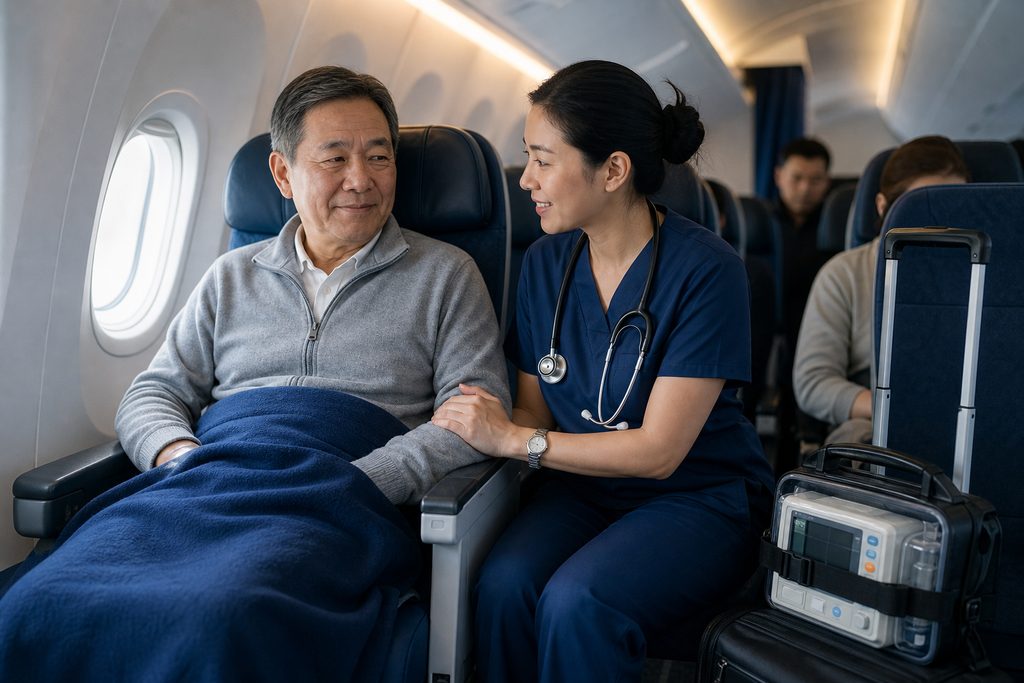
Key Takeaways
- A commercial medical escort provides a nurse or paramedic to accompany a stable patient on a commercial flight — the patient sits in a standard seat, not on a stretcher, keeping costs far below air ambulance rates.
- Nurse escort flight China cost typically ranges from $3,000 to $8,000, a fraction of the $40,000–$120,000 price tag for a dedicated medical jet.
- This service suits patients who are medically stable enough to sit upright for the flight duration but need professional monitoring, medication management, or mobility assistance during transit.
- Arranging a nurse-accompanied flight into China requires coordination across three separate systems: the medical escort provider, the receiving Chinese hospital, and Chinese visa authorities — gaps in any one strand can strand a patient at the border.
The Problem: When You Are Too Stable for an Air Ambulance but Too Fragile to Fly Alone
Every year, approximately 12 to 14 million Americans travel abroad for medical care, according to CDC estimates. A meaningful slice of that number involves patients who have already been treated overseas and need to get home — or patients heading toward treatment who cannot safely manage a 12-hour flight unassisted. The math gets brutal fast. A long-haul air ambulance from a European capital to Shanghai runs $40,000 to $120,000. From North America, the quote often exceeds $150,000. Insurance rarely covers the full amount. Families drain savings. Some patients postpone care they urgently need.
But what if the patient does not need a flying ICU? What if they are stable — alert, breathing on their own, no active bleeding — but simply cannot navigate airports, manage medications across time zones, or sit for 14 hours without someone checking their vitals? That is where the commercial medical escort model fits. A registered nurse or critical-care paramedic flies with the patient on a standard commercial airline. The patient sits in business or economy class. The escort monitors oxygen saturation, administers timed medications, assists with mobility, and handles any mid-flight deterioration within the scope of their training. The cost drops by 80–90% compared to a dedicated medical jet. And the safety record, when patients are correctly screened, is strong.
Yet getting this right for a flight into China is not simply a matter of booking a ticket and hiring a nurse. China’s visa system, hospital admission protocols, and ground transport logistics add layers of complexity that a generic medical escort broker in Florida or London may never have encountered. Our team has coordinated nurse-escorted arrivals into Beijing, Shanghai, and Guangzhou for patients from over a dozen countries. We know where the process breaks — and how to keep it from breaking.
Who We Are
We are not a hospital. We do not provide medical treatment, clinical diagnoses, or flight nursing services directly. Our organization is the logistical layer between international patients and China’s top-tier medical infrastructure. We maintain relationships with 340+ top-ranked hospitals across 37 Chinese cities, understand the S2 visa pathway in granular detail, and coordinate with vetted commercial medical escort providers to get stable patients from their home airport to the door of the right Chinese hospital — with a qualified nurse at their side for every mile of the journey. Think of us as the architects of your medical travel. You bring the clinical need. We build the route, the paperwork, the ground connections, and the safety net.
What a Commercial Medical Escort to China Actually Is — and What It Is Not
The phrase “commercial medical escort” gets thrown around loosely. Let us define it with precision. A commercial medical escort is a licensed healthcare professional — typically a registered nurse, sometimes a critical-care paramedic — who accompanies a medically stable patient on a regularly scheduled commercial flight. The escort is not a flight attendant. They are not a doctor. They are a trained clinician whose sole job for the duration of the journey is the safety and comfort of one patient.
This model works for patients who meet specific criteria: hemodynamically stable, no active cardiac ischemia, oxygen requirements that can be met with portable concentrators approved by the airline, and the physical ability to sit upright in a standard seat for the flight duration. Patients who are bedbound, intubated, or requiring continuous IV infusions generally need a dedicated air ambulance instead. The screening process is rigorous — and for good reason. A mid-flight emergency at 35,000 feet over Siberia is not something anyone wants to manage with a single nurse and the aircraft’s basic medical kit.
The escort handles medication scheduling across time zones, assists with meals and hydration, monitors vital signs at regular intervals, accompanies the patient to the lavatory if needed, and communicates with ground medical teams at both ends. On arrival, the escort stays with the patient through immigration and baggage claim, then hands over directly to the receiving hospital’s clinical team or to our bilingual ground coordinator waiting at the arrivals gate. The continuity of care is the point. No gaps. No patient left sitting alone in a wheelchair at Pudong Airport wondering where their contact is.
How to Arrange a Nurse-Accompanied Flight for a Stable Patient to China
The process has five distinct stages. Skip one, and the whole plan can collapse at the worst possible moment — with a patient mid-journey and no backup.
Stage 1: Clinical Screening and Flight Fitness Assessment
Before anyone books a ticket, the patient’s current treating physician must complete a flight fitness assessment. This is not a formality. The assessment documents the patient’s diagnosis, current stability, medication regimen, oxygen requirements, mobility level, and any red flags that could escalate at altitude. The medical escort provider reviews this document and, in most cases, conducts a video consultation with the patient and their family. They are looking for the same thing we are: is this patient genuinely stable enough for a commercial cabin environment? If the answer is anything less than a confident yes, the conversation shifts to air ambulance options. Pushing a borderline patient onto a commercial flight serves no one.
Stage 2: Escort Matching and Logistics
Once the patient clears screening, the escort provider assigns a nurse whose clinical background matches the patient’s condition. A post-surgical oncology patient needs different monitoring skills than a post-orthopedic patient with mobility restrictions. The nurse reviews the full medical file, plans the medication schedule across time zones, and coordinates with the airline on oxygen concentrator approval and any special meal or seating requirements. The patient or family books the flight — usually two adjacent seats, one for the patient and one for the escort. Business class is common for long-haul routes because the lie-flat capability reduces DVT risk and makes positioning easier. But economy works too, and the cost difference is substantial.
Stage 3: Chinese Visa Coordination
Here is where many generic escort brokers hit a wall. China does not issue medical visas on arrival. The patient and any accompanying family members need S2 visas with the purpose of medical treatment explicitly noted. The escort — if they are not a Chinese national — also needs appropriate documentation. We handle this in parallel with the flight booking. Our team works directly with the receiving hospital to generate the invitation letter and treatment confirmation documents that Chinese visa offices require. Turnaround times vary by consulate, but we budget two to four weeks for the full visa process. Rushing it invites rejection. And a rejection resets the clock.
Stage 4: Ground Transport and Hospital Handover
The flight lands. The escort and patient clear immigration. Our bilingual coordinator meets them at the arrivals gate — this is a non-negotiable part of our process. The coordinator handles luggage, confirms the ground ambulance or private vehicle, and rides with the patient to the hospital. At the hospital entrance, the handover happens in person: the escort briefs the receiving nurse or attending physician on the patient’s status during the flight, any medications administered, any changes in condition. The patient’s medical record, translated into Chinese by our team before travel, is already in the hospital’s system. Admission proceeds without the patient or family needing to explain anything in a language they do not speak.
Stage 5: The Return Journey — Medical Repatriation with Nurse
Many of the patients we assist are traveling to China for a specific procedure — a complex orthopedic surgery, a cardiac intervention, an oncology treatment protocol — and plan to return home afterward. The same commercial medical escort model works in reverse. Post-procedure, once the treating Chinese physician clears the patient as stable for travel, we coordinate a nurse-escorted flight back to the patient’s home country. A medical repatriation with nurse China quote typically falls in the same $3,000 to $8,000 range as the inbound journey, depending on the patient’s post-operative needs and the routing. The key variable is timing: the patient must be genuinely stable, and the surgeon must sign off. We never push for an earlier discharge than the clinical team recommends.
Nurse Escort Flight China Cost: Breaking Down the Numbers
Families ask about price early in the conversation. That is sensible. The figures below represent what we have seen across dozens of coordinated cases. Every quote is case-specific — routing, patient acuity, business versus economy class, and the escort provider’s own pricing structure all shift the final number.
| Cost Component | Typical Range (USD) | Notes |
|---|---|---|
| Escort nurse professional fee | $1,500 – $4,000 | Covers the nurse’s time, clinical prep, and one-way travel; varies by route length and patient acuity |
| Nurse’s flight ticket and expenses | $800 – $3,000 | Patient/family books this directly; business class on long-haul routes pushes the upper end |
| Patient’s flight ticket | $600 – $4,000 | Economy to business class range for long-haul international |
| Ground ambulance (airport to hospital) | $100 – $400 | Private ambulance with basic monitoring; higher if ALS-level transport is needed |
| Visa coordination and documentation | $200 – $500 | Consular fees plus our document preparation service |
| Total estimated medical escort service price China (all-in) | $3,200 – $11,900 | Most cases we coordinate cluster in the $4,000–$7,000 zone |
Compare that to a dedicated air ambulance on the same route: $40,000 to $120,000. The commercial escort model is not cheap in absolute terms. But for families who would otherwise liquidate assets or take on crushing debt, it opens a door that was previously welded shut.
One nuance worth flagging: some international health insurance policies cover commercial medical escort services when deemed medically necessary. Others do not. We advise families to check their policy language carefully before committing. If the insurer requires pre-authorization, we provide the clinical documentation package to support the claim. We do not bill insurers directly — the patient pays the escort provider and seeks reimbursement — but we make sure the paperwork is bulletproof.
Booking a Nurse Escort Flight to Shanghai: What Makes It Different
Shanghai is the most common entry point for our escorted patients. Pudong International Airport handles over 70 million passengers annually and has direct flights from most major European, Middle Eastern, and North American hubs. That connectivity matters. Fewer layovers mean fewer transfers, less fatigue, and lower risk for a medically fragile patient.
But Shanghai also presents specific logistical challenges that a first-time medical traveler would not anticipate. Pudong’s international terminal is vast — the walk from gate to immigration can exceed 15 minutes for a healthy adult. For a post-surgical patient or someone with compromised mobility, that distance is genuinely daunting. We pre-arrange wheelchair assistance through the airline and have our ground coordinator positioned at the arrivals gate with a wheelchair and a clear path to the waiting vehicle. The handover between the flight escort and our ground team is rehearsed, not improvised.
Traffic from Pudong to the major hospitals in central Shanghai — Huashan Hospital, Zhongshan Hospital, Ruijin Hospital — can take 45 to 90 minutes depending on the time of day. We monitor traffic conditions in real time and adjust departure timing accordingly. The patient is never left waiting curbside. The vehicle is climate-controlled, and the escort stays with the patient until the hospital admission paperwork is signed. If you are looking to book nurse escort flight to Shanghai, the process is identical to the five-stage framework described above, with the added layer of Shanghai-specific ground logistics that our local team handles daily.
What You Need to Know Before Attempting This Independently
Some families consider arranging a nurse-escorted flight without a coordinator. They find a freelance nurse online, book the tickets themselves, and assume the rest will fall into place. Occasionally, it works. More often, it does not. Here is why:
- Chinese hospital admission without pre-arrangement: A foreign patient showing up at a Chinese public hospital without a confirmed admission through the international department will be directed to the general outpatient queue. That queue can involve hours of waiting, no English-speaking staff, and no guarantee of seeing the right specialist. The nurse escort’s job ends at the hospital door — they cannot manufacture a hospital bed that was never reserved.
- Visa category errors: We have seen cases where a well-meaning travel agent applied for an L (tourist) visa for a medical patient because it was faster. Chinese immigration officers at the border can and do deny entry when the stated purpose of visit does not match the visa category. A patient turned away at the border after a 14-hour escorted flight is a catastrophic outcome that is entirely preventable.
- Payment system incompatibility: Chinese hospitals require upfront payment for international patients. Many do not accept foreign credit cards directly. Wire transfers can take days to clear. We help families set up the payment pathway — often via the hospital’s international department banking portal — before the patient leaves home. Arriving without a funded payment channel means treatment does not start.
These are not theoretical risks. They are the specific failure modes we have been called in to fix after a DIY approach went sideways. Fixing them mid-crisis costs more — in money, time, and clinical risk — than getting the coordination right from the start.
How We Keep the Process from Breaking
Our role sits at the intersection of three systems that do not naturally talk to each other: the medical escort provider (usually based in the patient’s home region), the receiving Chinese hospital, and the Chinese visa and immigration apparatus. We translate clinically, linguistically, and bureaucratically across all three.
Before the patient travels, we confirm the hospital admission in writing — not a vague “we have availability” but a specific bed reservation with an admission date, a named attending physician, and a deposit paid. We translate the patient’s full medical record into Chinese and deliver it to the receiving department at least one week before arrival. We brief the escort nurse on the hospital’s handover protocol so there is no confusion at the door. And we station our bilingual coordinator at the airport with a sign, a wheelchair if needed, and a direct line to the hospital’s international patient center.
After treatment, if the patient needs a medical repatriation with nurse China quote for the return journey, we reverse the process. The treating physician clears the patient for travel. We coordinate the escort for the flight home. The discharge summary and post-operative instructions are translated into the patient’s language. The handover at the destination airport — to a family member, a home health agency, or a receiving hospital — is confirmed before the plane takes off from Shanghai.
None of this is magic. It is methodical case management backed by deep familiarity with how Chinese hospitals actually operate. The free consultation is where we learn the specifics of your situation and determine whether the commercial escort model is the right fit.
Frequently Asked Questions
A commercial medical escort is a licensed nurse or paramedic who flies with a stable patient on a regular commercial airline flight. The patient sits in a standard seat — not a stretcher — and the escort monitors their condition throughout the journey. An air ambulance is a dedicated medical aircraft configured as a flying ICU, with a full medical team, for patients who are critically ill or cannot sit upright. The cost difference is roughly tenfold: $3,000–$8,000 for a commercial escort versus $40,000–$120,000+ for an air ambulance on the same route.
The all-in cost for a nurse escort flight to China typically lands between $4,000 and $7,000 for the cases we coordinate. The biggest variables are the flight distance (a direct flight from Frankfurt costs less than a multi-leg journey from São Paulo), the class of service (business class adds significant cost but improves patient comfort on long-haul routes), and the patient’s acuity (a patient requiring continuous oxygen monitoring costs more than one needing only mobility assistance). Every quote is case-specific. We provide a detailed breakdown before any commitment is made.
Can I book a nurse escort flight to Shanghai directly with an airline?
Airlines do not provide medical escorts. Some offer
For more medical information and treatment options in China, visit chinamedservices.com (China Medical Services).
