China ICU Ambulance: How We Help Foreign Patients Move Safely
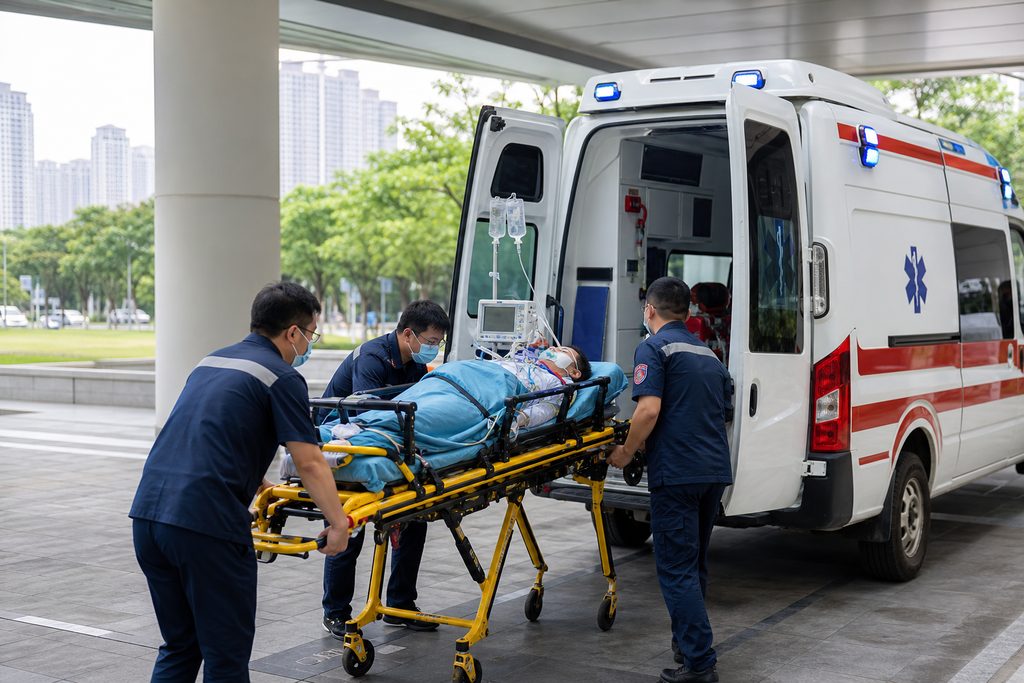
China ICU Ambulance: The Short Answer
An ICU ambulance service in China typically costs from $1,500 to $6,000 for a domestic intercity transfer, and considerably more — often $20,000 to $60,000 or beyond — when a cross-border air ambulance with a full critical care team is involved. Those figures vary widely by distance, aircraft type, medical staffing and the receiving hospital’s requirements.
Here is the caveat that no price list will tell you. The transport itself is rarely the hard part. What stops families cold is the paperwork, the language barrier, and the fact that a Chinese ICU bed cannot simply be reserved by phone from another country. Movement and admission are two separate problems, and most people only discover that halfway through a crisis.
Who This Is Right For — and Who It Isn’t
Emergency medical transport between Chinese cities, or from China back to a home country, is not a universal solution. It helps in specific situations and creates real risk in others.
Usually a reasonable path:
- A patient already stabilized in a Chinese hospital who needs a higher-level ICU at a major referral center in another city.
- An international resident or traveler in China whose condition is stable enough to fly, but who needs continuous monitoring during the journey.
- A family that has decided to repatriate a critically ill relative and needs a medically staffed aircraft rather than a commercial seat.
- Patients whose home-country insurer has already authorized the transfer in writing.
Where we would tell you to stop and think again:
- An unstable patient who has not yet been assessed by a treating intensivist. Moving someone before they are transport-ready can be more dangerous than staying put.
- Anyone hoping to bypass a hospital’s own admission decision. No transport company, and no coordinator, can promise an ICU bed.
- Cases where the receiving hospital has not agreed in advance to accept the patient.
- Families under financial pressure who have not checked whether a domestic transfer at a lower tier would achieve the same clinical goal.
Being blunt about the last four is the only way the first four mean anything.
The Options, Compared
There is no single “China ICU ambulance.” There are several distinct transport tiers, and the right one depends on distance, stability and destination.
| Transport type | Typical use | Indicative cost (USD) | Medical staffing |
|---|---|---|---|
| Ground ICU ambulance | Same-city or short intercity transfer | From $1,500–$4,000 | Paramedic or nurse, sometimes physician |
| Ground ambulance, long distance | 500–1,500 km, stable patient | From $4,000–$12,000 | Nurse plus monitoring equipment |
| Fixed-wing air ambulance | Cross-border or very long domestic | From $25,000–$60,000+ | Physician, nurse, full ICU rig |
| Commercial airline with medical escort | Stable patient, scheduled route | From $6,000–$20,000 | One or two escorts, portable oxygen |
| Helicopter | Remote area to nearest trauma center | From $8,000–$25,000 | Flight paramedic or physician |
Which column fits you? If the patient is in a Chinese city with a capable tertiary hospital nearby, ground transport almost always wins on cost and speed. Air ambulance earns its price only when geography or borders make ground travel impossible, or when the destination hospital is in another country entirely.
How Does Medical Evacuation Work in China?
This is the section most families need and few articles explain. Medical evacuation inside China runs on a sequence, and skipping a step usually means starting over.
It begins with a treating physician’s assessment of transport fitness — a written statement that the patient can tolerate the journey. Without it, reputable providers will not accept the case. Next comes destination confirmation: a specific hospital department has to agree to receive the patient, and that agreement is what unlocks the ICU bed. Only then does the transport provider schedule the vehicle or aircraft.
Documentation comes next. Passport and visa status matter here, especially for cross-border moves. For relatives traveling to accompany a patient into China, the applicable short-stay category for medical treatment and private affairs is the S2 visa, granted subject to the latest embassy or consulate requirements and supporting hospital documents. It is worth saying plainly: the M visa is a commercial and trade category and has nothing to do with medical treatment.
Payment usually runs in parallel. Chinese public hospitals generally require prepayment, with insurance reimbursement handled afterward. Private international hospitals more often bill insurers directly. Neither arrangement happens instantly, and evacuation providers typically want confirmation of funds before wheels-up.
Is ICU Care in China Safe for Foreigners?
China’s top-tier hospitals handle enormous volumes, and their intensive care units are equipped to a standard comparable with major Western centers. The country’s 35,000-plus hospitals include a top 5% ranked by Fudan University and JCI accreditation, and many of those run dedicated international departments with English-speaking staff.
Safety, though, is not the same as comfort. Two things reliably cause problems for foreign patients. The first is communication: outside international departments, English is scarce, and ICU consent discussions are not a good place for improvised translation. The second is the sheer scale of these institutions, where a single day’s outpatient volume can exceed 10,000 visits. Navigating that as a non-Chinese speaker without help is genuinely difficult.
So is ICU care in China safe for foreigners? In an accredited tertiary hospital with proper support, yes — the clinical capability is there. The variable is whether you have someone bridging the language and process gaps around the bed.
What It Costs and What Drives the Number
Emergency medical transport China pricing is driven by four variables, not one.
- Distance and mode. A 20 km ground run and a 2,000 km flight are not in the same universe.
- Medical crew. A physician-staffed air transfer can double the cost of a nurse-escorted one.
- Equipment. Ventilators, infusion pumps and monitoring gear add weight, certification and crew.
- Cross-border permissions. Overflight and landing clearances take time and money.
What is usually included: the vehicle or aircraft, the medical crew, on-board equipment, and coordination between sending and receiving facilities. What is frequently not included: the receiving hospital’s ICU charges, ground ambulance at either end, medical escort for family members, and any treatment after arrival. Ask for an itemized quote. If a provider will not itemize, that is your answer.
International Patient ICU Transfer to Beijing: Practical Notes
Beijing concentrates more Fudan-ranked hospitals than any other Chinese city — 21 of the top 100 — which makes it a frequent destination for complex critical care. Shanghai follows with 18, Guangzhou with 10.
If you are coordinating an international patient ICU transfer to Beijing, three logistics matter most. First, the receiving hospital’s international department is your point of contact, not the general switchboard. Second, public hospital ICU admission follows the hospital’s own clinical assessment; no external party can override it. Third, family members should sort out their S2 visa documentation early, because consular processing takes time you may not have.
For a broader view of which institutions handle which specialties, our directory of Fudan-ranked hospitals by city is a reasonable starting point, and the specialty rankings help narrow a critical care destination by clinical area.
How We Help With the Non-Medical Half
We are not a hospital. We do not diagnose, we do not treat, and we do not operate ambulances. What we do is handle the coordination layer that sits between a frightened family and a Chinese hospital system.
That can mean translating existing examination reports so a Chinese specialty team can review them, arranging a written second opinion or a video consultation before anyone boards a plane, and coordinating registration and hospital medical card creation through official international or VIP channels. When a patient does travel, our bilingual medical companions handle queueing, registration, payment, wayfinding and interpretation — from $300 per day.
For families weighing whether to move a patient at all, a remote consultation first is often the wiser spend. Video consultations with a general tertiary international department run $100–300; a written second opinion from a top-tier hospital specialist runs $300–500; multidisciplinary team reviews run $1,500–2,000. Any consultation fee is credited in full toward on-the-ground coordination if you proceed within 90 days. That credit applies to the coordination fee only and never to hospital treatment charges.
One clarification we make to every family: this is case management — records, official-channel appointment coordination, and interpretation labor. It is not a payment for queue-jumping, and we cannot promise a specific specialist or a specific admission date. If we cannot secure the appointment you requested, the coordination fee is refunded in full.
Frequently Asked Questions
You can contact providers directly, but the transport is only one piece. Most reputable operators will not move a patient until a receiving hospital has confirmed acceptance in writing. That confirmation is the bottleneck, and it usually requires Chinese-language communication with the hospital’s international department.
Sometimes, but only with prior authorization, and often only to a facility the insurer designates. Call your insurer before you call a transport company. If you authorize transport first and seek approval second, reimbursement is frequently denied. Public hospitals in China generally require prepayment regardless of your coverage.
It happens, and it is not necessarily a judgment on the case. ICU capacity, specialty fit and clinical stability all factor in. The realistic response is to approach a second facility, or to stabilize further at the current hospital before attempting transfer again. No coordinator can compel a hospital to admit.
A domestic ground transfer between cities can be arranged within 24 to 72 hours once a receiving hospital agrees. Cross-border air ambulance missions typically take three to seven days because of clearances, crew scheduling and destination confirmation. Unstable patients take longer, not shorter.
Your Next Step
The core message is simple: the ambulance is the visible part, and the coordination is the part that decides whether the move happens at all. Get the receiving hospital’s agreement first, then the transport, then the paperwork.
If you are trying to work out whether a transfer makes sense, or you need records reviewed before committing to anything, our team at China Medical Services can walk through the options with you. Start with a free consultation — no obligation, and no pressure to decide anything today.
This article is for general information only and is not medical advice. Transport decisions for critically ill patients must be made by qualified treating physicians. Costs are indicative and vary by hospital, distance and case complexity.
For more medical information and treatment options in China, visit chinamedservices.com (China Medical Services).
