Snoring Surgery in China: How We Help You Breathe and Sleep Again
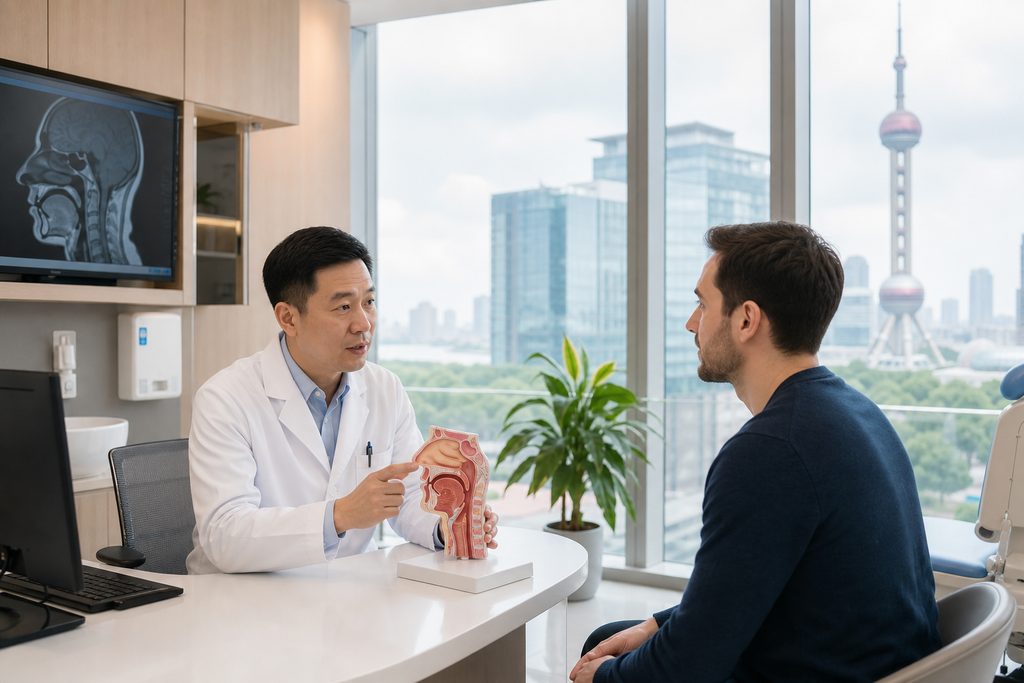
When 44-year-old David from Portland finally agreed to a sleep study, his wife had already moved to the guest room. The results came back severe: an apnea-hypopnea index of 38 events per hour, meaning his breathing stopped roughly 38 times every sixty minutes. CPAP therapy failed after six weeks. The mask leaked, his claustrophobia won, and his cardiologist started using words like “atrial fibrillation risk” and “pulmonary hypertension.” His ENT in Oregon quoted a uvulopalatopharyngoplasty with a $28,000 facility fee, and his insurance called it “elective.” That was the week David typed “snoring surgery cost China” into Google at 2 a.m.
He is not alone. Every month, our team speaks with patients who have exhausted the standard American pathway — the sleep study, the CPAP trial, the dental appliance, the frustrating insurance denials — and are now looking abroad. What they want is not a bargain. They want a real surgical plan, a surgeon who performs the procedure weekly rather than yearly, and a total bill that does not require a second mortgage.
This article explains how that process actually works, what it costs, and where the genuine risks sit.
How This Actually Works, Step by Step
Most people assume the first step is booking a flight. It is not. It is not even the second step. The sequence that produces good outcomes looks like this:
Step one: you send us your existing records. That means your sleep study report (polysomnography, with the AHI number and oxygen desaturation data), any prior ENT examination notes, a drug-induced sleep endoscopy report if you have one, your medication list, and relevant imaging. We handle translation into Chinese and route everything to the appropriate specialty — typically otolaryngology, sometimes oral and maxillofacial surgery, occasionally both.
Step two: a Chinese specialist reviews the file and responds in writing. This is a written second opinion, and it usually comes back within three to five business days. It will tell you whether you are a plausible surgical candidate at all, which procedure the reviewing physician would consider — UPPP, tonsillectomy with uvuloplasty, tongue base reduction, maxillomandibular advancement, or a hypoglossal nerve stimulator evaluation — and what additional testing they would want first.
Step three: a video consultation. Records alone rarely settle the question. In a live session, the specialist asks about your nasal obstruction history, your bite, your neck circumference, whether you have tried a mandibular advancement device. You hear the reasoning directly. Interpreters are provided.
Step four: a decision about travel. If the plan is feasible and you agree, we coordinate arrival support, hospital registration, and the in-person examination that must precede any surgical scheduling. No legitimate Chinese public hospital will book an operating room for a patient they have never examined. That rule exists for your protection.
The whole sequence, from first email to a scheduled surgery date, typically runs four to eight weeks. Some cases move faster. Complex ones take longer.
What Snoring Surgery in China Actually Costs — and Why
Here is the honest picture. A standard UPPP with tonsillectomy at a top-tier Chinese public hospital generally falls in the range of $4,000 to $9,000 all-in, including the hospital stay, surgeon fees, anesthesia, and post-operative medications. The same procedure in the United States, without insurance, commonly runs $15,000 to $35,000 depending on the facility and region.
More complex operations shift the numbers. Hypoglossal nerve stimulation — the implantable device that stimulates the tongue’s genioglossus muscle during sleep — is available at selected Chinese centers, and pricing varies considerably because device availability and regulatory status differ from Western markets. Maxillomandibular advancement, a major skeletal procedure, sits higher, often $12,000 to $25,000. These figures are ranges, not quotes. Final pricing depends on the hospital, the surgeon’s seniority, the length of ICU or monitored-bed time, and whether complications arise.
| Procedure | Typical China Range (USD) | Typical US Range (USD) |
|---|---|---|
| UPPP with tonsillectomy | $4,000 – $9,000 | $15,000 – $35,000 |
| Tongue base reduction | $6,000 – $12,000 | $20,000 – $40,000 |
| Maxillomandibular advancement | $12,000 – $25,000 | $60,000 – $150,000 |
| Hypoglossal nerve stimulator | Varies by center | $30,000 – $50,000 |
Why the gap? It is not because Chinese surgeons are less skilled. It is because hospital labor costs, liability insurance structures, and device procurement differ enormously between the two markets. China’s top public hospitals perform surgical volumes that would be unthinkable in most Western centers — Fuwai Hospital in Beijing, for instance, handles over 14,000 cardiac operations a year. High volume builds pattern recognition. That matters in airway surgery, where anatomical variation between patients is the norm.
You can browse the specialty rankings by department to see which hospitals sit at the top for otolaryngology and oral surgery.
A Realistic Timeline
Patients routinely underestimate how long the administrative layer takes. Here is a schedule that reflects reality rather than optimism.
| Phase | Typical Duration | What Happens |
|---|---|---|
| Record collection and translation | 3–7 days | You gather sleep study, imaging, medication list; we translate |
| Written second opinion | 3–5 business days | Chinese specialist reviews and responds |
| Video consultation | Scheduled within 1–2 weeks | Live discussion with interpreting support |
| Visa application (S2) | 1–3 weeks | Requires hospital invitation documents |
| Travel and in-person exam | 2–4 days after arrival | Mandatory pre-surgical assessment |
| Surgery and hospital stay | 3–7 days inpatient | Varies by procedure |
| Initial recovery in China | 10–14 days | Wound check before flying |
| Full recovery at home | 2–6 weeks | Soft diet, voice rest, follow-up sleep study at 3–6 months |
The step people forget is document translation. A sleep study report with 40 pages of raw data does not translate itself overnight. Also, visa processing times fluctuate by consulate and season. Build in buffer.
What Can Go Wrong — and What Happens Then
Airway surgery is not minor. Anyone who tells you otherwise is selling something.
Bleeding after tonsillectomy. This is the most common serious complication, occurring in roughly 2 to 4 percent of adult cases, usually between days 5 and 10. Chinese hospitals keep patients in or near the facility during this window for exactly this reason. If it happens after you fly home, you need emergency care locally — and your Chinese operative report, translated, becomes essential.
Insufficient improvement. UPPP success rates vary widely in the literature, and “success” is often defined loosely as a 50 percent reduction in AHI. Some patients wake up breathing better. Some do not. A pre-operative drug-induced sleep endoscopy helps predict who will benefit, but it is not a guarantee.
Velopharyngeal insufficiency. This is the medical term for liquids coming out your nose when you swallow. It is usually temporary. Occasionally it is not. Speech therapy helps in most persistent cases.
Airway compromise from swelling. Rare, but serious enough that monitored beds exist. This is why we do not work with facilities that offer to send you home the same day.
The recourse for every one of these is the same: a hospital that has a documented complication protocol, a surgeon willing to be reachable afterward, and a translated medical record you can hand to any physician anywhere. If a provider cannot give you those three things in writing, walk away.
Choosing a Surgeon: What the Numbers Actually Tell You
Volume matters more than marketing. Ask how many sleep surgeries the surgeon performs annually. Ask what their personal complication rate is. Ask whether they use drug-induced sleep endoscopy for surgical planning — a surgeon who skips this step is operating blind.
In China, the most experienced airway surgeons cluster in the large teaching hospitals. Beijing has the deepest concentration, with several institutions ranked in the Fudan University hospital rankings. Shanghai and Guangzhou also have strong programs. You can review the top-ranked hospitals by city to see which facilities carry the highest Fudan tier ratings.
One more thing worth knowing: private international hospitals in China — United Family, Jiahui, Parkway — offer English-speaking staff, JCI accreditation, and direct insurance billing. They are comfortable. They are also roughly 1.5 to 2 times the price of a public hospital’s international department for equivalent surgical work. For straightforward procedures, the public route is often the better value. For complex revision cases, the calculus changes.
Practical Considerations: Records, Visas, Payment, and Follow-Up
Visa. Foreign patients coming to China for medical treatment apply for the S2 visa, which covers short-stay medical and private affairs. Accompanying family members apply under the same category. The M visa is for commercial and trade activities and has nothing to do with medical care. Applications require supporting documents from the treating hospital, and approval is always subject to consulate discretion. We provide guidance on assembling the paperwork, but we do not guarantee visa outcomes.
Payment. Chinese public hospitals require prepayment. You pay upfront, then seek reimbursement from your insurer afterward. Private international hospitals often bill insurance directly. Bring a credit card that does not charge foreign transaction fees, and confirm with your bank before you travel.
Language. China’s top hospitals are enormous — some see over 10,000 outpatients daily. Signage is in Chinese. Registration queues are in Chinese. The pharmacy is in Chinese. This is where bilingual medical companion services earn their keep: navigating registration, payment counters, pre-operative testing, and discharge paperwork so you are not guessing.
Follow-up at home. Before you leave China, request a complete operative report, discharge summary, and imaging on a USB drive, all in English. Your sleep physician at home will need these. Schedule a repeat sleep study for three to six months post-surgery — that is the only way to know whether the operation worked.
Frequently Asked Questions
Top-tier Chinese hospitals maintain international accreditation and publish surgical outcomes comparable to Western centers. The safety question is less about the country and more about the specific hospital, surgeon volume, and whether proper pre-operative evaluation happens. Any facility that offers to operate without an in-person examination first should be avoided entirely.
For a standard UPPP with tonsillectomy, expect $4,000 to $9,000 at a top public hospital, all-in. More complex procedures like maxillomandibular advancement range from $12,000 to $25,000. These are ranges — final pricing varies by hospital and case complexity, and you should receive a written estimate after the video consultation.
Plan on 10 to 14 days in China before you are cleared to fly, with the most uncomfortable period being days 3 through 7. Full recovery — meaning soft diet, normal voice, and return to work — typically takes two to four weeks. A follow-up sleep study at three to six months confirms whether the surgery achieved its goal.
Public hospitals do not accept overseas surgical bookings without an in-person consultation first. The practical path is remote evaluation, video consultation, then travel for examination and surgery. Coordination services exist precisely to manage this sequence, and they do not promise a specific surgeon or date — only that they will coordinate in good faith and refund the coordination fee if no appointment is secured.
Your Next Step
The core message is simple: sleep apnea surgery in China can cost a fraction of Western pricing at hospitals with genuine surgical depth, but the process rewards preparation over spontaneity. Get your records translated, get a written opinion, talk to a surgeon on video, and only then book a flight.
Our team at China Medical Services connects international patients with 340+ top-ranked hospitals across 37 cities. We are not physicians and we do not practice medicine — we handle the records, the scheduling, the language, and the logistics so your surgeon can focus on your airway. If you would like a free consultation to see whether this path fits your case, reach out. No pressure, no obligation, just a conversation about what is possible.
For more medical information and treatment options in China, visit chinamedservices.com (China Medical Services).
