Body Fat Test in China: Public or Private — Costs and Accuracy
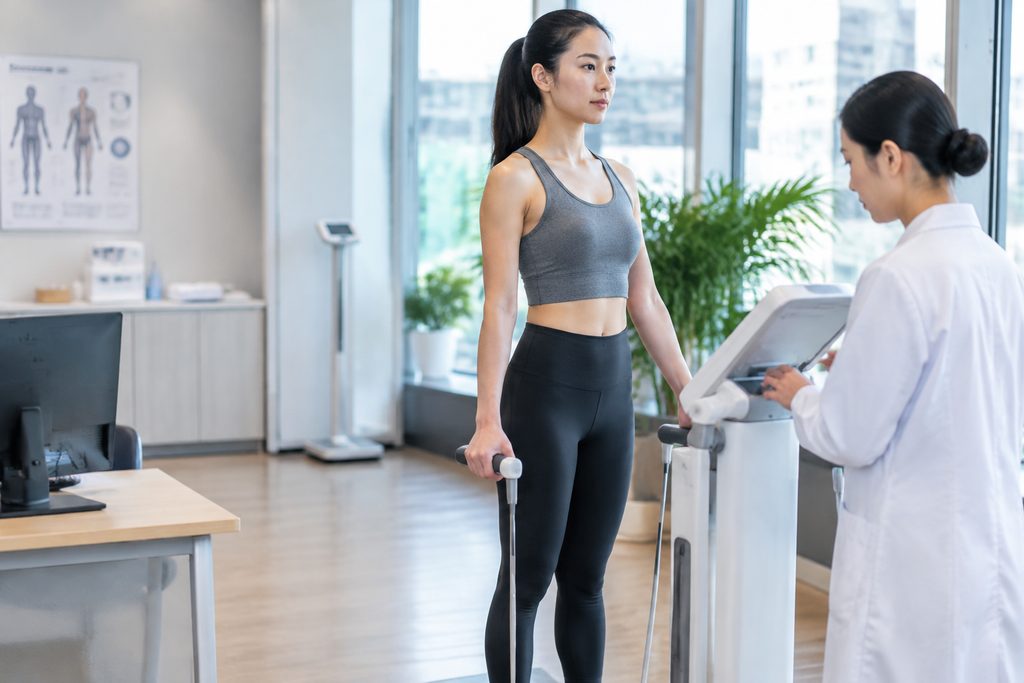
Body Fat Test in China: Public or Private — Costs and Accuracy
Daniel, a 44-year-old from Portland, had been lifting for six years and had the scale to prove it. What he did not have was a clue what any of it meant. His gym’s bioimpedance machine told him 21 percent body fat on Monday and 26 percent on Friday, and when his employer posted him to Shanghai for two years, he decided to finally get a real number. His first question was the practical one: what does a body fat test cost in China, and should he go to a public hospital or a private clinic?
Short answer: a DEXA scan in China typically runs RMB 200 to 500 at a public hospital (roughly $30 to $70), and $150 to $400 at a private international clinic. Public hospitals are cheaper and the equipment is identical. Private clinics are faster, English-friendly, and easier to book from abroad. The tradeoff is not quality — it is access and language.
That gap sounds simple. In practice, it hides a few things worth knowing before you book, especially if you are planning this as part of a broader medical trip.
Public or Private? The Body Fat Test Cost in China Comes Down to Access
China’s public tertiary hospitals — the ones ranked in the Fudan Top 100 — operate at a scale that surprises most Western visitors. A single hospital can see 10,000 outpatient visits in a day. The equipment is current, often newer than what you would find in a mid-sized American clinic. What you will not find is a receptionist who speaks English, or a booking system that accepts an international credit card.
Private international hospitals solve that. Facilities like United Family, Jiahui, Parkway and Raffles are built around English-speaking staff, direct insurance billing and appointments you can schedule by email. A DEXA scan there costs three to six times more than the public equivalent. You are paying for convenience, not for a better machine.
Who This Is Right For — and Who It Isn’t
Body composition testing in China makes sense for a specific set of people. It is not for everyone.
Good candidates:
- Expats and long-stay visitors who want a baseline and a repeat scan six or twelve months later
- People already traveling to China for a health checkup who want to add DEXA to the package
- Athletes and serious recreational lifters tracking lean mass changes across a training block
- Patients whose doctor at home asked for a body composition assessment and who are in China anyway
Poor candidates:
- Anyone expecting a diagnosis. A body fat test measures tissue, not disease.
- People with a pacemaker or implanted electronic device — DEXA is generally avoided in that group
- Pregnant patients, unless a physician specifically requests it
- Anyone who needs the result in 24 hours for a same-week decision back home
And if you are in China for two days on a layover, this is not worth the logistics. Wait until you have a longer stay.
The Options, Compared
Four methods dominate the market. They are not interchangeable, and the price difference does not track accuracy the way you might expect.
| Method | Typical Cost (Public) | Typical Cost (Private) | Accuracy | Time |
|---|---|---|---|---|
| DEXA (dual-energy X-ray) | $30–70 | $150–400 | Reference standard, ±1–2% | 10–15 min scan |
| Bod Pod (air displacement) | Rare in public | $80–200 | Close to DEXA, ±2–3% | 20 min |
| InBody / BIA scale | $5–15 | $20–50 | ±3–8%, hydration-sensitive | 2 min |
| Skinfold calipers | $10–30 | $50–100 | ±3–5%, tester-dependent | 5 min |
DEXA is the one most clinicians treat as the benchmark. It separates bone mineral, lean tissue and fat, and it reports regional distribution — visceral fat, android-gynoid ratio, left-versus-right limb symmetry. An InBody gives you a number. DEXA gives you a map.
If you want the best body composition analysis clinic Shanghai has to offer, look for a facility that runs a Hologic or GE Lunar DEXA unit and prints a full regional breakdown. Both public sports medicine departments and private imaging centers have them. The machine matters more than the logo on the door.
Is Body Fat Testing Accurate in China?
Yes — with one caveat that has nothing to do with geography.
DEXA accuracy depends on three things: the scanner’s calibration, the technician’s positioning, and the software’s reference database. Chinese tertiary hospitals maintain calibration schedules like any accredited facility elsewhere. The physics does not change at the border.
What does change is the normative database. Some DEXA software ships with Caucasian reference populations, which can slightly shift how your percentile ranking is reported. The raw fat percentage stays reliable. The “you are in the 70th percentile for your age” line may be less precise for non-white patients. Ask the technician which reference set the machine uses if that matters to you.
Bod Pod availability is thinner in China than in the US or UK. InBody units are everywhere — gyms, clinics, even some pharmacies. Calipers are the least standardized option and depend heavily on who is holding them.
How Much Does a DEXA Scan Cost in Beijing?
Beijing pricing sits at the low end of the national range. A DEXA body composition scan at a public tertiary hospital typically runs RMB 200 to 400, which converts to roughly $28 to $56. Sports medicine departments and endocrinology clinics are the usual entry points. Some hospitals bundle it into a broader health checkup package for RMB 800 to 2,000, which adds bloodwork, ECG, ultrasound and a physician review.
Private international clinics in Beijing — the ones with English-speaking staff and direct insurance billing — charge $150 to $400 for the same scan, sometimes more if a physician consultation is included.
Shanghai prices are similar. Guangzhou and Chengdu run slightly lower. Tier-2 cities can be cheaper still, but DEXA availability drops outside major academic centers.
What drives the variance? Three things: whether a physician consultation is bundled, whether you are on the public or private track, and whether the scan is standalone or part of a package. Nothing about the imaging itself changes.
Booking a Body Fat Test in China as a Medical Traveler
This is where most foreign visitors hit a wall.
Public hospitals in China generally do not accept advance bookings from overseas. You register on the day, in person, in Chinese, at a queue that starts before dawn. For a routine DEXA, that is manageable if you have a Chinese-speaking friend and a free morning. It is not manageable if you are flying in for a two-day trip.
Private international hospitals do accept advance bookings. You can email, send your passport details, and confirm a slot. That is the main practical reason people choose them.
If you want to book a body fat test in China as part of a wider medical visit — say, alongside a cardiology consult or an executive health screening — the coordination gets more complex. Different departments, different buildings, different payment systems. This is the kind of logistics our team at China Medical Services handles routinely, and it is also where a bilingual medical companion earns their fee.
For readers comparing hospital tiers more broadly, our breakdown of Fudan-ranked hospitals by city is a useful starting point. If you are weighing private facilities specifically, the private international hospital directory covers insurance and language details.
Practical Considerations: Records, Payment and Language
Documentation. Bring your passport. Public hospitals require it for registration. If you have prior DEXA results from home, bring them — comparison across time is where the real value sits.
Payment. Public hospitals require prepayment. International insurance is usually reimbursed after the fact, not settled at the desk. Private international hospitals often bill insurers directly, but confirm before you book — not every policy is accepted.
Language. This is the single biggest friction point. Radiology technicians in public hospitals rarely speak English. The report will be in Chinese. If you need the result explained, budget for a translator or use a private clinic.
Visa. If you are entering China specifically for medical treatment, the applicable short-stay category is the S2 visa, with supporting documents from the receiving hospital. Requirements vary by embassy and consulate, so check the latest guidance for your jurisdiction. Accompanying family members apply under the same category. Note that the M visa is for commercial and trade activities and is not the medical route.
Follow-up. A DEXA report is portable. Take the PDF home and give it to your physician. Nothing about the scan requires you to stay in China for interpretation.
Frequently Asked Questions
Usually no. Most public hospitals and private clinics accept walk-in or self-referred patients for body composition DEXA. Some facilities prefer a department registration first — endocrinology, sports medicine or health management — which is a formality rather than a clinical gatekeeping step.
Sometimes, but rarely for a standalone body composition scan. Insurers typically cover DEXA when it is ordered for a clinical reason — suspected osteoporosis, hormone disorder, or monitoring a known condition. A fitness-motivated scan is usually out of pocket. Private international hospitals are more likely to bill insurers directly, but coverage still depends on your policy.
A body fat percentage is not a diagnosis. If your scan shows very low bone density, unusually high visceral fat, or an asymmetry that concerns you, the next step is a physician review — not a second scan. Bring the report to a qualified doctor, in China or at home. Nothing in a DEXA report should be acted on without clinical context.
Every six to twelve months is typical for tracking. More frequent scans add cost without adding much signal, since meaningful body composition change takes weeks to months. If you are mid-training-block, twelve weeks is a reasonable minimum interval.
Your Next Step
A body fat test in China is cheap, accurate and easy to arrange — once you know which door to walk through. Public hospitals give you the same DEXA data at a fraction of the private price. Private clinics give you English, speed and a bookable calendar. Pick based on what your time is worth, not on which sounds more prestigious.
We are China Medical Services, a coordination service rather than a hospital or clinic. We do not diagnose, and we do not perform scans. What we do is help international patients navigate the practical layer — hospital matching, appointment coordination, bilingual accompaniment, and visa guidance — so the medical part stays simple. If you would like to talk through options for a checkup or scan in China, you can start with a free consultation. No pressure, no obligation.
This article is for general information only and does not constitute medical advice. Costs vary by hospital and case complexity. Always consult a qualified physician about your individual health.
For more medical information and treatment options in China, visit chinamedservices.com (China Medical Services).
