Voice Assessment in China: Cost, Booking, and What to Expect
How This Actually Works, Step by Step
When 44-year-old David, a high-school choir director from Portland, lost his voice for six weeks after a routine intubation, his ENT in Oregon handed him a folder and a shrug. “Could be paresis, could be scarring,” the doctor said. “Wait three months and we’ll scope again.” David did not want to wait three months. He started searching for options abroad, and that search is what brings most of our readers to this page.
So here is the real sequence. Nothing abstract.
Step one — records first, travel later. David gathered his laryngoscopy video, the operative report from his intubation, and a recent CT of the neck. He sent them through our intake form rather than booking a flight. This matters. No Chinese hospital will schedule a diagnostic procedure for an overseas patient on the basis of a phone call alone.
Step two — the relevant specialty reviews the file. In David’s case that meant a laryngology team at a tertiary hospital’s international department. They read the imaging, watched the scope footage, and came back with a written opinion: likely unilateral vocal fold immobility, further evaluation warranted, estimated two to three clinic days on the ground.
Step three — you decide whether to travel. The written second opinion costs between $300 and $500 and carries no obligation. If you want to speak with the team directly first, a video consultation runs $100 to $300 at a standard international department, or $500 to $800 with a top-tier specialist.
Step four — appointment coordination. Once David confirmed, we handled registration, his hospital medical card, and the outpatient slot through the international channel. That coordination starts from $300.
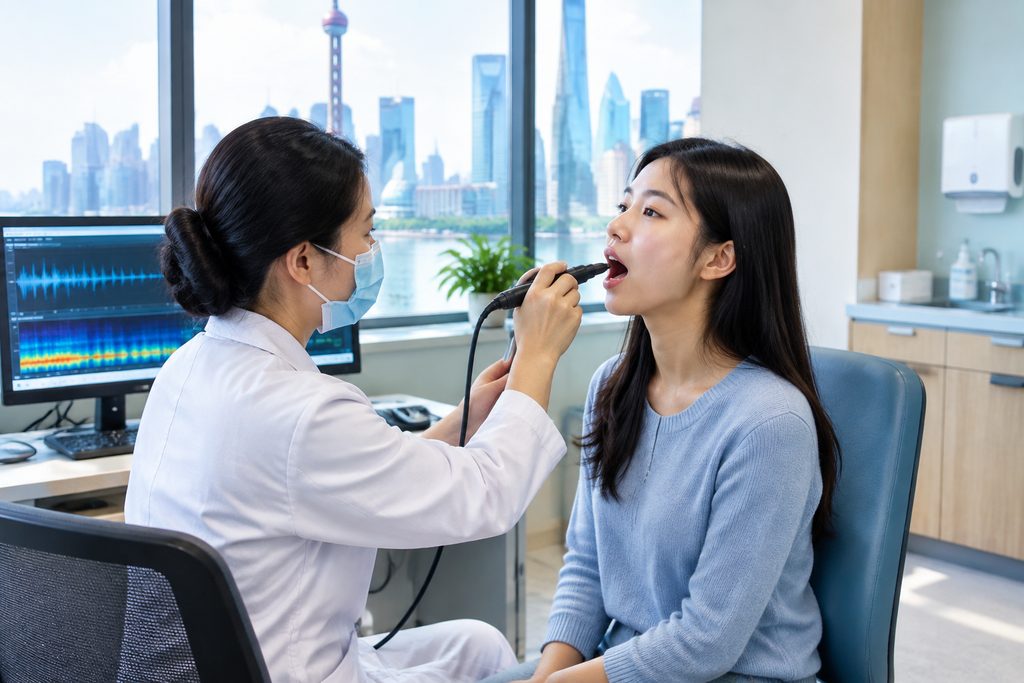
Step five — you arrive, and someone walks you through it. Bilingual medical companion support runs from $300 per day. On the ground, David had a same-week laryngoscopy with stroboscopy, a videolaryngoscopy recording, and a voice handicap index scored in English.
Voice Assessment Cost China: What the Numbers Actually Look Like
Let’s talk about money, because that is usually the second question after “can they even help me.”
A comprehensive voice assessment in China typically includes laryngoscopy or videostroboscopy, acoustic analysis, aerodynamic measurement, and perceptual rating by a speech-language pathologist. At a top-tier public hospital’s international department, the clinical component generally lands in the $400 to $1,200 range depending on how many studies are performed. Add the coordination and companion layers and a realistic all-in figure for a two-to-three day trip sits between $1,500 and $3,500, excluding flights and hotel.
| Component | Typical Range (USD) | Notes |
|---|---|---|
| Written second opinion | $300–$500 | Records review, written analysis |
| Video consultation (standard) | $100–$300 | International department |
| Top-specialist video consult | $500–$800 | Senior laryngologist |
| Appointment coordination | from $300 | Registration, medical card, scheduling |
| Bilingual companion | from $300/day | Half or full day |
| Clinical assessment itself | $400–$1,200 | Varies by hospital and case complexity |
Every figure above varies by hospital and case complexity. Final quotes come after the records are reviewed, not before. And any consultation fee you pay is credited in full toward on-the-ground coordination if you travel within 90 days — a one-time credit applied to the coordination fee only, never to hospital treatment charges.
A Realistic Timeline
People underestimate the administrative tail. Here is what actually happens, with honest ranges.
| Stage | Typical Duration | What Slows It Down |
|---|---|---|
| Record collection and translation | 3–10 days | Missing operative notes, poor-quality scope video |
| Specialty review and written opinion | 5–10 business days | Complex cases needing multidisciplinary input |
| Video consultation scheduling | 3–7 days | Time zone gaps, specialist availability |
| Outpatient appointment booking | 1–3 weeks | International department capacity |
| S2 visa processing | 1–3 weeks | Consulate workload, document completeness |
| Flights and hotel | 3–14 days | Season, city |
| On-ground assessment | 2–4 days | Number of studies ordered |
Realistically, from first email to sitting in a clinic chair: three to six weeks. Anyone promising you a diagnostic slot next week is either exaggerating or selling you something other than a hospital appointment.
What Can Go Wrong — and What Happens Then
Honesty earns more trust than optimism, so let’s go through the failure modes.
The records are not enough. This happens often with voice cases. A phone-recorded scope video shot at 15 frames per second tells a laryngologist almost nothing about mucosal wave. If the reviewing team cannot reach a conclusion, they will say so, and the honest answer is that you need to be examined in person. You have lost a week and a $300–$500 review fee. That is the cost of finding out early rather than after a 14-hour flight.
The specialist you wanted is fully booked. China’s top voice specialists see enormous volumes. We do not promise a specific named physician or a specific date. We coordinate through official international and VIP channels and we tell you plainly when a target is unreachable. If we cannot secure the appointment shown in your order, the coordination fee is refunded in full.
The visa is delayed. Medical travel to China uses the S2 visa, with S1 for stays beyond 180 days. Accompanying family members apply for S2 as well. Note carefully: the M visa is for commercial and trade activity and has nothing to do with medical treatment. Consular requirements change, so always confirm current rules with the embassy or consulate handling your application. We provide document guidance; we cannot guarantee approval.
The diagnosis changes the plan. Sometimes the assessment reveals something that needs surgery, or nothing that needs treatment at all. Both outcomes are useful. Neither is a failure.
Best Voice Clinic Beijing Price vs. Shanghai: How to Choose
Beijing and Shanghai both host hospitals in the Fudan Top 100, and both have strong otolaryngology and speech-language pathology capacity. The differences that matter to a foreign patient are practical, not prestige-driven.
Beijing concentrates the largest number of top-ranked hospitals in the country — 21 of the Fudan Top 100 sit there. Shanghai follows with 18. For voice specifically, you want a department with videostroboscopy equipment, a dedicated voice laboratory, and speech-language pathologists who can administer and interpret English-language voice handicap instruments.
Price differences between the two cities for the same assessment battery are modest, usually within 15 to 20 percent. The bigger variables are hotel cost, flight routing, and how quickly the international department can slot you in.
If you are weighing specific departments, our department-by-department rankings list the top hospitals by specialty, and the full Fudan Top 100 directory groups them by city so you can compare Beijing and Shanghai side by side.
One more consideration people miss: follow-up. If your assessment leads to voice therapy, you will want a plan for continuing it at home. Ask the team to document their findings in a format your local SLP can act on. A written report with acoustic measures and stroboscopy stills travels better than a verbal summary.
Practical Considerations: Records, Visa, Payment, Language
Records. Send the original scope video file, not a compressed clip. Include prior imaging on disc if available, plus any previous voice therapy notes. Translation of key documents into Chinese helps the reviewing team move faster.
Visa category and timing. S2 for short-stay medical treatment, S1 beyond 180 days. Apply with supporting hospital documents. Build two to three weeks into your schedule.
Payment. Public hospitals require prepayment; international insurance is typically reimbursed after the fact. Private international hospitals often bill insurance directly. Bring a card that works internationally.
Language. China’s top hospitals handle enormous daily outpatient volumes. English signage is limited and staff availability varies. This is precisely where a bilingual companion earns their fee — registration, queuing, payment, wayfinding, and interpreting the conversation with your laryngologist.
Insurance and follow-up at home. Ask for itemized receipts and a full English-language report. Your insurer will want both.
Frequently Asked Questions
The procedures themselves — laryngoscopy, stroboscopy, acoustic analysis — are established, low-risk diagnostic studies performed worldwide, and China’s tertiary hospitals run them at high volume. The realistic risks are logistical rather than clinical: communication gaps, unfamiliar paperwork, and rushed decisions. A bilingual companion and a written second opinion before travel reduce those risks substantially.
For the same battery of studies, expect clinical charges in the $400 to $1,200 range in either city, with Shanghai sometimes running 10 to 20 percent higher at private international hospitals. Total trip cost depends far more on flights and accommodation than on the assessment itself.
You can start remotely — records review, written opinion, and video consultation all happen before any flight. What you cannot do is lock in a same-week in-person diagnostic slot from overseas. Public hospital outpatient registration generally happens on the day, and international departments have limited capacity. Plan on one to three weeks of lead time for the appointment itself.
Be careful with the word “package.” Legitimate coordination covers registration, medical card creation, scheduling, and companion services. It does not bundle hospital charges, and no honest provider quotes a fixed clinical price before seeing your records. Treat any all-inclusive flat rate for medical care with suspicion.
If the assessment points to a procedure, the team will explain options and you decide whether to proceed in China or at home. Nothing is scheduled without your explicit agreement, and any admission remains subject to hospital rules.
Your Next Step
Voice problems are rarely emergencies, but they are almost always more treatable when evaluated early and by the right subspecialist. The path is straightforward: send your records, get a written opinion, decide with real information in hand.
China Medical Services connects international patients with more than 340 top-ranked hospitals across 37 cities, and we handle the parts that trip people up — records, coordination, language, and logistics. We are not doctors and we do not practice medicine, and we never promise a specific outcome or a guaranteed appointment.
If you would like to know what your own case would involve, start with a free consultation. No pressure, no obligation, and no cost to ask.
This article is for general information only and does not constitute medical advice. Diagnostic and treatment decisions should always be made with a qualified physician who has reviewed your individual case.
For more medical information and treatment options in China, visit chinamedservices.com (China Medical Services).
