Veneers in Beijing: Real Costs, Top Clinics, and How to Book
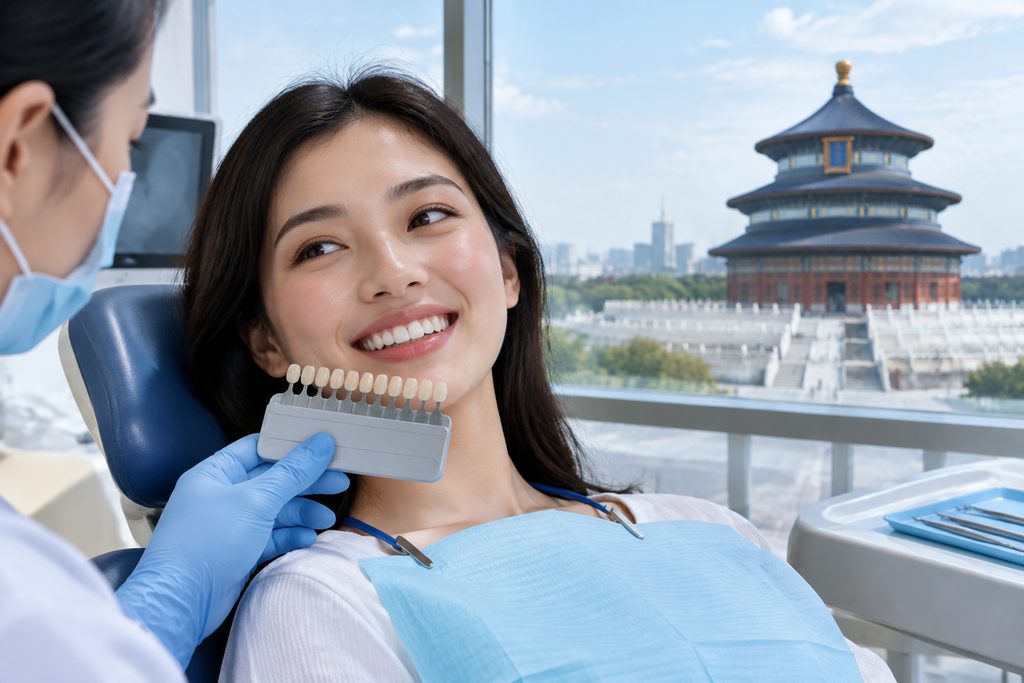
You have probably heard that dental work overseas means gambling with your smile. Cheap materials, rushed labs, a dentist you cannot verify. The reality in Beijing is more interesting than that — and more complicated. Beijing is home to stomatology departments that rank among China’s top ten nationally, and a veneer cost Beijing patients actually pay often lands 60 to 80 percent below London or New York prices. But the same city also has thousands of small clinics with uneven standards, and the good ones do not answer English emails quickly. Knowing the difference is the whole game.
Key Takeaways
- A single porcelain veneer in Beijing typically runs $250–600 per tooth at a reputable private or international clinic, versus $1,000–2,500 in the US or UK — but the spread between clinics is enormous.
- China’s top stomatology programs (Peking University School of Stomatology, West China, Shanghai Ninth People’s Hospital) treat very high volumes and are ranked in the Fudan specialty reputation list, which is why material quality at the top tier is genuinely competitive.
- The real friction is not price or skill — it is access. Public hospital dental departments generally cannot be pre-booked from abroad, and English-speaking slots at international clinics fill weeks ahead.
- Veneers are irreversible. Enamel does not grow back. Anyone quoting you a price before examining your bite, gums, and enamel thickness is selling, not diagnosing.
The Problem: Western Dental Prices Have Outrun Reason
In the United States, the average cost of a single porcelain veneer sits between $1,000 and $2,500 depending on the city and the ceramist, according to long-running fee surveys published by the American Dental Association’s Health Policy Institute. A full smile of eight veneers can clear $20,000 before you have paid for the CT scan, the temporary set, or the night guard.
The UK is not much kinder. Private cosmetic dentistry in London routinely quotes £600–£1,200 per veneer. In Australia, the figure lands near AUD 1,200–1,800 per tooth. For a procedure that is purely elective and purely aesthetic, those numbers push veneers out of reach for a large share of the people who want them.
So patients start looking outward. Turkey, Thailand, Hungary, Mexico — and increasingly China, where the same lithium disilicate ceramic from the same international brands (Ivoclar, VITA, 3M) is shaped by technicians who do this at extraordinary volume. The question is not whether China can do it. The question is how you find the right chair.
Why Beijing Delivers Results in Cosmetic Dentistry
Clinical volume that most Western cities cannot match
Peking University School of Stomatology, attached to Peking University Health Science Center, is one of the largest and most established dental institutions in Asia. Its prosthodontics and aesthetic dentistry departments handle patient volumes that dwarf a typical private practice in Europe. Volume matters for a simple reason: repetition builds skill, and skill shows up in the marginal details — incisal translucency, gingival margins, shade matching under different lighting.
Beijing also holds the largest concentration of Fudan-ranked hospitals in the country, with 21 of the top 100 institutions located in the city. You can browse the full breakdown by city on our ranked hospital directory.
Materials are the same global brands
This is the part Western patients find hardest to believe. A pressed lithium disilicate veneer made in Beijing is often the identical Ivoclar IPS e.max block used in a Beverly Hills practice. Zirconia, feldspathic layering porcelain, and digital intraoral scanners (3Shape, iTero) are all standard equipment at the better clinics. The material cost is not where the savings come from.
Cost structure, not corner-cutting, drives the price gap
Lower prices come from three structural facts. Chair-time and technician labor cost far less in Beijing than in Manhattan. Dental labs are often in-house or a short drive away, cutting turnaround from three weeks to five days. And clinics see enough veneer cases that the fixed cost of a scanner or a ceramic furnace is spread across far more patients. None of those factors touch the quality of the ceramic itself.
What Dental Veneers Actually Cost in China: A Real Comparison
Prices below are per tooth, in USD, and reflect what reputable private and international clinics in Beijing and Shanghai quoted international patients in 2024–2025. Public hospital stomatology departments can be 20–40 percent cheaper than these figures, but require in-person registration and offer less English support. Every number varies by hospital and case complexity.
| Market | Porcelain veneer (per tooth) | 8-veneer smile | Typical lab turnaround |
|---|---|---|---|
| United States | $1,000–2,500 | $8,000–20,000 | 2–3 weeks |
| United Kingdom | £600–1,200 (~$760–1,520) | ~$6,000–12,000 | 2–3 weeks |
| Australia | AUD 1,200–1,800 (~$790–1,180) | ~$6,300–9,400 | 2–3 weeks |
| Beijing — private / international clinic | $250–600 | $2,000–4,800 | 5–10 days |
| Beijing — public hospital stomatology | $180–400 | $1,400–3,200 | 7–14 days |
Add diagnostics. A cone-beam CT, digital scans, and a diagnostic wax-up usually run $80–250 in Beijing, versus $300–600 in the US. Temporary veneers, if needed, add roughly $40–80 per tooth.
How to Choose the Best Dental Clinic in Beijing for Veneers
Searching for the best dental clinic Beijing veneers patients actually trust means looking past the website photography. Four things separate a clinic you should book from one you should walk away from.
- They insist on a diagnostic wax-up or digital smile design before touching enamel. A clinic that quotes a final price without imaging your bite is guessing.
- They can name the ceramic system. Ask directly: pressed lithium disilicate, feldspathic, or zirconia? Vague answers about “high-quality porcelain” are a red flag.
- They show you their own before-and-after cases, not stock images. Ask to see cases at the two-year mark, not just the day of cementation.
- They tell you what veneers cannot fix. Severe crowding, an unstable bite, or active gum disease may need orthodontics or periodontal treatment first. Honest clinics say so.
Is Dental Work in China Safe? An Honest Answer
The question “is dental work in China safe” deserves a straight response rather than reassurance.
At accredited institutions, yes — infection control standards at top-tier hospitals meet international norms, instruments are autoclaved, and single-use barriers are standard. Many private international clinics in Beijing hold JCI accreditation or follow equivalent protocols, and several bill Western insurers directly. You can review accredited private facilities in our international hospital guide.
The risk sits at the bottom of the market. Walk-in clinics in tourist areas, “same-day smile” packages advertised at suspiciously low prices, and providers who skip the diagnostic phase are where problems happen. There is also a language gap: consent forms, aftercare instructions, and follow-up scheduling are usually in Chinese outside the international clinic tier.
One more honest point. Veneers are a permanent commitment. If a clinic in any country — China included — promises a reversible or “no-prep” result that will not alter your enamel, get a second opinion before agreeing.
How to Book Dental Veneers in Beijing as a Foreigner
This is where most overseas patients hit a wall, so here is the actual sequence.
Step 1 — Records first. Send recent panoramic X-rays, intraoral photos, and any prior dental notes. A qualified clinic can give a preliminary assessment and a price range from these alone. Without records, any quote is fiction.
Step 2 — Remote consultation. A video consultation with the treating dentist lets you discuss shade, shape, and expectations, and confirms whether you are a candidate. This usually happens before you book flights.
Step 3 — Visa. For medical treatment in China, the applicable short-stay category is the S2 visa, which covers medical treatment and private affairs; stays beyond 180 days fall under S1. Accompanying family members apply under the same S2 category. Requirements are set by the Chinese embassy or consulate in your country and depend on supporting documents from the hospital — always confirm the current checklist with your local mission. Note that the M visa is for commercial and trade activity and has nothing to do with medical treatment.
Step 4 — Scheduling. Public hospital dental departments generally cannot be pre-booked from abroad; you register in person, often early in the morning. International clinics and hospital international departments do accept advance appointments, and their fees run roughly 1.5 to 2 times the standard public rate.
Step 5 — Plan for two trips or one long stay. Most veneer cases need a preparation visit, a try-in, and a cementation visit. Compressed schedules of five to seven days are possible at clinics with in-house labs; traditional workflows may need ten days or a return visit.
Practical Considerations Before You Commit
Payment. Chinese public hospitals generally require prepayment, with insurance reimbursement handled afterward in your home country. Most Western dental plans will not cover elective cosmetic veneers regardless of where they are placed, so plan on paying out of pocket. International clinics in Beijing often accept international credit cards; smaller public departments may be cash or local payment app only.
Documentation. Bring your dental records in English or with translation, plus a list of any medications and allergies. If you have existing crowns or implants, tell the clinic in advance — they affect veneer planning.
Aftercare. Ask for written aftercare instructions in English before you leave the chair. If a veneer debonds after you fly home, you will need a local dentist, so request the material specifications and shade codes in writing.
Follow-up. Request a direct contact for the treating dentist or clinic coordinator. Many Beijing clinics will review photos by email if a problem appears within the first months.
If you would rather not navigate registration systems, language barriers, and scheduling alone, our team at China Medical Services coordinates hospital matching, appointment booking, and bilingual accompaniment. We are a coordination service, not a clinic — we do not diagnose or treat, and we do not sell access to any specific doctor.
Frequently Asked Questions
Expect $250–600 per tooth at a reputable private or international clinic, and $180–400 at a public hospital stomatology department. That compares with $1,000–2,500 per tooth in the US. Final pricing depends on the ceramic type, the number of teeth, and whether preparatory work like gum treatment is needed.
Sometimes. Clinics with in-house labs can complete preparation, try-in, and cementation in five to seven days. If your case needs a diagnostic wax-up, gum conditioning, or a shade adjustment, plan for ten days or a second visit. Never let a clinic rush cementation to fit your flight.
At accredited hospitals and international clinics, infection control and materials meet international standards, and several facilities are JCI-accredited. The risk concentrates in low-cost walk-in clinics that skip diagnostics. Verify credentials, ask about sterilization protocols, and insist on a diagnostic phase before any enamel is prepared.
The S2 visa category covers short-stay medical treatment and private affairs, and accompanying family members apply under the same category. Requirements vary by embassy and depend on supporting documents from the hospital, so confirm the current checklist with your local Chinese consulate. The M visa is for commercial activity and does not apply to medical treatment.
It happens occasionally, usually within the first weeks. Ask for the ceramic brand, shade code, and bonding protocol in writing before you leave, plus a clinic contact. A local dentist can usually re-cement a debonded veneer using those specifications without remaking it.
Your Next Step
Beijing offers genuine cosmetic dentistry value — not because standards are lower, but because labor economics and case volume are different. The catch is access and language, and those are solvable problems. If you want a written assessment of your case from a Chinese dental specialist before committing to travel, our team can arrange a records review and a video consultation, with any consultation fee credited toward on-the-ground coordination if you decide to come. Start with a free consultation and no obligation to proceed.
This article is for general information only and is not medical or dental advice. Treatment suitability, pricing, and outcomes vary by individual case. Always consult a qualified dental professional before making treatment decisions.
For more medical information and treatment options in China, visit chinamedservices.com (China Medical Services).
