Cochlear Implant Surgery China: Tackling Complex Temporal Bone Cases at Beijing Tongren
Key Takeaways
- Beijing Tongren Hospital performs over 1,500 cochlear implant surgeries annually, ranking it among the highest-volume centers globally for managing routine and complex temporal bone anatomy.
- For patients with difficult temporal bone cases—like ossified cochleae or inner ear malformations—access to a surgical team with high-volume, repetitive exposure to rare anatomy significantly lowers intraoperative risk.
- The hospital’s public-facing system is not built for international self-navigation; without local coordination, you cannot secure a confirmed surgical slot or a specific senior surgeon before arriving in China.
- Total surgical package costs, including the latest implant device, typically range from $28,000 to $42,000—a fraction of the $100,000+ often billed for comparable complexity at major US centers.
The Problem: When Standard Ear Surgery Is Not Enough
What happens when the cochlea is completely blocked by bone? Roughly 15% of pediatric cochlear implant candidates present with inner ear malformations. Another subset—both children and adults who lost hearing after meningitis—develop cochlear ossification. In these cases, the standard electrode array simply cannot pass through the scala tympani. The surgeon must drill out the ossified bone, potentially use a split-array device, or navigate a common cavity deformity where there is no modiolus to guide placement. A single misplaced drill stroke risks damaging the facial nerve or entering the internal carotid artery. The margin for error is measured in fractions of a millimeter.
Many ENT surgeons in smaller centers might see one or two such cases in a decade. That is not enough volume to maintain the microsurgical fluency required. Patients are often told the surgery is too risky, or they are placed on indefinite waiting lists for a specialist who might attempt it. The anxiety of that limbo—knowing a solution exists but feels out of reach—is what drives families to look beyond their borders.
Who We Are
We are not a hospital. We do not provide medical treatment or dispense clinical diagnoses. We are your logistical architects. Our team connects international patients with China’s top-tier medical institutions, specifically the 340+ top-ranked hospitals within our network across 37 cities. For complex otology cases, we bridge the gap between your need for a highly specialized surgeon and the operational reality of navigating a massive Chinese public hospital. We handle the translation of medical records, the scheduling through official international department channels, and the on-the-ground support so that you arrive with a confirmed plan, not just a hope.
Why Beijing Tongren Hospital Delivers Results for Difficult Temporal Bone Cases
Beijing Tongren Hospital’s Department of Otolaryngology–Head and Neck Surgery is not simply a large department. It is a national clinical research center. The hospital has been ranked first or second nationally in otolaryngology by the Fudan University Hospital Rankings for years. When evaluating the cochlear implant surgery cost Beijing Tongren Hospital charges, patients must understand they are purchasing access to a system built on extreme volume. This volume directly translates into safer outcomes for complex anatomy.
Surgical Volume Drives Mastery in Rare Anatomy
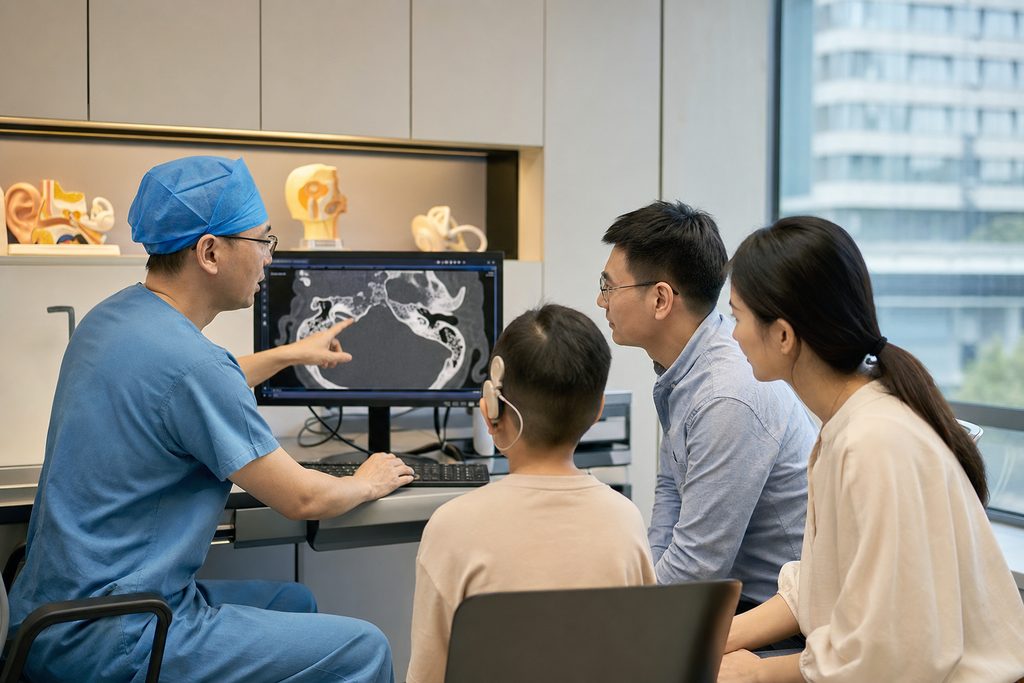
The otology team at Tongren completes more cochlear implant procedures in one month than many Western teaching hospitals complete in a year. Annual implant volumes exceed 1,500 cases. Within that cohort, a significant percentage involves difficult temporal bone cases: Mondini dysplasia, enlarged vestibular aqueduct syndrome, common cavity deformities, and post-meningitic ossification. The surgical team has published extensively on the management of “facial nerve anomalies” during cochlear implantation—a critical concern when the fallopian canal takes an unexpected path over the oval window. Our team has observed that the surgeons here use intraoperative CT and real-time nerve monitoring as standard protocol for these complex cases, not as an exception.
Technology Access Without Long Procurement Delays
China’s regulatory environment allows for the rapid adoption of new implant hardware. Patients at Tongren have access to the latest fully-implantable processor trials and slim modiolar electrode arrays designed specifically for malformed cochleae. In some Western systems, a hospital’s purchasing committee might take 18 months to approve a new electrode variant. At Tongren, the high-volume program maintains real-time stock of multiple manufacturer options—Cochlear, MED-EL, and Advanced Bionics—meaning the surgeon can choose the electrode best suited to your specific temporal bone CT findings, not just the one available on the shelf.
How Much Does a Cochlear Implant Cost in China for Complex Cases?
This is the question that brings most international patients to our door. The answer is not a single number, but a range that depends on the implant hardware and the length of hospital stay. For a complex case requiring extended drilling, intraoperative navigation, and a premium electrode array, the total hospital bill—including surgeon fees, anesthesia, operating theater, device cost, and a 5-7 day inpatient stay—typically falls between $28,000 and $42,000. This is the all-in figure for the hospital side.
Compare this to the United States, where a complex cochlear implant without complications can generate a hospital charge of $100,000 to $150,000. The structural reason for the cost difference is straightforward. Labor costs, hospital administrative overhead, and the device markup applied by intermediaries are significantly lower in China. The device itself—often manufactured in similar global facilities—does not carry the same multi-layered distribution premium. The surgical outcome hinges on the surgeon’s hands, not the price tag on the operating room.
| Cost Component | Beijing Tongren (Complex Case) | USA Average (Complex Case) |
|---|---|---|
| Implant Device (Premium Array) | $18,000 – $25,000 | $40,000 – $60,000 |
| Surgeon & Hospital Fees | $10,000 – $17,000 | $60,000 – $90,000 |
| Total Estimated Range | $28,000 – $42,000 | $100,000 – $150,000 |
It is worth mentioning that the how much does cochlear implant cost in China for complex cases question always requires a personalized quote. A patient with a totally ossified cochlea requiring a double-array implant will naturally fall at the higher end. Our coordination fee is separate and covers pre-arrival case review, scheduling, and bilingual accompaniment. That cost starts from $300 for appointment coordination, with comprehensive VIP end-to-end packages ranging from $5,000 to $8,000. Any consultation fees are credited in full toward on-the-ground coordination if you proceed within 90 days.
Is Beijing Tongren Hospital Good for Complicated Ear Surgery?
Let us be direct. If you have a straightforward cochlear implant case—a post-lingually deafened adult with a normal cochlea—many hospitals can serve you well. The question is Beijing Tongren Hospital good for complicated ear surgery matters most when the temporal bone anatomy is hostile. In those cases, the answer is unequivocally yes. The department handles referrals from across Asia for failed primary surgeries and anatomical outliers. The facial nerve monitoring team works with dedicated neurophysiologists, not just automated machines. The audiology team has experience mapping electrodes in malformed cochleae where the tonotopic organization is unpredictable. Post-operative activation often requires creative programming strategies—fitting a cochlea with only 1.5 turns instead of the usual 2.5 turns is a different challenge entirely.
What You Need to Know Before Going Alone
Deciding to travel to Beijing for surgery is the first step. The operational hurdles that follow are real and can derail the process if underestimated.
- Visa Requirements: Medical treatment in China requires an S2 visa with a specific annotation for therapeutic purposes. Hospital invitation letters must be formatted precisely for the Chinese consulate in your country. A generic appointment slip will not suffice. The visa is typically valid for 180 days or less; for stays beyond that, an S1 visa is required.
- Payment Systems: The international department at Tongren operates on a pre-payment model. You must deposit the estimated surgical cost before admission. International wire transfers can take 3-5 business days to clear. Credit card limits often cap at $10,000 per transaction. We have seen patients arrive assuming they could pay with a standard overseas card, only to face multiple declined transactions.
- Medical Records and Imaging: The surgeon will want your original temporal bone CT scan in DICOM format on a CD, not just the radiology report. They will perform their own multiplanar reconstructions. Without a local coordinator, getting that CD into the right hands before your consultation is a logistical bottleneck.
How We Help You Navigate This
These barriers exist for structural reasons, not malice. A public hospital serving 10,000 outpatients daily cannot pause its workflow for an international patient unfamiliar with the system. That is where we come in.
Before you travel, we translate and format your medical records, audiograms, and imaging into the clinical summary format expected by Chinese surgeons. We do not just email a PDF. We walk the file through the international department’s official channel, securing a specific appointment date with the otology team. This is not a “show up and wait” scenario. Your case is previewed by the surgical team before you step on the plane. Once in Beijing, our bilingual medical companion meets you at the hospital entrance. They handle registration, payment queueing, and real-time translation during the surgeon’s consultation. During the post-operative mapping sessions, they ensure the audiologist’s instructions are fully understood. The goal is that you focus entirely on recovery, not on figuring out where to pay for the next hearing test.
For patients specifically searching for the best surgeon for difficult temporal bone cases China can offer, we do not promise a specific named individual. We promise access to the senior surgical team within the otology division that handles these referrals. If a particular surgeon’s schedule is fully booked, we coordinate with the next available attending within that same high-volume team—the surgeons who operate together, share protocols, and review each other’s difficult cases. This is how elite surgical programs function: as a team, not a solo practitioner.
Frequently Asked Questions
International patient feedback on Beijing Tongren Hospital cochlear implant reviews international patients share online tends to cluster around two themes. The first is deep satisfaction with surgical expertise and the audiology team’s willingness to tackle difficult mapping. The second is frustration with the physical environment—long corridors, crowded waiting areas, and a cafeteria that does not cater to Western palates. The hospital’s international wing is more navigable, but it is still a high-throughput Chinese public institution. Expect clinical excellence in a no-frills setting. The surgeon will spend the necessary time on your temporal bone, not on bedside manner.
You cannot purchase a fixed-price surgery package directly from the hospital’s website. When patients ask us about a book cochlear implant surgery Beijing Tongren Hospital package, they are usually seeking a single all-inclusive price. The hospital provides an itemized estimate based on the specific implant chosen and the anticipated length of stay. Our coordination service bundles the hospital’s estimate with our logistical support—visa invitation letters, airport transfer from $200 round-trip, and daily bilingual companion services from $200 per day. The final number is always confirmed after the in-person consultation and pre-operative CT review, because the surgical plan can change once the surgeon examines the imaging personally.
We do not offer clinical guarantees—no ethical organization can. What we do offer is continuity. If a complication arises, the same bilingual companion remains with you through any extended hospital stay. We coordinate communication between the Chinese medical team and your home-country physician. If a revision surgery is required, we manage the rescheduling. The hospital’s otology department has experience managing complications like electrode migration or infection. Your case does not disappear after the initial surgery.
Your Next Step
Complex temporal bone anatomy does not have to mean a lifetime without sound. The surgical skill exists. The technology exists. What has been missing is a reliable bridge between your home country’s diagnosis and China’s high-volume surgical centers. We provide that bridge. You arrive with a plan.
If you are ready to discuss your specific case—or if you simply want to understand whether your cochlear anatomy makes you a candidate for surgery here—reach out for a free consultation. There is no pressure and no commitment. Just a clear, honest conversation about what is possible. Start with a free consultation today.
Medical Disclaimer: This article is for informational purposes only and does not constitute medical advice. Always consult a qualified healthcare professional regarding any medical condition or treatment. Surgical outcomes vary by individual case. Prices cited are estimates based on historical data and may vary by hospital and case complexity.
For more medical information and treatment options in China, visit chinamedservices.com (China Medical Services).
