3D Printed Orthopedic Implants in China: Custom Titanium Prosthesis for Foreigners
Key Takeaways
- A custom 3D printed titanium implant in China typically costs 60-80% less than an equivalent procedure in the United States, with access to surgeons who perform hundreds of these complex operations annually.
- Chinese regulatory approvals for 3D printed orthopedic devices have accelerated dramatically since 2015, giving surgeons access to technology that is still experimental or prohibitively expensive in many Western countries.
- Navigating the public hospital system independently is genuinely difficult without Mandarin fluency—the registration process, digital payment gateways, and post-operative protocols are not designed for international patients.
- No implant, however precisely printed, compensates for poor surgical planning. Hospital and surgeon selection matters far more than the hardware itself.
The Problem: When Standard Implants Cannot Solve Your Anatomy
What if your bone defect is so complex that no off-the-shelf implant fits? This happens more often than most patients realize. Severe trauma, congenital deformities, tumor resections, and multiple failed revision surgeries can leave bone geometry that standard prostheses simply cannot address. The surgeon opens the surgical site, measures the void, and discovers that every implant in the tray is wrong. The patient is closed up. Another surgery is scheduled. More waiting. More uncertainty.
Approximately 5-10% of complex revision arthroplasty cases encounter this problem, according to clinical data from major orthopedic centers. For these patients, a custom implant is not a luxury. It is the only viable path forward. But in the United States, a custom 3D printed titanium spinal cage or acetabular cup can take 6-12 weeks to manufacture and cost $25,000-$60,000 for the implant alone. In Canada and the UK, the wait for a custom device through public health systems can stretch past six months. The patient lives in pain. Bone stock deteriorates. The surgical window narrows.
Who We Are
We are not a hospital. We do not provide medical treatment, surgical opinions, or clinical diagnoses. Our team at China Medical Services functions as your logistical architects—we bridge the gap between you and China’s top-tier orthopedic centers. We maintain direct relationships with the international patient departments of hospitals that have published peer-reviewed research on 3D printed orthopedic implants. We handle case preparation, medical record translation, hospital matching, visa documentation, and on-the-ground bilingual support. You focus on your health. We handle everything else.
Why 3D Printed Titanium Implants in China Deliver Results
Surgical Volume Creates Pattern Recognition
A senior orthopedic spine surgeon at a major Chinese tertiary hospital may perform 300-500 instrumented spinal fusions per year. The average US spine surgeon performs roughly 110-120 annually, based on published workforce surveys. This gap widens further for complex deformity and tumor cases. Volume does not guarantee skill. But for rare, technically demanding procedures involving custom implants, the surgeon who has seen 50 variations of a problem will recognize patterns the surgeon who has seen 10 cannot. Chinese hospitals operate at a scale that generates this pattern recognition naturally.
The orthopedic departments at hospitals like Peking University Third Hospital and West China Hospital have published extensively on 3D printed implant design and clinical outcomes. Their surgeons have been designing and implanting custom titanium prostheses since the technology received CFDA (now NMPA) approval in 2015-2016. That is nearly a decade of accumulated institutional experience.
Technology Integration From Design to Surgery
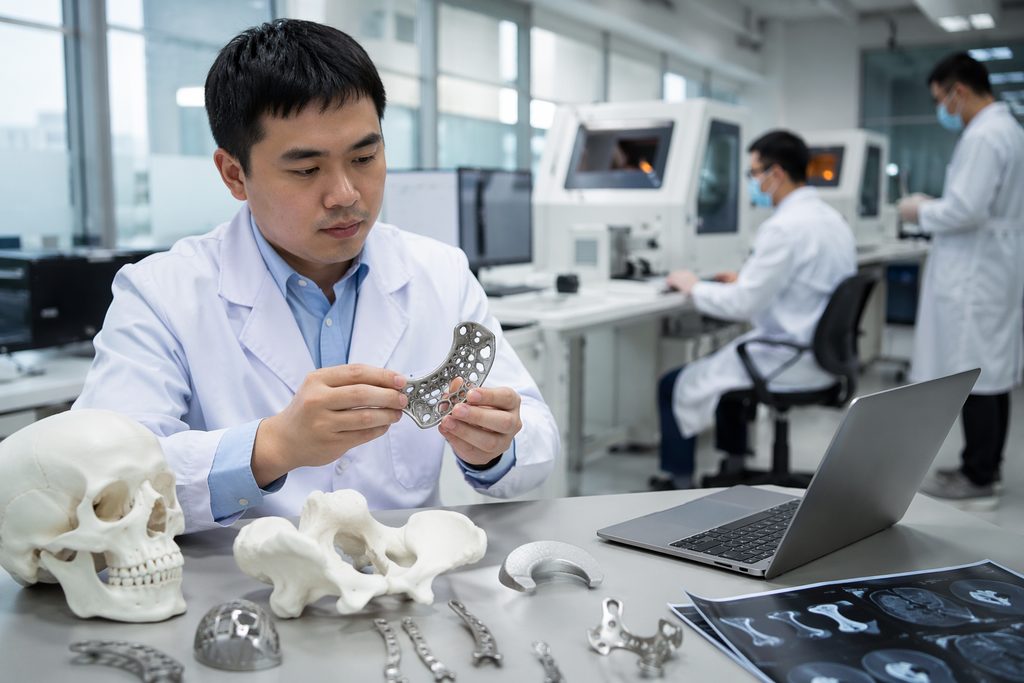
Here is how the workflow actually functions at a top Chinese orthopedic center equipped for custom implant cases. The patient receives a high-resolution CT scan, typically with 0.5-1.0mm slice thickness. The DICOM data is imported into 3D reconstruction software—Mimics or similar platforms. The surgeon and a biomedical engineer collaborate on the implant design, often over 2-3 iterative sessions. They account for bone density, load-bearing vectors, screw trajectory, and porous structure for osseointegration. The final design file is sent to an in-house or partnered titanium powder bed fusion printer. The implant is printed, post-processed, sterilized, and ready for surgery within 7-14 days in most cases. Some hospitals have reduced this to under one week for urgent oncology cases.
The porous titanium surface is not a marketing gimmick. Electron microscopy shows pore sizes of 300-800 microns, which published research confirms is optimal for osteoblast migration and vascular ingrowth. The elastic modulus of the printed porous structure can be tuned closer to that of natural cancellous bone than a solid machined implant, reducing stress shielding. These are measurable engineering advantages, not theoretical ones.
The Cost Reality: A Structural Advantage, Not a Discount
Let us address the question every international patient asks first: the 3D printed titanium spine implant cost in China. For a single-level custom titanium vertebral body replacement cage, the implant itself typically ranges from $8,000 to $15,000 USD. A custom acetabular cup with iliac fixation flanges for a complex revision hip might run $10,000 to $18,000. A total custom distal femoral replacement for tumor reconstruction could reach $20,000 to $30,000. These are implant-only figures. The total surgical package—including hospital stay, surgeon fees, anesthesia, and postoperative care—typically adds 40-60% to the implant cost.
Compare this to the United States, where a custom 3D printed spinal implant alone often costs $30,000 to $60,000, and the total procedure can exceed $150,000. The cost difference is not because Chinese surgeons are cheaper in a way that implies lower quality. It is structural. Hospital construction costs are lower. Administrative overhead is dramatically lower—Chinese hospitals do not maintain the billing and insurance coding armies that American hospitals require. Malpractice insurance costs are a fraction of US levels. And the sheer patient volume allows fixed costs to be amortized across far more cases.
Does this lower cost mean compromised safety? The data does not support that conclusion. Multiple Chinese orthopedic centers now report 2-5 year follow-up data on custom 3D printed implant cohorts with complication and revision rates comparable to published Western series. The implants themselves are typically manufactured to ISO 13485 standards. The titanium alloy powder—usually Ti6Al4V ELI—is the same medical-grade material used globally.
What You Need to Know Before Going Alone
We tell every prospective patient the same thing: the technology is real, the surgeons are skilled, and the barriers are also real. These are the obstacles you will face if you attempt to arrange this independently.
- Hospital Access and Registration: Top-tier Chinese public hospitals do not accept direct international patient bookings through their general outpatient systems. You cannot email a professor and schedule surgery. The international department or VIP clinic must coordinate your case. Walk-in registration at a public hospital with 10,000+ daily outpatient visits, entirely in Mandarin, is not a realistic option for a foreign patient.
- Payment Architecture: Chinese hospitals require upfront deposit payments. The deposit for a complex custom implant surgery can range from $30,000 to $60,000 USD, wired in advance. Most hospitals do not accept foreign credit cards. International wire transfers must clear through specific Chinese bank accounts, and the hospital’s finance department issues a deposit receipt in Chinese. This process alone can delay treatment by 2-3 weeks if handled incorrectly.
- Medical Documentation Standards: Chinese implant surgeons need imaging in specific formats—DICOM files on CD or secure cloud upload, not printed films or JPEG screenshots. Radiology reports must be translated into Chinese with precise anatomical terminology. A poorly translated report that misidentifies a vertebral level or joint compartment can result in the wrong implant design. This is not a theoretical risk. We have corrected such errors during case preparation.
How We Help You Navigate This
These barriers exist for structural reasons, not because anyone wants to exclude foreign patients. The Chinese hospital system was built to serve a domestic population of 1.4 billion people. International patients are an afterthought in the system’s design. That is precisely where we fit.
Before you travel, we collect and translate your complete medical records—imaging studies, surgical history, pathology reports, current medications. We present your case to the international patient departments of hospitals that match your specific orthopedic needs. If you need a custom spinal implant, we target centers with published experience in vertebral reconstruction. If you need a revision hip prosthesis, we approach hospitals with documented outcomes in complex arthroplasty. We do not send your records to every hospital in our database. We send them to the right ones.
Once a hospital accepts your case and provides a preliminary treatment plan and cost estimate, we coordinate the S2 visa documentation. The S2 visa is specifically for medical treatment purposes in China. Family members traveling with you also apply for S2 visas. We provide the invitation letters and hospital documentation that the Chinese consulate requires. This is not an M visa scenario—M visas are for commercial business and will be rejected for medical travel.
During your stay, a bilingual medical companion accompanies you to every appointment. They handle registration kiosks, payment counters, pharmacy queues, and real-time translation during surgeon consultations. They ensure your deposit is correctly applied, your imaging is properly routed, and your discharge instructions are fully understood. After you return home, we coordinate follow-up imaging reviews with your surgical team and help manage any ongoing communication needs.
Our consultation coordination fee starts from $300 for hospital appointment arrangements. Bilingual medical companion services start from $200 per day. For patients requiring comprehensive case management—including implant design coordination, surgical scheduling, accommodation, and full concierge support—our VIP End-to-End Coordination package ranges from $5,000 to $8,000 depending on case complexity. Any consultation fees paid are credited in full toward on-the-ground coordination services if you proceed with treatment within 90 days.
Frequently Asked Questions
Custom 3D printed titanium implants used in Chinese hospitals are regulated by the National Medical Products Administration (NMPA), which requires device registration and manufacturing quality certification. The titanium alloy powder and printing processes must meet ISO 13485 medical device quality management standards. Published clinical studies from major Chinese orthopedic centers report complication and revision rates for custom implants that are comparable to those seen in Western literature. The primary safety risk is not the implant itself—it is the surgeon’s experience with the specific anatomical challenge your case presents. This is why hospital and surgeon selection matters far more than implant brand or manufacturing origin.
For a single-level custom titanium vertebral body replacement, expect a total cost of $20,000 to $35,000 USD including the implant, surgeon fees, hospital stay (typically 7-14 days), anesthesia, and postoperative imaging. Multi-level constructs, cases requiring both anterior and posterior approaches, or tumor resections with adjuvant therapy will push costs higher—potentially $40,000 to $60,000. These figures are estimates. Final pricing depends entirely on your specific case, the hospital selected, and the complexity of the implant design. We provide detailed cost breakdowns only after a hospital reviews your imaging and issues a formal treatment proposal.
Yes. Shanghai has multiple hospitals with 3D printing capabilities for orthopedics, including Shanghai Ninth People’s Hospital, which operates one of China’s most active custom implant programs. Their orthopedic department has published extensively on custom titanium implants for complex joint reconstruction, including distal femoral replacements, proximal tibial replacements, and total femoral replacements. The same hospital has an integrated 3D printing center that can design and manufacture custom implants without outsourcing to third-party facilities. Other Shanghai hospitals with relevant capabilities include Changhai Hospital and Ruijin Hospital. The key question is not whether the technology exists in Shanghai—it does—but whether your specific case is appropriate for the surgeons who practice there.
This is the hardest question, and we answer it directly. If a complication arises after you leave China, your local orthopedic surgeon becomes your primary point of care. The Chinese surgical team can provide operative notes, implant specifications, and imaging guidance remotely, but they cannot physically examine you or perform revision surgery from across the ocean. Before you commit to traveling for a custom implant, you must have a local orthopedic surgeon who agrees to manage your postoperative care and is willing to communicate with the Chinese team if complications develop. We strongly recommend establishing this relationship before you travel. Some patients also purchase medical complication insurance or medical evacuation coverage, though these policies have significant limitations for elective international procedures.
Plan for a minimum of 4-6 weeks. The first week covers final consultations, preoperative testing, and implant manufacturing if the design was not completed remotely. Surgery and acute hospital recovery typically require 7-14 days. The remaining 2-4 weeks allow for wound healing, early mobilization, suture removal, and a postoperative CT scan to confirm implant position before you fly home. Some complex cases—pelvic reconstructions, multi-level spinal fusions—may require 8-10 weeks. Your surgeon will clear you for long-haul air travel only after confirming there are no signs of infection, deep vein thrombosis, or implant migration. Do not book a return flight with a fixed date until your surgeon approves it.
Your Next Step
A custom 3D printed titanium implant can solve anatomical problems that standard hardware cannot address. Chinese hospitals offer this technology at a fraction of Western costs, with surgeons who have accumulated genuine depth of experience in these complex cases. But the logistics of accessing that care—the language barrier, the payment systems, the documentation requirements—are not trivial. They are surmountable, but only with proper preparation and local support. If you are considering this path, start with a conversation. We will review your case honestly and tell you whether China is a realistic option for your specific situation.
To discuss your case with our team, visit our patient coordination page for a free initial consultation. No commitment. No pressure. Just an honest assessment of your options.
For more medical information and treatment options in China, visit chinamedservices.com (China Medical Services).
