3D Printed Cervical Vertebra China: World First Movable Neck Bone Saves Motion
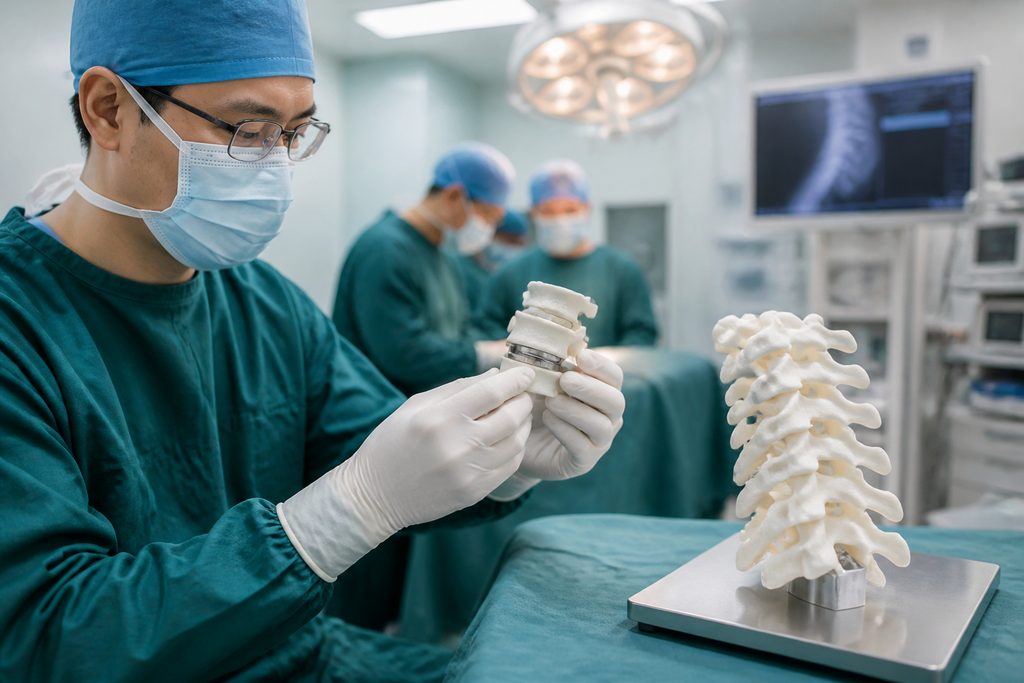
A cervical vertebra is one of the seven small bones stacked in your neck. When disease or injury destroys one, surgeons usually fuse the bones above and below it together with metal plates and screws. Your neck becomes permanently stiff. That was the only option.
Until now.
Chinese surgeons have implanted the world’s first movable 3D printed artificial cervical vertebra. The patient kept their neck motion. The implant is custom-printed to match the patient’s own bone exactly. This is not a prototype. The surgery happened. The recovery data is real. And for patients facing cervical spine destruction from tumors, severe trauma, or degenerative disease, this changes everything.
Key Takeaways
- Chinese surgeons completed the world’s first implantation of a movable 3D printed cervical vertebra — the patient retained neck rotation and flexion, which fusion surgery permanently eliminates.
- The 3d printed cervical vertebra cost China ranges from approximately $18,000 to $35,000 for the implant and surgery combined, roughly 80-90% less than comparable complex spine procedures in the United States.
- This is a highly specialized procedure currently available at a small number of top-tier Chinese hospitals — independent access is extremely difficult without local medical coordination and language support.
- Not every cervical spine patient qualifies. Tumor patients with single-level vertebral destruction are the primary candidates. Degenerative multi-level disease usually still requires fusion.
The Problem: When Your Neck Bones Cannot Be Saved
About 1 in 5 spinal tumors metastasize to the cervical spine. Primary bone tumors like chordomas and giant cell tumors also attack these vertebrae. When a tumor eats through the bone, the vertebra collapses. The spinal cord gets compressed. Pain becomes unbearable. Paralysis is a real threat.
The standard surgical answer has not changed in decades. Surgeons remove the destroyed vertebra — a procedure called corpectomy — and fill the gap with a static cage or bone graft. Then they screw a metal plate across the three vertebrae. The two healthy bones above and below get locked to the implant. Forever.
That fusion stops the pain. It stabilizes the spine. But it also kills all motion at that segment. A patient with a fused C5 vertebra loses the ability to turn their head naturally. Looking over their shoulder while driving becomes impossible. Everyday movements vanish. And the adjacent vertebrae now absorb extra stress. Studies show adjacent segment disease develops in approximately 25% of cervical fusion patients within 10 years. More surgery follows.
For decades, spine surgeons worldwide searched for a better answer. An implant that replaces the bone, supports the weight of the head, and still lets the neck move. That search led to a surgical breakthrough in China.
Who We Are
We are not a hospital. We do not provide medical treatment, clinical diagnoses, or surgical opinions. Our team at China Medical Services acts as your logistical bridge to China’s top-ranked hospitals. We handle hospital matching, appointment coordination, bilingual medical companion services, visa guidance, and every practical detail of traveling to China for complex procedures. When a patient needs access to a world-first procedure like a movable artificial neck bone surgery price China patients can afford, we make the connection happen — safely, transparently, and without the chaos of navigating a foreign healthcare system alone.
How the World’s First Movable 3D Printed Spine Implant Works
The breakthrough came from a surgical team at a leading Chinese orthopedic hospital. Their patient had a tumor destroying the C5 vertebra. Fusion would have permanently frozen their neck. Instead, the team designed something entirely new.
Custom-Printed from Titanium Alloy Powder
The implant starts as a digital file. Surgeons take a high-resolution CT scan of the patient’s cervical spine. That scan becomes a 3D model. Engineers design a replacement vertebra that matches the patient’s bone shape, height, and endplate angles exactly. No off-the-shelf cage can do this. The implant is then printed layer by layer from medical-grade titanium alloy powder using electron beam melting technology.
The surface is porous. Real bone grows into those pores over time — a process called osseointegration. The implant literally becomes part of the skeleton. This is not a foreign object the body tolerates. It is a scaffold the body colonizes.
The Motion-Preserving Mechanism
Here is what makes this implant fundamentally different from every spinal implant before it. The artificial vertebra has an integrated joint mechanism. The top and bottom surfaces are fixed to the adjacent vertebrae with screws. But a central articulating component allows controlled movement — flexion, extension, and limited rotation. The neck bends. The head turns.
The implant mimics the function of a natural intervertebral disc and vertebral body together. No fusion means no adjacent segment stress. No permanent stiffness. The patient in the reported case demonstrated preserved range of motion at follow-up. The world first 3d printed spine implant preserves motion — that phrase is not marketing. It is a description of what the surgical team achieved and documented.
Who Qualifies for This Surgery
This is not for everyone with neck pain. The primary candidates are patients with single-level vertebral destruction from a tumor, severe trauma, or infection where the bone must be removed but the adjacent discs and facet joints are still healthy. Multi-level degenerative disc disease patients typically still need fusion. A thorough pre-operative assessment determines eligibility. Imaging, neurological exams, and tumor staging all factor into the decision. The surgical team reviews each case individually before accepting a patient.
Why China Delivered This Breakthrough First
Some readers will ask: why China? Why not Germany, Japan, or the United States? The answer sits at the intersection of surgical volume, regulatory speed, and manufacturing capability.
Surgical Volume Drives Innovation
A senior spine surgeon at a top Chinese orthopedic center performs roughly 300 to 500 complex spinal procedures annually. The average US spine surgeon performs approximately 100 to 150. When you operate at that volume, you encounter rare tumor cases frequently enough to justify developing new solutions. You also accumulate the operative experience needed to execute a world-first procedure safely.
China’s top hospitals are vast. A single orthopedic department may handle more complex spinal tumor cases in one year than many Western university hospitals see in five. That case volume creates a clinical environment where surgical teams can push boundaries — not recklessly, but with the confidence that comes from deep experience.
3D Printing Manufacturing at Scale
China leads the world in metal 3D printing production capacity. The same industrial base that produces aerospace components and precision machinery also supplies medical implant manufacturing. A custom titanium vertebra can be designed, printed, post-processed, sterilized, and delivered to the operating room in under two weeks. The cost of production is a fraction of what it would be in Europe or North America.
That manufacturing speed matters. A patient with an aggressive spinal tumor cannot wait months for a custom implant. The window for surgery is narrow. Chinese hospitals can move from CT scan to implant delivery faster than almost anywhere else on earth.
Cost Structure Without Quality Compromise
Let us address the obvious question directly. The 3d printed cervical vertebra cost China hospitals charge is significantly lower than Western prices — and that makes some patients nervous. Does lower cost mean lower quality?
No. The cost difference is structural, not qualitative. Chinese hospital systems operate on different economics. Surgeon salaries, facility fees, and device manufacturing costs are all lower. A complex custom 3D printed implant surgery in China runs approximately $18,000 to $35,000 total — implant, surgeon fees, hospital stay, and rehabilitation included. A comparably complex custom implant procedure in the United States would exceed $150,000 easily, and most insurers would classify it as experimental and deny coverage entirely.
The titanium alloy powder used is the same medical-grade material. The printing technology — electron beam melting — is the same. The sterilization standards are the same. The operating microscopes and intraoperative navigation systems are the same brands used in Western operating rooms. What differs is the cost of the system surrounding the surgery. That is where the savings come from. Not from corners cut.
What You Need to Know Before Pursuing This Surgery Alone
The procedure exists. That is the good news. The harder truth is that accessing it independently from overseas is extraordinarily difficult. We tell patients this directly because unrealistic expectations help no one.
- Visa Requirements: Foreign patients traveling to China for medical treatment require an S2 visa with a medical purpose annotation. You need an official invitation letter from the treating hospital, a confirmed treatment plan, and documentation of your medical condition. Hospitals do not issue these letters casually. You must be an accepted patient first. Applying without hospital documentation leads to visa rejection. M visas are for business only and cannot be used for medical treatment.
- Language and Navigation: A top Chinese public hospital handles over 10,000 outpatient visits per day. Signage is in Chinese. Registration counters operate in Mandarin. Payment terminals require local payment methods. Without a bilingual companion who knows the hospital layout, the registration system, and the unwritten rules of getting things done, a foreign patient is functionally stranded. This is not a criticism — it is the reality of a healthcare system built for a domestic population of 1.4 billion people.
- Payment Systems: Chinese public hospitals require prepayment. International credit cards are often not accepted at hospital counters. You need a local payment method or an intermediary who can handle deposits, ongoing billing, and settlement. Insurance reimbursement happens after the fact — you pay first, then claim. Private international hospitals with direct billing exist, but this specific procedure is performed at public hospitals with dedicated international departments, not at private clinics.
How We Help You Navigate This
These barriers are real. They exist for structural reasons that will not change overnight. Our entire service model exists to solve each one systematically.
Before you travel, we handle hospital matching. We present your medical records — translated into Chinese by medical professionals — to the appropriate surgical teams. We confirm whether your case is suitable for the procedure. We coordinate the invitation letter for your S2 visa application. We arrange pre-operative video consultations so you speak with the surgical team before committing to travel. The best hospital for 3d printed spine implant China will not be the same for every patient — we match based on your specific diagnosis, imaging, and medical history.
During your treatment, a bilingual medical companion stays with you. They handle registration, queue management, payment processing, and real-time translation during every consultation, pre-operative exam, and post-operative follow-up. You focus on recovery. We handle everything else. For patients seeking to book 3d printed neck bone surgery abroad, having a coordinator who knows the hospital’s international department protocols is not a luxury — it is the difference between a smooth process and weeks of frustration.
After surgery, we coordinate rehabilitation arrangements, follow-up imaging, and communication with your home-country physician. We ensure your medical records are translated back into English and formatted for your local doctor’s review. The relationship does not end when you board the plane home.
Frequently Asked Questions
The process starts with a high-resolution CT scan of your cervical spine. Engineers create a 3D digital model of your destroyed vertebra and the healthy bones above and below it. A custom titanium implant is designed to match your anatomy exactly — height, width, endplate curvature, and screw trajectory. The implant is printed using electron beam melting, sterilized, and delivered to the operating room. During surgery, the surgeon removes the diseased vertebra, places the custom implant, and secures it with screws. The articulating joint mechanism allows the neck to continue moving after healing. The entire process from CT scan to surgery typically takes two to three weeks.
The total cost — implant manufacturing, surgeon fees, anesthesia, hospital stay, and initial rehabilitation — ranges from approximately $18,000 to $35,000. The final figure depends on the complexity of your case, the specific hospital, and the length of your inpatient stay. This is the price charged by the hospital. It does not include travel, accommodation, visa fees, or coordination services. Compared to $150,000 or more for a comparably complex custom spinal procedure in the US — assuming you could find a surgeon willing to attempt it — the difference is substantial. Most international patients pay out of pocket and seek reimbursement from their home insurer afterward.
The first implantation was successful, and the patient demonstrated preserved neck motion at follow-up. However, this is a new procedure. Long-term data spanning 10 or 20 years does not exist yet — the surgery is too new. Known risks include implant loosening, infection, nerve injury, and failure of the articulating mechanism over time. These are the same categories of risk present in any complex spinal surgery, but the specific long-term durability of a moving 3D printed implant is still being studied. The surgical team will discuss all known risks during your pre-operative consultation. You should ask hard questions. A good surgical team welcomes them.
No. This procedure is currently available at a small number of top-tier orthopedic and spine surgery centers. These are hospitals with dedicated spinal tumor programs, in-house 3D printing facilities, and surgical teams that have published on custom implant techniques. We match patients to hospitals with demonstrated experience in this specific procedure — not to general orthopedic departments. The hospital that performed the world-first case has the most direct experience. Other centers are developing their own programs, but experience levels vary. We verify current capabilities before making any referral.
If the articulating mechanism wears out or the implant loosens, revision surgery is possible. The fallback option is the same surgery that has existed for decades: removal of the failed implant and conversion to a standard fusion with a static cage and plate. That would eliminate neck motion at that segment — the very outcome this new implant was designed to avoid. But it means a failed movable implant does not leave you without surgical options. The revision pathway is well understood. Discuss this scenario with the surgical team before your first operation. Know the plan.
Your Next Step
A world-first procedure that preserves neck motion where fusion would destroy it. A custom titanium vertebra printed to match your anatomy exactly. A surgical team with the volume and experience to execute it safely. And a cost structure that makes it accessible when Western healthcare systems would charge six figures or deny coverage entirely.
If you or someone you care about faces cervical spine destruction from a tumor, trauma, or infection, this option deserves serious investigation. Not every patient qualifies. The only way to know is to have your case reviewed by the surgical team that performs this procedure. We can make that connection happen. Contact our team to start the conversation — no commitment, no pressure, just an honest assessment of whether this path fits your situation.
For more medical information and treatment options in China, visit chinamedservices.com (China Medical Services).
