Brain Tumor Surgery in China for Kuwait Patients: Your Arabic-Speaking Companion
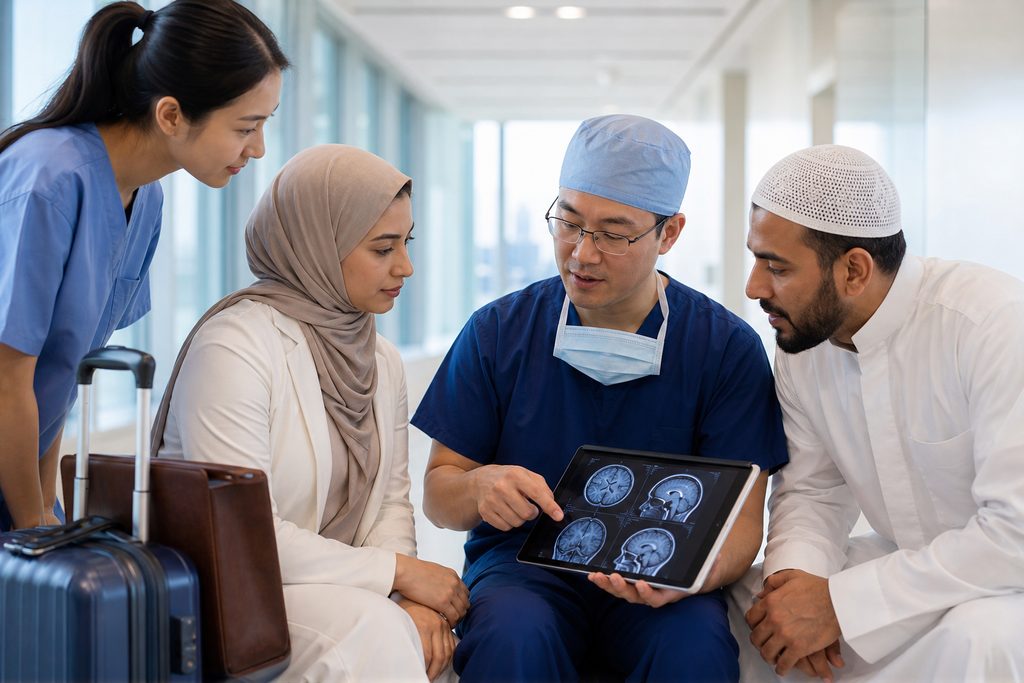
How This Actually Works, Step by Step
You sit in a consultation room in Kuwait City. The neurosurgeon has just explained the diagnosis. The immediate questions are not only clinical. They are logistical. Can this be done somewhere else? Where is the expertise concentrated? And who will translate every word, every consent form, every post-operative instruction into Arabic?
That is where our team enters the picture. We do not perform surgery. We are not doctors. We are the operational layer between your family and China’s top-tier neurosurgery centers. Here is the sequence.
First, you send us the existing medical records. MRI scans, CT images, pathology reports, blood work. Everything in DICOM format or high-resolution PDFs. Our clinical coordinators organize these into a standardized dossier. This takes about two business days.
Next, we route that dossier to the neurosurgery department at one or more hospitals from our network of 340+ top-ranked institutions across 37 cities. The selection is not random. We match the tumor type, location, and complexity to the department’s documented case volumes and sub-specialty strengths. For a glioma near the language cortex, we go to a center with awake craniotomy protocols and intraoperative language mapping. For a skull-base meningioma, we look for neurosurgeons who perform over 100 such resections annually.
The hospital’s team reviews the records. They produce a written second opinion. This document outlines whether they accept the case, what surgical approach they recommend, the expected hospital stay, and a preliminary cost range. This costs between $300 and $500 and serves as your decision-making foundation. It is not a prescription. It is an expert analysis you can take back to your doctor in Kuwait.
If you decide to proceed, we coordinate a video consultation with the Chinese neurosurgery team. An Arabic-speaking medical interpreter joins the call. You ask your questions directly. The neurosurgeon explains the plan. This consultation is your chance to look the surgeon in the eye, hear their reasoning, and gauge your comfort level. The fee for a top-specialist video consultation ranges from $500 to $800.
After the call, if you choose to move forward, we begin the practical work. Hospital appointment coordination. Visa support documentation. Travel and accommodation logistics. And we assign a bilingual Arabic-English-Chinese medical companion who will be at your side from the moment you land.
That is the architecture. Remote evaluation first. In-person treatment only when you have enough information to commit with clarity.
What Brain Tumor Surgery Costs in China Versus Kuwait
The brain tumor surgery cost China for Kuwait patients is not a single number. It depends on the tumor type, the surgical complexity, the hospital tier, and whether you go through the public international department or a private facility. But we can give you ranges grounded in real cases we have coordinated.
A standard craniotomy for tumor resection at a top-tier public hospital’s international department typically falls between $20,000 and $45,000. This includes the surgeon’s fee, anesthesia, operating theater, ICU stay, ward bed, and basic medications. Complex cases requiring intraoperative MRI, awake brain mapping, or extended ICU monitoring push toward the upper end of that range or slightly beyond.
| Procedure | China (International Dept) | Kuwait (Private Hospital) | United States |
|---|---|---|---|
| Standard craniotomy (glioma/meningioma) | $20,000 – $45,000 | $30,000 – $60,000 | $70,000 – $150,000 |
| Awake craniotomy with brain mapping | $35,000 – $55,000 | $50,000 – $80,000 | $100,000 – $200,000 |
| Transsphenoidal pituitary tumor resection | $18,000 – $30,000 | $25,000 – $45,000 | $50,000 – $100,000 |
| Gamma Knife radiosurgery (single session) | $6,000 – $10,000 | $8,000 – $15,000 | $30,000 – $50,000 |
These are pre-negotiated international department rates. They are higher than what a Chinese citizen pays through the standard public channel but include English-capable administrative staff, faster admission scheduling, and private or semi-private rooms. Compared to private hospitals in Kuwait, the savings are meaningful but not dramatic. Compared to the United States, the difference is fivefold or more.
What you do not see in the table is the hidden cost of delay. Some patients wait months for a surgical slot in overburdened systems. In China’s high-volume neurosurgery centers, once the international department confirms your case, the wait is typically two to four weeks. That speed has clinical value, especially for high-grade tumors.
Finding the Best Neurology Hospital in China That Welcomes Arabic Speakers
The phrase “best neurology hospital China for Arabic speakers” contains two distinct requirements. One is clinical. The other is linguistic and cultural. They rarely coexist in the same institution by default. You have to build the bridge.
On the clinical side, China’s neurosurgery capabilities are concentrated in a handful of centers. Huashan Hospital affiliated with Fudan University in Shanghai runs one of the largest neurosurgery departments in the world, performing over 17,000 procedures annually. Its subspecialty teams cover neuro-oncology, skull-base surgery, and functional neurosurgery. Beijing Tiantan Hospital, affiliated with Capital Medical University, operates a dedicated brain tumor center with a case volume exceeding 10,000 craniotomies per year. Both institutions appear consistently in the Fudan University hospital rankings for neurosurgery, placing among the top-tier programs nationally.
These hospitals do not have Arabic-speaking neurosurgeons. But they do have international patient departments accustomed to working with interpreters. And that is where the Arabic medical companion becomes indispensable.
We recruit companions who speak Arabic, English, and Chinese. Many are medical graduates from Chinese universities who trained in China, understand the hospital system, and can translate clinical terminology accurately. They do not just interpret words. They interpret context. When a neurosurgeon uses a term like “eloquent cortex,” the companion knows how to render that in Arabic without losing the clinical weight. When a nurse explains post-operative precautions, the companion ensures the instructions are culturally appropriate for a Kuwaiti family.
This is not a service you can improvise with a general translator found online. Neurosurgery conversations involve consent for risks like aphasia, hemiparesis, or CSF leak. Every syllable matters. The companion sits in on every consultation, every pre-op briefing, every post-op round. They are your voice when you are intubated and cannot speak for yourself.
We have coordinated cases at Shanghai and Beijing hospitals where the Arabic companion stayed with the patient for the entire two-week admission, rotating shifts with a second companion to ensure 24-hour coverage during the critical post-operative window. That level of support transforms the experience from isolating to manageable.
A Realistic Timeline
Time matters. Here is what the sequence actually looks like, including the waiting steps most websites skip.
| Stage | What Happens | Duration |
|---|---|---|
| Week 1 | You send medical records. We organize, translate key summaries, and submit to 1–3 target hospitals. | 3–5 business days |
| Week 2–3 | Hospital neurosurgery department reviews the case. Written second opinion is drafted and delivered. | 5–10 business days |
| Week 4 | Video consultation with the Chinese neurosurgeon. Arabic interpreter present. Decision point. | 1–2 hours scheduled |
| Week 5–6 | If proceeding: hospital appointment coordination, deposit payment, visa invitation letter issued. | 5–10 business days |
| Week 6–8 | S2 visa application at Chinese embassy in Kuwait. Processing time varies by season. | 5–15 business days |
| Week 8–9 | Travel to China. Airport pickup. Hospital admission. Pre-operative workup (MRI, bloods, anesthesia consult). | 2–4 days pre-op |
| Week 9 | Surgery day. ICU stay typically 1–3 days depending on complexity. | 1 day surgery + ICU |
| Week 10–11 | Ward recovery. Drain removal. Mobility. Pathology results (preliminary). Discharge planning. | 7–14 days |
| Week 12+ | Return to Kuwait. Follow-up imaging schedule. Remote consultation with China team if needed. | Ongoing |
Eight to twelve weeks from first contact to surgery day is realistic. Some cases move faster if the hospital has immediate availability and the visa office processes quickly. Others stretch longer if additional diagnostics are requested or if the tumor board wants a repeat MRI with specific sequences.
The S2 visa is the correct category for medical treatment in China. It covers short-term private affairs, including medical visits. Your accompanying family members apply under the same S2 category. Do not let anyone tell you to apply for an M visa. That is for commercial trade. Using the wrong visa category can result in denial or complications at the border. The hospital provides an invitation letter that supports the S2 application. We guide you through the documentation package, but we never guarantee approval. Embassy decisions are sovereign.
What Can Go Wrong — and What Happens Then
We need to talk about the things that do not go according to plan. Not to scare you. To prepare you.
The first failure point is records. A patient sends scans on a CD that cannot be read, or MRI sequences that are incomplete for surgical planning. The hospital requests a repeat scan with contrast and specific slice thicknesses. This adds two weeks. We now ask for a DICOM file inventory before we submit anything. It saves time.
The second is clinical rejection. The Chinese neurosurgery team reviews the case and declines. The tumor is in a location they consider too high-risk for the expected benefit, or the patient’s comorbidities make anesthesia unsafe. This happens. It is disappointing, but it is honest. We route the case to a second center. If both decline, we tell you directly and discuss alternatives. We do not shop your records to a dozen hospitals hoping someone says yes. That is reckless.
The third is intraoperative complication. Brain surgery carries irreducible risks. Hemorrhage, infection, neurological deficit. Chinese neurosurgery departments manage these complications with the same protocols as any major international center. The difference is that you are far from home. Your Arabic companion is your advocate in the ICU. They communicate your family’s concerns to the nursing staff. They explain what the monitors mean. They call your family in Kuwait at the agreed times. We have protocols for escalation if the standard of care is not being met, though we have rarely needed them.
The fourth is discharge logistics. Some patients are not medically fit to fly immediately after discharge. We coordinate extended stay in a serviced apartment near the hospital, with daily nursing visits if needed. This adds cost but reduces risk. A patient who flies too soon after a craniotomy risks a cabin-pressure-related complication. Most neurosurgeons recommend waiting at least 10 to 14 days post-craniotomy before flying. We enforce that advice.
A change in neurological status in the first 72 hours post-operatively requires immediate CT imaging. The hospital can do this. But if you have already checked out and are in a hotel, you need a clear emergency pathway back to the neurosurgery department. We establish that pathway before discharge. Do not leave the hospital without a written emergency contact protocol in Arabic and Chinese.
Is Brain Tumor Surgery Safe in China for International Patients? The Data Question
The question “is brain tumor surgery safe in China for international patients” deserves a straight answer. The safety of a craniotomy depends on three variables: the surgeon’s experience with that specific tumor type and location, the hospital’s perioperative care infrastructure, and the patient’s pre-operative condition. Nationality does not appear in that equation.
China’s top neurosurgery centers publish their outcome data. Beijing Tiantan Hospital reports a 30-day mortality rate for elective craniotomy below 1.5%, which is comparable to major centers in North America and Europe. Huashan Hospital’s neuro-oncology division tracks post-operative infection rates below 3%, consistent with international benchmarks. These are not marketing claims. They are peer-reviewed figures.
What international patients do face is a communication vulnerability. A post-operative patient who cannot describe their symptoms accurately is at higher risk of delayed intervention. That is why the Arabic companion is not a luxury. It is a safety measure. The companion catches subtle changes. A patient who says “I feel strange” in Arabic gets the full diagnostic workup. A patient who cannot express that feeling in Mandarin or English might be observed rather than scanned.
Another safety factor is continuity. Some medical tourism models drop the patient at the hospital and disappear. Our coordination continues through discharge and into the follow-up period. The Chinese neurosurgery team expects to receive follow-up imaging from Kuwait at defined intervals. We facilitate that transmission. If the Kuwaiti follow-up team has questions, we arrange a remote consultation with the Chinese surgeon. The loop stays closed.
Infection control standards in Chinese international departments meet JCI benchmarks. Private rooms reduce cross-contamination risk. Antibiotic stewardship protocols are in place. These are not things you need to worry about at the top-tier centers. At lower-tier hospitals, standards vary. We only work with hospitals in the top tier of the national ranking system, those that represent the top 5% of China’s 35,000-plus hospitals. That filtering is the core of what we do.
How to Evaluate a Medical Tourism Package That Includes an Arabic Translator
Search for “medical tourism China brain tumor treatment package Arabic translator” and you will find offers. Some are legitimate. Some are not. Here is how to tell the difference.
First, look at who employs the translator. Is the translator on the hospital’s payroll or the agent’s payroll? A hospital-employed translator reports to the hospital administration. Their loyalty is to the institution. An independent companion employed by the patient’s coordination service reports to the patient. That structural difference matters when there is a dispute about care or billing. We employ the companions directly. Their job is to represent your interests, not to smooth over hospital problems.
Second, examine the package’s clinical transparency. A legitimate package will tell you which neurosurgeon is proposed, their annual case volume for your specific procedure, and the hospital’s outcome data. A vague package that says “top surgeon” without naming the department or the doctor is a red flag. We provide the surgeon’s name and credentials before you pay anything beyond the second opinion fee.
Third, check whether the package includes post-operative rehabilitation. Brain tumor surgery is not just about the resection. Some patients need speech therapy, physiotherapy, or occupational therapy afterward. Does the package coordinate this? In China, rehabilitation services in international departments are well-developed. We can arrange Arabic-speaking therapists or, more commonly, English-speaking therapists with the companion translating.
Fourth, verify the visa pathway. Any package that mentions the M visa for medical treatment is either ignorant or dishonest. Walk away. The correct S2 visa process requires an invitation letter from the hospital. We ensure that letter is issued correctly and that the stated purpose of visit matches the visa category.
Fifth, ask about the refund policy if the hospital declines your case after you have paid a deposit. Our hospital appointment coordination fee starts from $300 and is fully refunded if we cannot secure the appointment we committed to. That is a concrete promise, not a vague assurance.
Before committing to any package, request a direct video call with the proposed neurosurgeon. If the agent cannot arrange this, question why. A surgeon who will operate on your brain should be willing to speak with you beforehand. The video consultation fee is a small price for the confidence it buys.
Practical Considerations: Records, Visa Timing, and Follow-Up at Home
Let us get into the details that determine whether this actually works.
Medical records must be complete and recent. Most Chinese neurosurgery departments want an MRI with contrast performed within the past 30 days. Older scans are useful for comparison but not for surgical planning. If your most recent MRI is from three months ago, budget time and money for a repeat scan before submission. We can advise on the specific sequences required—typically T1, T2, FLAIR, DWI, and contrast-enhanced T1 at minimum. Spectroscopy and perfusion imaging add diagnostic value for certain tumor types.
Visa
Frequently Asked Questions
Yes. The hospitals used for international patients are JCI-accredited and follow the same international safety standards as top hospitals in the US and Europe. Surgical teams perform high volumes of procedures — often more than their Western counterparts — which studies show leads to better outcomes.
Costs vary by procedure and hospital, but international patients typically save 40-80% compared to US prices — even when factoring in travel and accommodation. A consultation with our team will give you an exact, all-inclusive quote with no hidden fees.
Send us your existing medical reports to get started. We handle everything from hospital selection and appointment scheduling to visa assistance and post-operative recovery planning. Your medical records are reviewed by the specialist before you even book a flight.
For more medical information and treatment options in China, visit chinamedservices.com (China Medical Services).
