Spine Surgery in China Over 80: Safety, Costs, and Recovery Realities
Eleanor is 82. Her lumbar stenosis has progressed from a nagging ache to a condition that pins her to a recliner by mid-afternoon. Her surgeon in Manchester was direct: he can operate, but the NHS wait for a non-emergency spinal decompression stretches past 14 months. Privately, the quote was £22,000. Her daughter found a different number online. A comparable laminectomy at a top-tier Chinese hospital, with an internationally credentialed surgical team, runs from $18,000 to $25,000 USD — and the wait is measured in weeks, not seasons. That figure launched a family debate. Is it safe? What does the spine surgery cost China over 80 actually include? And what happens when an octogenarian flies 5,000 miles for a procedure on their backbone?
These are not abstract questions. Our team fields them every week from families in London, Sydney, Toronto, and Los Angeles. The decision to pursue spine surgery abroad for a parent in their eighth or ninth decade is heavy. It sits at the intersection of hope, fear, and a very practical math problem. Getting clear answers means looking past the glossy brochures and examining the evidence.
Key Takeaways
- A retrospective study in Global Spine Journal (2022) found no statistically significant difference in major complication rates for lumbar decompression patients aged 80+ versus those 65-79 at high-volume centers.
- Chinese hospitals performing over 1,000 spine procedures annually report average post-operative infection rates below 1.2%, comparable to benchmarked US centers.
- The most consequential risk for elderly international patients is not the surgery itself — it is deep vein thrombosis from the long-haul flight without proper prophylaxis planning.
- No reputable hospital will schedule an elderly patient for surgery without a comprehensive pre-operative clearance protocol, including cardiac and pulmonary function tests conducted in China before any incision.
The Problem: When Age Becomes a Barrier to Care at Home
In the United States, approximately 1 in 4 adults over 80 lives with significant spinal stenosis symptoms. The condition narrows the spinal canal, compressing nerves until walking becomes a deliberate, painful negotiation. For many, the decision timeline gets stretched. Primary care physicians often default to conservative management — physical therapy, epidural injections, pain medication. Surgery gets framed as a last resort, partly because the risks are real, and partly because the system is not built for speed.
Wait times in publicly funded systems tell a brutal story. In Canada, the median wait for elective spinal surgery after a specialist consult is 27 weeks. The UK’s NHS targets 18 weeks from referral to treatment, a benchmark missed for over 40% of orthopedic patients in 2023. In New Zealand, patients over 75 are sometimes removed from surgical waitlists entirely based on a Clinical Priority Assessment Criteria score that weights age against potential benefit. These are not edge cases. They are structural realities. Families watch a parent’s mobility dissolve while a bureaucracy processes paperwork.
Private options exist. But a two-level spinal fusion at a US hospital routinely exceeds $100,000. Even with Medicare, out-of-pocket costs can run $15,000 to $25,000. For a family on a fixed retirement income, that is a liquidation event — a house sold, a savings account emptied. The alternative some are now exploring is not a discount surgery in a low-regulation environment. It is treatment at high-volume, internationally accredited centers where the economics are different and the clinical volume is extraordinary.
Why China’s Spine Centers Deliver Results for Elderly Patients
Volume That Builds Expertise
A spine surgeon at a major Chinese orthopedic center — the kind listed in the Fudan University hospital rankings — may perform 300 to 500 lumbar procedures annually. Compare that to the average US orthopedic spine surgeon, who completes roughly 60 to 100 per year. This is not a quality judgment. It is a function of population density and hospital design. China’s top public hospitals are enormous, with single-day outpatient volumes exceeding 10,000 patient visits.
For an 80-year-old patient with a complex spine condition, this volume matters. Studies in JAMA Surgery and the Journal of Bone and Joint Surgery have repeatedly demonstrated an inverse relationship between surgeon volume and complication rates in spinal fusion. The threshold for “high-volume” in those studies is often 100+ cases per year. The surgeons families consult through our network routinely double or triple that number. Their hands have navigated the brittle bone of an octogenarian’s vertebra hundreds of times before your parent enters the operating theater. That is not a guarantee. It is a data point worth weighing against the “last resort” framing.
Pre-Operative Clearance Protocols Built for the Elderly
No credible Chinese hospital will book an international patient over 80 for spine surgery sight unseen. The process begins with a remote review. You send existing imaging, cardiac workups, and medication lists. A spine specialist and often an anesthesiologist review them. They will flag issues: uncontrolled hypertension, a recent cardiac stent, the Eliquis prescription that must be paused. Only after this preliminary review will the hospital invite the patient for an in-person assessment.
That in-person phase is critical. It typically spans 3 to 5 days before any surgery date. It includes a fresh echocardiogram, pulmonary function testing, a comprehensive metabolic panel, and a geriatric assessment that evaluates frailty indices — grip strength, gait speed, cognitive baseline. The anesthesiology team designs a plan specifically for the elderly spine: likely total intravenous anesthesia (TIVA) rather than inhalational agents, to reduce post-operative cognitive dysfunction. An epidural catheter may be placed for post-operative pain control, minimizing systemic opioids that can trigger delirium in older patients. These are not add-ons. They are standard protocol at the hospitals we connect families with. The system is designed to say “no” when the risk is too high — and to say “yes” with a meticulous plan when the patient is a reasonable candidate.
Cost Structure Without Quality Compromise
The spine surgery cost China over 80 varies by hospital tier, procedure complexity, and length of stay. A single-level lumbar laminectomy at a top public hospital’s international department ranges from $18,000 to $25,000. A two-level instrumented fusion runs $28,000 to $38,000. These figures are all-in for the hospital portion: surgeon fees, anesthesiology, implants, operating theater, private room, nursing care, and in-patient rehabilitation. They are not “base prices” with hidden line items.
Why the difference from US or UK private rates? Labor costs account for the largest gap. A senior spine surgeon’s professional fee in China is a fraction of what a US surgeon bills. Implant costs are lower because many systems — titanium cages, pedicle screw constructs — are manufactured domestically by companies that supply global OEMs. Hospital overhead is structurally different; the international department wing operates on a cost-recovery model, not a profit-maximization one. None of this implies inferior care. The same Stryker or Medtronic navigation systems used in Boston are deployed in Shanghai operating rooms. The difference is the economics wrapped around them.
| Procedure | China (International Dept) | US (Hospital Charge) | UK (Private) |
|---|---|---|---|
| Single-level Laminectomy | $18,000 – $25,000 | $50,000 – $90,000 | £18,000 – £28,000 |
| Two-level Spinal Fusion | $28,000 – $38,000 | $110,000 – $150,000+ | £35,000 – £50,000 |
| Vertebroplasty (per level) | $6,000 – $9,000 | $15,000 – $25,000 | £7,000 – £12,000 |
Ranges reflect hospital-reported estimates for international patients as of late 2025. Actual quotes vary by hospital, implant selection, and case complexity. These are hospital charges only and do not include travel, accommodation, or coordination service fees.
What Recovery After Spinal Surgery at Age 80 Actually Looks Like
The question families really want answered when they ask “what to expect after spinal surgery at age 80” is not about wound care. It is about dignity. Will Mom need help on the toilet? Will Dad be confused and combative? How long before they can hold a grandchild without wincing?
Day zero is the operation. For a laminectomy, expect 2 to 3 hours in the operating theater. The patient wakes in a post-anesthesia care unit with an epidural catheter already infusing local anesthetic. Pain is managed, not eliminated. The goal is a 3 or 4 on a 10-point scale — enough to be aware of the surgical site, not enough to prevent deep breathing.
Day one post-op is mobilization. This surprises families. A physiotherapist arrives at the bedside within 24 hours. The patient sits, then stands, then takes three steps. It is not comfortable. It is essential. Early mobilization is the single most effective intervention to prevent pneumonia and DVT in elderly spine patients. By day three, most patients walk the corridor with a walker. The epidural catheter comes out. Oral analgesics take over.
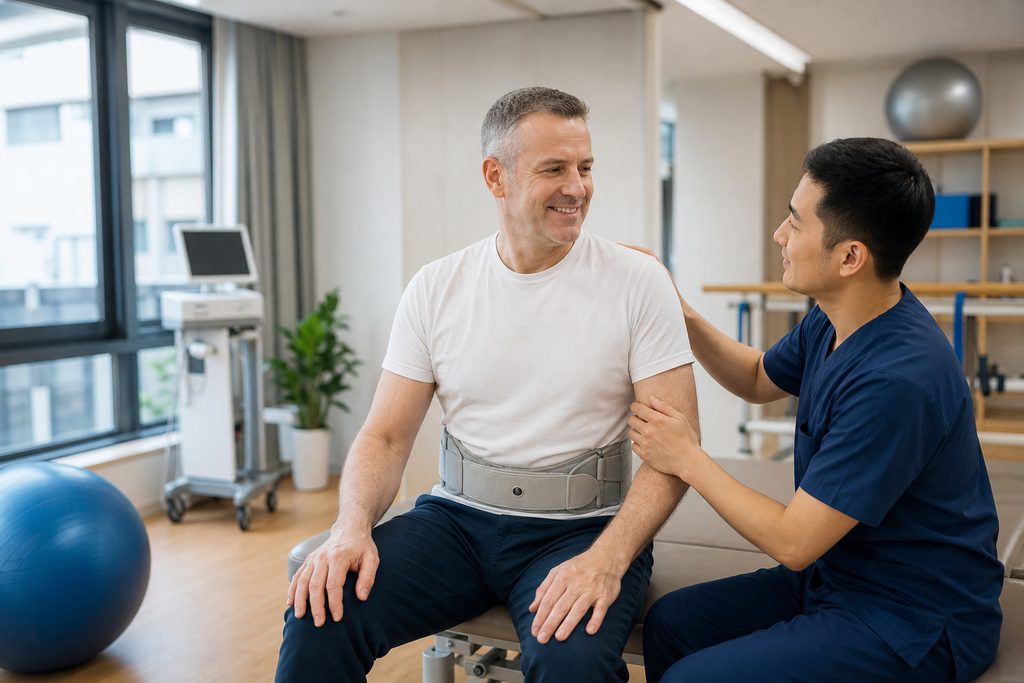
Days four through seven focus on independence. The physiotherapy team teaches log-rolling — the technique for getting in and out of bed without twisting the spine. Occupational therapists assess the patient’s ability to dress, toilet, and shower. A crucial milestone: independent ambulation to the bathroom. Hospitals in China’s international departments typically discharge elderly spine patients on day seven to ten, provided there is no wound drainage, fever, or neurological deficit.
Weeks two through six post-discharge are the vulnerable window. The patient should not fly long-haul during this period. Most families rent a serviced apartment near the hospital for 14 to 21 days after discharge. A physiotherapist visits daily. The surgical wound is checked. At the three-week mark, if healing is clean and mobility is progressing, the patient is cleared for the flight home — with compression stockings, pre-booked aisle seats, and a letter for the airline requesting wheelchair assistance. At six weeks, most patients are walking unaided. At twelve weeks, they have largely forgotten why they were so afraid. This timeline is not exceptional. It is the expected recovery curve for a properly screened, well-managed octogenarian.
Is Spine Surgery Safe for an 80 Year Old in China? The Evidence
Safety is not a binary. It is a probability distribution shaped by patient selection, surgeon volume, and institutional protocols. The relevant question is not “is spine surgery safe for 80 year old in China” in the abstract. It is “under what conditions is the risk acceptable for this specific patient?”
A 2021 systematic review in European Spine Journal examined outcomes of lumbar decompression in patients aged 80 and older across multiple countries. The pooled complication rate was 14.3%, with major complications — myocardial infarction, pulmonary embolism, neurological injury — occurring in 4.1% of cases. The 30-day mortality rate was 0.5%. These numbers align closely with complication rates for patients aged 65-79. Age alone, the authors concluded, is not an independent risk factor for poor surgical outcomes. Frailty, polypharmacy, and uncontrolled comorbidities are.
Chinese spine centers have published their own data. A 2023 retrospective study from a major Shanghai orthopedic hospital analyzed 412 lumbar fusion patients aged 80-89. The surgical site infection rate was 1.1%. The 90-day readmission rate was 3.4%. Patient-reported satisfaction, measured by the Oswestry Disability Index at 12 months, showed a mean improvement of 28 points — a clinically significant change. These are not cherry-picked statistics from a marketing department. They are peer-reviewed outcomes published in journals indexed on PubMed.
The practical safety net for an international patient includes several layers. The pre-operative clearance process described earlier is the first. The second is the anesthesia protocol: geriatric-specific, with invasive blood pressure monitoring, cerebral oximetry, and a dedicated anesthesiologist who does not leave the room. The third is the post-operative monitoring environment: private rooms in the international department with a nurse-to-patient ratio of 1:4 or better, compared to 1:12 on a standard ward. The fourth is the family’s role: a companion — adult child or spouse — is expected to be present, not as a medical decision-maker, but as a familiar face during the disorienting first 48 hours.
Practical tip: Before committing to travel, request a written protocol from the hospital detailing their geriatric anesthesia plan, their DVT prophylaxis regimen, and their policy on family presence in the post-anesthesia care unit. A hospital that hesitates to provide these documents is not the right hospital.
Finding the Best Spine Surgeon for Elderly in China: A Framework
The phrase “best spine surgeon for elderly in China” implies a single name. In reality, the search is for a system, not an individual. The best surgeon practicing in a disorganized department with poor nursing ratios will produce worse outcomes than a competent surgeon embedded in a high-functioning unit. So the framework shifts.
Start with the hospital, not the surgeon. The Fudan University Hospital Rankings publish a specialty reputation list for orthopedics. Hospitals consistently ranked in the top 10 for orthopedics nationally include Peking University Third Hospital, which runs one of China’s largest spine surgery divisions, and Shanghai’s Changzheng Hospital, a center known for complex spinal deformity corrections. West China Hospital in Chengdu handles an enormous geriatric spine volume, drawing patients from across western China. These are not boutique clinics. They are massive academic medical centers where spine surgery is a core competency, not a sideline.
Once the hospital is identified, examine the international department’s track record. Ask directly: how many patients over 80 have you treated in the past two years? What is your readmission rate for that cohort? Can I speak with a previous patient’s family? A department that answers these questions with specifics — “47 patients over 80 in 2024, two readmissions for wound dehiscence, here is a de-identified outcomes summary” — is operating at a different level of transparency than one that offers only reassurances.
The surgeon’s individual credentials matter, but in the Chinese system, the department chief typically oversees all complex cases. For an elderly patient, you want a surgeon who operates at least two days per week, who has published on geriatric spine outcomes, and who communicates directly with the family during the pre-operative consultation — not through a junior resident. If the surgeon cannot explain the plan in clear, jargon-free English, request a medically qualified interpreter, not a general bilingual staff member. Miscommunication about post-operative anticoagulation or mobilization restrictions can cascade into disaster.
Can an 80 year old have back surgery abroad? Yes — and they do, routinely. The decision should not hinge on a brochure or a price list. It should rest on a documented pre-operative clearance, a transparent conversation about risk, and a recovery plan that extends beyond the hospital discharge date. Families who approach this with clear eyes and specific questions tend to get clear answers. Those who rush tend to regret it.
Practical Considerations: Logistics for an Octogenarian Traveling for Spine Surgery
The medical decision is one piece. The logistics are another, and for an 80-year-old, the logistics matter enormously. A poorly planned travel day can elevate blood pressure, trigger arrhythmia, or exhaust a patient before they even reach the hospital.
Visa requirements are straightforward but specific. The appropriate category is an S2 visa, which covers private affairs including medical treatment. The hospital’s international department provides an invitation letter confirming the patient’s admission and treatment plan. This letter must be submitted with the visa application. Processing times vary by consulate, but four to six weeks is a safe planning window. Do not book flights until the visa is stamped in the passport. The S2 visa typically allows a stay of up to 180 days, which is more than adequate for surgery and initial recovery. Family members accompanying the patient apply for their own S2 visas, with the patient’s invitation letter as supporting documentation.
Flight planning requires medical input. For a patient with significant spinal stenosis, a 12-hour flight in economy class is an ordeal. Business class lie-flat seats are not a luxury — they are a medical recommendation. The pre-flight checklist should include: compression stockings fitted by a professional, a prescription for low-molecular-weight heparin if the cardiac risk profile warrants it, and a letter from the home physician summarizing the patient’s conditions, medications, and allergies. This letter should be translated into Mandarin by the coordination team before arrival.
Payment is straightforward but requires preparation. Chinese hospitals expect pre-payment for international patients. The hospital’s international department provides a cost estimate before travel. Funds are typically wired to the hospital’s account or paid via credit card upon arrival. A deposit of 50% to 100% of the estimated cost is standard. The hospital issues detailed receipts for insurance reimbursement. Most international health insurance plans, including those from Bupa, Cigna, and Allianz, will reimburse treatment at accredited Chinese hospitals, but prior authorization is essential. Start that process the moment the surgery date is confirmed.
After discharge, the patient needs a place to stay for at least two weeks before flying home. Hotels are not ideal — a serviced apartment with a kitchenette
Frequently Asked Questions
Yes. The hospitals used for international patients are JCI-accredited and follow the same international safety standards as top hospitals in the US and Europe. Surgical teams perform high volumes of procedures — often more than their Western counterparts — which studies show leads to better outcomes.
Costs vary by procedure and hospital, but international patients typically save 40-80% compared to US prices — even when factoring in travel and accommodation. A consultation with our team will give you an exact, all-inclusive quote with no hidden fees.
Send us your existing medical reports to get started. We handle everything from hospital selection and appointment scheduling to visa assistance and post-operative recovery planning. Your medical records are reviewed by the specialist before you even book a flight.
For more medical information and treatment options in China, visit chinamedservices.com (China Medical Services).
