Remote Follow-Up After China Surgery: Staying Connected with Your Chinese Surgeon Year-Round
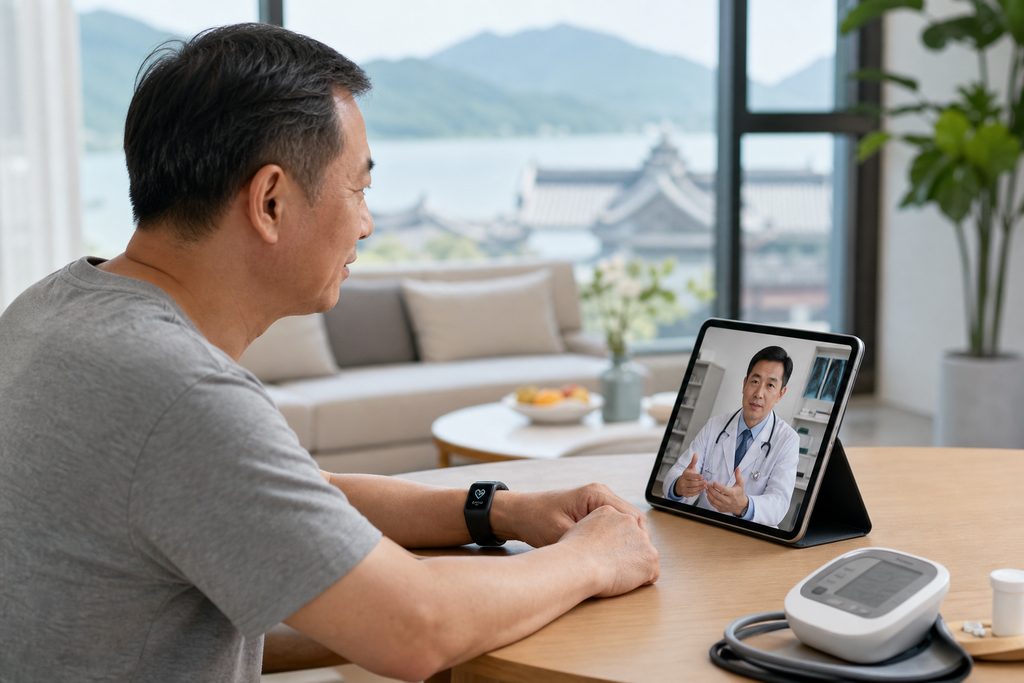
What Remote Follow-Up Actually Means
You flew home. The incision healed. Life moved on. But a question lingers — is everything still okay internally? Remote follow-up bridges the gap between your local doctor’s office and the operating theater in Shanghai or Beijing. It is not a casual video call. It is a structured clinical touchpoint where your Chinese surgical team reviews recent scans, labs, and your reported symptoms to assess long-term outcomes.
The core idea is continuity. A surgeon who has seen your anatomy firsthand holds context no new consultant can replicate from a written operative note alone. Our team has coordinated hundreds of these touchpoints. The process is simpler than most patients assume. But the details matter.
How This Actually Works, Step by Step
Most patients expect chaos. What they get is a surprisingly linear sequence. Here is the real flow, stripped of brochure language.
Step 1: You gather recent imaging and labs. Your local physician orders a CT, MRI, or blood panel — whatever the Chinese team specified in your discharge summary. Do not skip this. A video call without current data is just a conversation. Your surgeon needs numbers and pixels.
Step 2: You send everything to us. We handle the translation of reports and the formatting of DICOM files so they are readable on Chinese hospital systems. This step takes 2–3 business days depending on volume and complexity. Rush translation is available but rarely necessary for routine follow-up.
Step 3: The surgeon reviews your file. This is the bottleneck. Top specialists at hospitals like Zhongshan Hospital Fudan University or Peking Union Medical College Hospital are booked solid. A written second opinion review typically takes 5–7 business days. A scheduled video consultation may take 7–14 days to lock in, purely because of the surgeon’s clinical schedule.
Step 4: You connect. The session itself runs 20–40 minutes. The surgeon walks through the findings, compares them to your post-operative baseline, and dictates a follow-up plan. You get a written summary in English within 48 hours. Your local doctor gets a copy too, if you authorize it.
That is the skeleton. The muscle and sinew are in the preparation.
Telemedicine Follow Up After Surgery in China Cost: A Transparent Breakdown
Patients search for “telemedicine follow up after surgery in China cost” because the internet offers almost no straight answers. Here is what you actually pay, based on the service tier.
The price of a remote follow-up hinges on who reads your scans. A junior attending at a public hospital international department costs less. A sub-specialty chief who operates 400 times a year costs more. You are paying for the eyes on your file.
| Follow-Up Type | What You Get | Cost (USD) | Turnaround |
|---|---|---|---|
| Written Second Opinion (Standard) | One specialist reviews records, issues a written report | $300–500 | 5–7 business days |
| Video Consultation (Standard) | Live 20–40 min video session + written summary | $100–300 | 7–14 days to schedule |
| Top-Specialist Video Consultation | Live session with a department head or renowned sub-specialist | $500–800 | 10–21 days to schedule |
| Multidisciplinary Team (MDT) Review | 2+ specialists (e.g., surgeon + oncologist) review together; live session + integrated report | $1,500–2,000 | 14–21 days to schedule |
All prices are “from” figures. Final cost varies by hospital and case complexity. The written second opinion and video consultation fees carry a mechanism worth knowing: any amount you pay for remote evaluation is credited in full toward on-the-ground coordination if you return to China for further treatment within 90 days. This applies to the coordination service fee only, never to hospital treatment charges. It is a one-time credit designed so you never pay twice for access planning.
What is not included: the cost of getting new scans locally, courier fees for physical discs, and notarized translations if your home physician requires them for insurance. Budget an extra $100–300 for incidentals.
How to Do Remote Consultation with Chinese Surgeon After Returning Home
The mechanics of “how to do remote consultation with Chinese surgeon after returning home” are less about technology and more about institutional access. Chinese public hospitals do not list their senior surgeons on open telehealth platforms. You cannot download an app and book a professor at Huashan Hospital the way you might book a dermatologist on Teladoc.
Access runs through the hospital’s international department or a dedicated coordination service. Either way, someone needs to physically walk your file to the right office. The international department staff speak English. They handle scheduling, translation, and payment collection. But they are gatekeepers, not concierges. They will not chase a surgeon for you if the schedule slips. That is where a coordination team earns its keep — someone on the ground in Shanghai or Beijing who knows the department rhythm and can nudge without offending.
The practical checklist:
- Confirm your discharge summary specifies the recommended follow-up interval and imaging type.
- Get the imaging done at a facility that can export DICOM files on a CD or USB, not just a radiology report.
- Prepare a one-page symptom update in plain English. Be specific: “mild pulling sensation at the incision when bending forward” is useful. “I feel weird” is not.
- Send everything at least three weeks before you want the consultation. Lead time is everything.
One mistake we see often: patients wait until they feel a concerning symptom to initiate contact. By then, the 2–3 week scheduling window feels like an eternity. Book the follow-up when you feel fine. That way, the infrastructure is already warm if something changes.
A Realistic Timeline
Time compresses in the hospital. It stretches once you leave. Here is what a remote follow-up actually looks like on a calendar, including the hidden waiting periods most guides skip.
| Stage | What Happens | Typical Duration |
|---|---|---|
| Week 1 | You complete recommended imaging and lab work locally | 3–7 days (depends on local scheduling) |
| Week 2 | You send records to coordination team; translation and formatting begin | 2–3 business days |
| Week 3 | Records delivered to hospital international department; surgeon’s availability checked | 3–5 business days |
| Week 4–5 | Written review completed OR video consultation scheduled and conducted | 5–14 days |
| Week 5–6 | Written summary delivered; local physician integration if requested | 2–3 business days |
Total: roughly 4–6 weeks from the moment you decide to pursue follow-up to holding the final report. Urgent cases can compress to 2–3 weeks. But “urgent” means a clinical red flag, not travel anxiety. The system moves at the speed of a surgeon’s OR schedule, and no amount of money changes that.
What about the one-year mark? Many discharge protocols call for follow-up at 1 month, 3 months, 6 months, and 12 months post-operatively. Each touchpoint follows the same sequence. The 12-month follow-up often includes more extensive imaging — a contrast CT or MRI — and may warrant a top-specialist review if anything looks atypical.
Can My Doctor in My Country Coordinate with My Surgeon in China?
The short answer: yes, but not automatically. The question “can my doctor in my country coordinate with my surgeon in China” surfaces a real structural gap. Medical records do not cross borders unless someone carries them.
Most Chinese surgeons are willing to engage in peer-to-peer communication. They will review a colleague’s letter. They will respond to specific clinical questions. But they operate in a system that does not routinely integrate with foreign EMRs. Your local cardiologist cannot pull up your Fuwai Hospital operative note on Epic. The connection must be built manually each time.
What works: your local physician drafts a clinical query — “echo shows mild paravalvular regurgitation at 6 months; is this within expected range for the valve model implanted?” — and sends it as a PDF. We translate it, deliver it to the surgeon, and route the response back. This peer-to-peer loop adds about 5–7 business days to the standard follow-up timeline. It costs no extra fee beyond the underlying consultation tier.
What does not work: expecting real-time collaboration. Time zones, language, and hospital firewalls make live doctor-to-doctor calls impractical. Asynchronous written exchange is the norm. It is slower, but it creates a paper trail both sides can file.
For complex cases — oncology patients on multi-agent protocols, for instance — an MDT review that includes a summary explicitly addressed to the home physician is often the most efficient path. One integrated document, two audiences.
What Can Go Wrong — and What Happens Then
Honesty builds trust. Here are the failure modes we have seen, and what actually happens next.
The surgeon leaves the hospital. Chinese top-tier hospitals see constant faculty movement. A department chair may relocate to a private international hospital. If your surgeon has moved, the international department will typically assign another specialist from the same team who has access to your operative records. Continuity is preserved, but the personal relationship resets. We notify you before any handoff occurs.
The imaging is incompatible. Some local radiology centers export proprietary formats that Chinese PACS systems cannot read. The fix is tedious: we request the raw DICOM files, sometimes involving a direct call to the imaging center’s IT department. This adds 3–5 business days. Always ask for “standard DICOM format on physical media” when getting scans done for cross-border use.
The surgeon’s schedule collapses. A scheduled video consultation gets bumped by an emergency surgery. It happens. The international department reschedules, usually within 5–7 days. No additional fee. But the delay is real. Patients who book follow-up well before the clinically recommended window absorb these bumps without clinical risk.
The findings are ambiguous. The scan shows something — not clearly benign, not clearly pathological. The surgeon recommends a repeat scan in 3 months. This is not a failure of the follow-up; it is the follow-up doing its job. But it creates uncertainty. In these cases, we recommend looping in your local physician immediately so someone on the ground is tracking the watch-and-wait plan.
No system is frictionless. The measure of a good coordination service is not whether problems occur. It is whether someone answers the phone when they do.
What Is the Protocol for International Patients After Surgery in Shanghai?
Every hospital has a discharge protocol. But “what is the protocol for international patients after surgery in Shanghai” varies more by department than by city. The common thread is documentation.
Upon discharge, you should receive a sealed envelope or digital file containing: the operative report, the anesthesia record, the implant log if hardware was placed (valve serial number, graft type, screw dimensions), pathology results if tissue was sent, and a follow-up schedule. This packet is your passport for all future care, in China or at home. Guard it.
Shanghai hospitals like Ruijin Hospital and Zhongshan Hospital typically specify follow-up at 1, 3, 6, and 12 months for major procedures. The 1-month check is often in-person if you are still in the country. The 3-month and 6-month checks are commonly done remotely via the international department. The 12-month check may be recommended in-person, especially for orthopedic or cardiac procedures where imaging quality matters.
Beijing hospitals follow a similar rhythm. The phrase “book virtual check up with Beijing surgeon after medical travel” describes exactly what the international departments at Peking Union Medical College Hospital and Fuwai Hospital facilitate — a scheduled remote session that mirrors the in-person follow-up structure, minus the physical exam.
One Shanghai-specific nuance: some Pudong-based international private hospitals like Jiahui and Shanghai United Family offer hybrid follow-up. You do the imaging at a JCI-accredited facility in your home country that has a prior relationship with the hospital, and the Shanghai team reads it remotely. This costs more — expect $500–800 for the coordination and reading — but eliminates DICOM compatibility headaches.
Post Surgery Online Follow Up Packages China: What’s Actually Included
The term “post surgery online follow up packages China” suggests a productized offering. The reality is more bespoke. Most hospitals do not sell a “package” in the retail sense. They offer service tiers through their international departments, and coordination teams bundle the logistics around them.
A typical 12-month follow-up sequence for a cardiac surgery patient might look like this:
- Month 1: Written review of discharge labs and wound photos. $300.
- Month 3: Video consultation reviewing echocardiogram and ECG. $300.
- Month 6: Written review of repeat echo and stress test. $300.
- Month 12: Top-specialist video consultation with full imaging review. $500–800.
Total annual cost: roughly $1,400–1,700 for a structured follow-up cadence. This is not a prepaid package. Each touchpoint is scheduled and paid for individually. The advantage of this approach is flexibility — if the 3-month echo looks perfect, the 6-month touchpoint can be downgraded from video to written review, saving money without sacrificing clinical oversight.
Some private international hospitals are beginning to offer true bundled packages for specific procedures — orthopedic joint replacement and bariatric surgery lead this trend. A 12-month remote follow-up bundle might run $2,000–3,000 and include quarterly video consultations plus one priority re-evaluation if a concern arises. Ask during your initial hospital selection whether such bundles exist for your procedure type. They are not widely advertised.
Practical Considerations: Records, Language, and Insurance
Remote follow-up lives or dies on the quality of what you send. Grainy phone photos of a CT screen are useless. The surgeon needs the raw DICOM files — hundreds of thin-slice images, not a single summary frame.
Records: Request a CD or USB with DICOM files at the time of imaging. Do not leave the radiology center without it. Once you are home, uploading to a secure cloud folder is faster than couriering physical media. We provide a HIPAA-compliant upload link for all patients.
Language: All records submitted to a Chinese hospital international department must be in English or Chinese. If your local reports are in Arabic, French, or Russian, translation is required. Our team handles this as part of the coordination fee. Turnaround is 2–3 business days for standard medical translation.
Visa: If the remote follow-up identifies a need to return — a finding that warrants a physical exam or additional intervention — you will need an S2 visa for short-term medical travel. The hospital international department issues an invitation letter that supports the visa application. Processing time varies by consulate but averages 1–3 weeks. Do not book flights until the visa is in hand.
Insurance: Most international health insurance plans do not reimburse remote follow-up consultations with foreign providers unless the plan explicitly includes cross-border telehealth. Check your policy. If reimbursement is possible, we provide a detailed superbill with procedure and diagnosis codes. Payment to the hospital is upfront regardless; reimbursement is between you and your insurer.
Local physician integration: The single most underused resource in remote follow-up is the patient’s own primary care doctor. A local physician can perform the physical exam component — palpation, auscultation, wound inspection — and relay findings to the Chinese surgeon. This hybrid model (local hands, remote brain) often produces better clinical data than a video call alone. Ask your local doctor if they are willing to participate. Most are, especially when they receive the surgeon’s written summary afterward.
Frequently Asked Questions
A standard video consultation ranges from $100–300. A written second opinion from a top specialist runs $300–500. A video session with a department head or renowned sub-specialist costs $500–800. All prices are “from” figures and vary by hospital and case complexity.
Can my surgeon in China talk directly to my doctor at home?
Yes, through asynchronous written exchange. Your local physician
For more medical information and treatment options in China, visit chinamedservices.com (China Medical Services).
