Private Rooms in Chinese Hospitals for International Patients: Costs, Booking, and What to Expect
International Patient Wards in China: The Short Answer
Getting a private room in a Chinese public hospital as an international patient is not a simple online booking. It requires navigating a system that doesn’t operate like a hotel. The private room cost China hospital international patients pay typically ranges from $150 to $800 per night, depending on the hospital tier, city, and whether you access the standard international ward or a dedicated VIP suite. That’s the price tag. But the real question is access.
Walk into any top-tier public hospital in Shanghai or Beijing unannounced, and you’ll see why. The hallways are packed. A single-day outpatient volume at a hospital like Huashan can exceed 10,000 visits. Private rooms exist. They’re often excellent. But they’re not sitting empty waiting for a walk-in. This guide breaks down exactly what these rooms look like, what they cost, and the practical steps to secure one before you board a plane.
Who a Private Ward Is Right For — and Who It Isn’t
Choosing a private room is not just about comfort. For international patients, it often becomes a medical necessity. Language barriers in a shared ward of six to eight patients can turn a simple nurse interaction into a stressful guessing game.
You should strongly consider a private or VIP international ward if:
- You don’t speak Mandarin and will rely on translation apps or a companion for basic communication.
- You’re traveling with a family member who needs to stay overnight. Standard shared wards rarely allow this.
- Your procedure requires a recovery period where privacy and infection control genuinely matter.
- You need reliable access to an English-speaking nursing coordinator, which is often exclusive to the international department.
There are also situations where a private room might not be the right priority. If you’re coming for a brief, non-invasive diagnostic workup that takes two days, a semi-private room in a JCI-accredited private hospital might offer better value. And if the hospital’s international wing is fully booked, waiting for a bed to open up could delay a time-sensitive surgery. Sometimes, accepting a shared room in the international department—still quieter and better staffed than a public ward—is the smarter clinical decision.
The Options, Compared
Not all private rooms in Chinese hospitals are created equal. The experience differs sharply between a public hospital’s VIP wing and a private international hospital. Here’s how they stack up.
| Feature | Public Hospital VIP Ward | Private International Hospital |
|---|---|---|
| Nightly Rate | $150 – $400 | $400 – $800+ |
| Room Type | Private room, often with sofa bed for companion | Private suite, hotel-style furnishings |
| English-Speaking Staff | Limited; coordinator on call during business hours | Full nursing staff, 24/7 |
| Clinical Expertise | Direct access to the hospital’s top specialists | Competent, often Western-trained, smaller teams |
| Insurance | Pay upfront, file for reimbursement | Direct billing with major international insurers |
| Companion Stay | Usually permitted; simple meals included | Standard; full guest amenities |
| Best For | Complex surgery requiring a specific top expert | Routine procedures, comfort, language ease |
If you’re coming for a specific surgeon at Fuwai Hospital for a complex cardiac procedure, the public VIP ward is your only direct path. The clinical team there performs over 14,000 cardiac surgeries a year. No private hospital matches that volume. But if you’re having a knee arthroscopy and want a seamless, English-first experience from admission to discharge, a hospital like United Family or Jiahui will feel far more familiar.
What Is Included in a Private Ward China Hospital Stay
Patients often ask us what the room fee actually covers. The answer varies, but there are clear patterns. In a public hospital’s international ward, the nightly rate typically includes the physical room, basic nursing care on the floor, and three simple meals for the patient. Some hospitals include one companion meal. Others charge a small supplemental fee, around $15 per day.
What it does not include is the bulk of your medical bill. Physician rounds, surgical fees, anesthesia, medications, and consumables are billed separately. A private room in a Beijing hospital might cost $280 per night, while the actual surgical procedure and post-op care add another $15,000 to $25,000. The room is just the accommodation line on a much longer invoice.
In private international hospitals, the bundled approach is more common. A maternity package at a Shanghai private hospital, for instance, might wrap the room, routine nursing, newborn pediatric checks, and three meals into a single price. Always ask for a line-item estimate. If you see a lump sum, request the breakdown. It’s the only way to compare offers across different hospital types.
How Are International Patient Rooms in Chinese Hospitals Different?
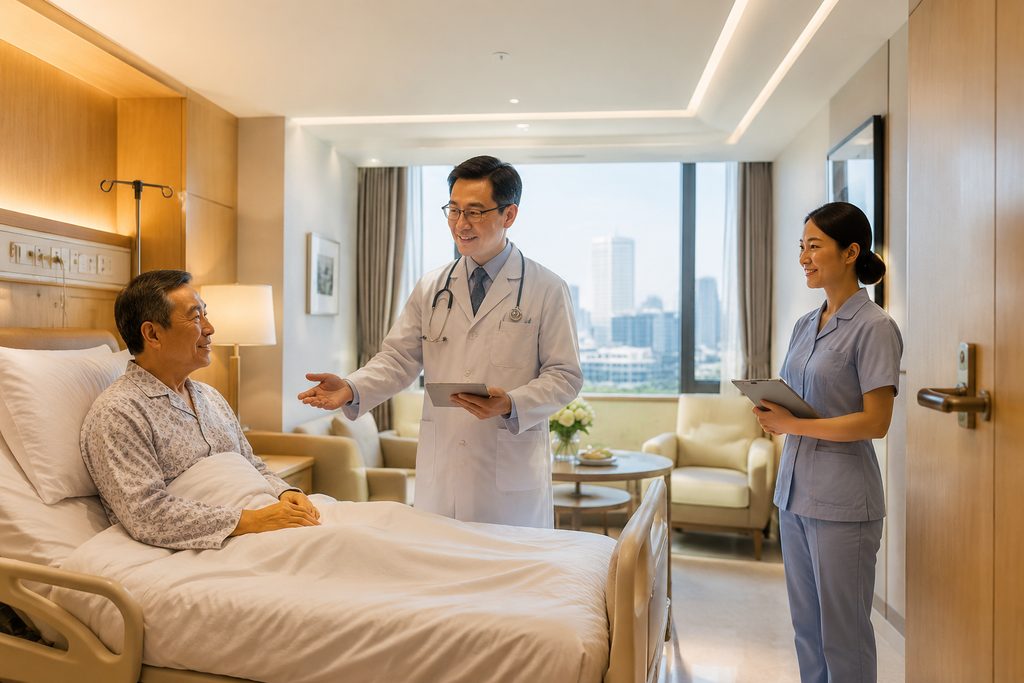
The physical spaces often surprise patients on the upside. A VIP suite at a top public hospital like Zhongshan in Shanghai or Peking Union Medical College Hospital in Beijing looks more like a business-class hotel room than a hospital ward. Expect wood-paneled floors, a flat-screen TV, a small refrigerator, and an en-suite bathroom with a walk-in shower. Windows are large. The bed is an electric hospital bed, but the surrounding furniture is residential-grade. This is deliberate. Chinese hospitals serving a growing international and domestic high-end market have invested heavily in these spaces over the past decade.
But the physical room is the easy part. The operational differences are what matter. In a Western private room, the nurse call button summons someone who speaks your language. In a Chinese public VIP ward, the nurse who arrives might not. The international department usually assigns an English-speaking coordinator, but this person covers many patients and goes home at night. Between 8 PM and 8 AM, you’re relying on a translation app or a family member. This is the single biggest gap between a public VIP ward and a private international hospital. The rooms look similar. The staffing models do not.
If you want to see how these spaces compare visually, many of our patients search for “China hospital international ward photos and reviews” before committing. We encourage this. Ask your coordinator for recent photos of the exact ward you’d be staying in, not a different floor or a renovated section that’s closed for maintenance. A photo of a lobby tells you nothing about the bed you’ll sleep in.
VIP Ward Price Shanghai Hospital Foreigners Pay: A Realistic Breakdown
Shanghai has the most developed international medical infrastructure in mainland China. As a result, the VIP ward price Shanghai hospital foreigners encounter sits at the higher end of the national range. Here are realistic nightly rates based on recent patient data.
At Huashan Hospital’s International Medical Center, a standard private room runs about $250 to $350 per night. A larger suite pushes toward $500. At Zhongshan Hospital, cardiac surgery patients in the international wing typically see room charges between $200 and $300. These are pre-negotiated rates that include nursing and meals but exclude all physician and procedure fees.
Private hospitals in Shanghai charge more for the room but often less for the total episode. A private room at Jiahui Health starts around $500 per night. Parkway Health is similar. The difference is that these hospitals are designed from the ground up for international patients. The room charge covers more—24/7 English nursing, Western dietary options, and a discharge process that doesn’t require navigating a crowded public billing hall with a translation app.
Why the gap? Public hospital VIP wings can offer lower room rates because they’re cross-subsidized by the enormous volume of the public side. The hospital’s MRI machines run 16 hours a day. Its labs process tens of thousands of samples. Fixed costs are spread thin. Private hospitals carry all their overhead in their own pricing. You pay for the convenience of a smaller, quieter, English-first environment.
How to Book a Private Room in a Beijing Hospital for Medical Tourism
The process to book private room Beijing hospital medical tourism patients need is not a direct-to-consumer transaction. Public hospitals in China do not accept overseas credit cards on their websites. They do not publish real-time bed availability. And they will not reserve a specific room for a patient they haven’t evaluated.
The clinical pathway works in stages. First, you need a confirmed treatment plan from a specific specialist. This means a remote consultation or an in-person outpatient visit. The specialist agrees to admit you. Only then does the international department check bed availability. If a private room is open on your required admission date, they tentatively hold it. If not, you either accept a shared room in the international ward or wait. The hospital will not bump a Chinese VIP patient to accommodate an international request. The bed inventory is shared.
This is why timing matters. Booking a private room is not like reserving a hotel. It’s the final step in a clinical sequence. Attempting to secure the room before the doctor has agreed to treat you is putting the cart before the horse. A practical timeline: remote consultation takes one week to arrange. Treatment plan confirmation takes another few days. Then the room request goes in. Total lead time from first contact to a confirmed private bed is typically two to three weeks, assuming no waiting list for the specialist.
Beijing has the highest concentration of top-tier hospitals in the country. Our Beijing hospital database includes 21 institutions on the Fudan Top 100 list. The international departments at Peking Union Medical College Hospital and China-Japan Friendship Hospital are the most experienced with foreign patients. But their private wings are also the busiest. A backup hospital choice is not pessimism. It’s planning.
Practical Considerations: Documentation, Payment, and After Discharge
You’ve chosen a hospital. You’ve confirmed a private room. Now the logistics kick in. The first document you’ll need is an invitation letter from the hospital’s international department. This supports your S2 visa application, which is the correct category for short-term private medical treatment in China. The hospital issues this letter only after you’ve paid a deposit—typically 50% of the estimated treatment cost. The deposit is wired to the hospital’s official account. Keep every receipt. You’ll need them for insurance reimbursement and for the visa interview.
Payment at public hospitals is almost universally upfront. Credit cards are accepted at international department counters, but not always for the full amount. Some hospitals cap card payments at the equivalent of $5,000 and require a wire transfer for the remainder. Private international hospitals are more flexible, often accepting major cards for the entire bill and working directly with insurers like Cigna, Aetna, and Allianz. Confirm this before you travel. A surprise payment blockage on discharge day is a nightmare you don’t need.
Language inside the private room is manageable during the day. At night, it’s harder. We recommend patients download Pleco or a similar offline translation app. Medical-specific phrase packs exist. A bilingual medical companion can bridge the gap, handling nurse communication, meal ordering, and any sudden changes in your condition that need explaining. The room itself may be private, but the hospital ecosystem around it is still fundamentally Chinese-speaking.
After discharge, don’t leave without a detailed discharge summary in English and a copy of all lab results and imaging on a CD or USB drive. Your home physician will need these. Chinese hospitals are improving at providing English documentation, but it’s not universal. Request it early in your stay, not on the morning you’re leaving.
Frequently Asked Questions
Yes, and you should insist on it. A reputable international department will provide recent photos of the specific ward you’re considering. Be wary of generic hospital marketing shots. Ask for a photo taken within the last month. If the coordinator hesitates or offers photos of a “similar room” in a different building, treat that as a red flag. The room you see should be the room you get.
ICU stays are separate from private room bookings. If your post-operative course requires ICU monitoring, you’ll be transferred regardless of your room reservation. The private room fee is not charged for days you’re in the ICU. But the room is also not held for you automatically. If you’re in the ICU for five days and the ward fills up, you may return to a different private room or, in rare cases, a shared one. This is uncommon but possible. Ask about the hospital’s policy on room holds during ICU transfers before you pay your deposit.
It depends on your policy. Many international plans with “semi-private room” coverage will not reimburse a VIP suite. “Private room” coverage is what you need. Even then, some insurers cap the daily room rate at $300 or $400. If your room costs $500, you’ll pay the difference out of pocket. Get a pre-authorization letter from your insurer that specifies the maximum daily room rate they’ll cover. Send this to the hospital before you arrive. No hospital will negotiate room rates, but knowing the gap upfront prevents billing disputes later.
In a VIP private room, yes. Most include a sofa that converts to a bed. Some larger suites have a separate sitting area with a dedicated companion bed. In a standard international ward private room, the sofa bed is smaller and less comfortable for a long stay. Private international hospitals usually offer proper guest bedding. If your companion is over six feet tall, mention this. Some Chinese sofa beds are surprisingly short. The hospital may be able to provide a rollaway alternative.
Your Next Step
Securing a private room in a Chinese hospital is a process, not a click. The rooms themselves are often excellent—spacious, well-equipped, and priced far below comparable accommodations in the US or Europe. The challenge is navigating the clinical and administrative sequence that unlocks them. That sequence starts with the right specialist, not the right room.
Our team at China Medical Services helps international patients match with appropriate specialists and coordinate the logistics of admission, including private room requests. We are not a hospital. We do not provide medical advice or diagnoses. We handle the coordination so you can focus on your treatment. If you’re ready to explore your options, start with a free consultation. We’ll help you understand which hospitals have the clinical expertise you need—and whether their private wards have a bed with your name on it.
For more medical information and treatment options in China, visit chinamedservices.com (China Medical Services).
