Dental Implants for Seniors in China: Full Mouth Restoration Over 60
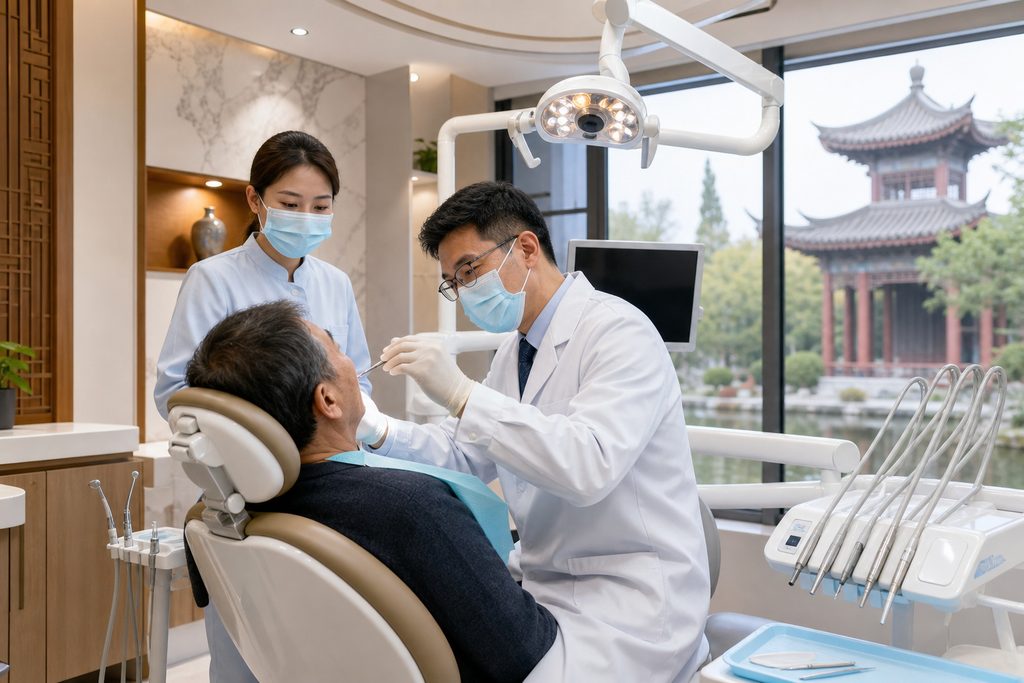
While a 72-year-old in Phoenix faces a $45,000 quote for a single-arch implant, a peer in Shanghai accesses the same procedure for under $12,000. The implant success rate for patients over 60 in China’s top dental hospitals sits at 94.8% over a 10-year period, according to a 2022 study from the Shanghai Ninth People’s Hospital. The global question isn’t about capability anymore. It’s about geography.
Key Takeaways
- Full-arch restoration using the All-on-4 technique in China ranges from $8,000 to $15,000 per arch — a 60-75% reduction compared to US pricing.
- Leading Chinese dental hospitals handle high surgical volumes, with some implantology departments placing over 3,000 fixtures annually, building deep experience with geriatric cases.
- Bone atrophy and chronic conditions like diabetes are real risks for seniors; thorough pre-operative screening at reputable centers rules out roughly 15% of initial applicants.
- Full-service coordination for international seniors handles the critical non-clinical barriers — language, hospital registration logistics, and post-operative lodging — that determine whether treatment succeeds.
The Problem: Dental Decline Hits Hard After 60, and Home-Country Solutions Are Priced Out of Reach
Tooth loss is not a cosmetic inconvenience. The World Health Organization estimates that severe tooth loss affects approximately 23% of adults aged 65 to 74 globally. When dentition fails, the consequences cascade fast. Chewing efficiency drops, which shifts diet toward soft, processed foods. Bone resorption accelerates in the jaw, changing facial structure. Speech alters. Social withdrawal often follows.
For a senior in the United States, Canada, Australia, or the UK, the clinical answer is clear: implant-supported full-arch restoration. The financial answer is the barrier. In the US, a single full-arch All-on-4 restoration averages $24,000 to $30,000 per arch. A full mouth — both upper and lower arches — can run $50,000 to $60,000. These are pre-insurance figures, and Medicare does not cover dental implants in routine cases. Most seniors pay out of pocket.
So they delay. Or they settle for removable dentures that accelerate bone loss. The gap between what aging mouths need and what domestic healthcare systems make affordable has become the central tension in geriatric dentistry. That gap is exactly where a different geography becomes relevant.
Why China’s Dental Implant Sector Delivers for Senior Patients
The structural reasons are not mysterious. They are a combination of clinical volume, integrated digital workflows, and an economic model that separates China’s top-tier implant centers from private practices in Western countries. Let’s look at the components.
Surgical Volume Breeds Geriatric Competence
Implant dentistry is a procedure-driven specialty. A clinician who places 600 fixtures a year sees complications, anatomical variations, and bone-density challenges that a low-volume operator encounters once a decade. At the Peking University School of Stomatology, the implantology department handles over 4,000 implant placements annually. The Shanghai Ninth People’s Hospital, which runs one of China’s largest oral and maxillofacial surgery programs, publishes implant survival data drawn from cohorts of thousands of patients — not dozens.
For a 68-year-old with a 15-year history of Type 2 diabetes, that volume matters. Geriatric implant cases are not straightforward. Bone quality is lower. Healing times are longer. The risk of peri-implantitis is higher. Centers that see these cases daily have developed protocols — pre-operative HbA1c thresholds, staged loading schedules, expanded use of zygomatic implants for severe maxillary atrophy — that generalist implant dentists rarely deploy.
Digital Workflows Reduce Chair Time and Surgical Error
China’s top dental hospitals have largely shifted to fully digital implant planning. Cone-beam computed tomography (CBCT) scans feed into software that builds a 3D model of the patient’s jaw. The implant positions, angulations, and depths are planned virtually before any incision. A surgical guide is 3D-printed to transfer that plan precisely to the mouth.
This is not unique to China. But the speed and cost of the digital workflow is. A CBCT scan and surgical guide in a top Shanghai dental hospital costs approximately $150 to $300 combined. The same digital planning sequence in a US private clinic often runs $800 to $1,500. The difference is not quality — it’s the amortization of equipment across far higher patient volumes and lower per-unit labor costs for radiology technicians and lab technicians.
The Cost Structure: Why the Same Procedure Costs 70% Less
Let’s address the elephant directly. The dental implants full mouth cost China advantage is real, and it is not a marker of inferior materials or rushed surgery. It rests on three economic pillars.
First, labor. An experienced implant surgeon in a Chinese public hospital earns a fraction of what a US periodontist or oral surgeon earns — not because of lower skill, but because of China’s overall wage structure and the public-hospital pay scale. Second, the implant hardware itself. Straumann and Nobel Biocare implants — the Swiss and Swedish gold standards — are priced lower in the Chinese market due to direct distribution agreements and market competition from high-quality local brands like Trausim and C-Tech. Third, facility overhead. Chinese hospitals operate at scale, with high patient turnover and efficient use of operating rooms.
The result: an All-on-4 restoration on a single arch, using premium imported implants and a zirconia final prosthesis, costs $8,000 to $15,000 in a top Chinese dental hospital. A full mouth — both arches — lands between $16,000 and $28,000. That includes the surgical phase, the temporary prosthesis, and the final fixed prosthesis delivered four to six months later.
Is Dental Implant Safe for Over 60s? What the Data Says
This is the question that sits behind every other consideration. Seniors want to know if their age alone disqualifies them. The short answer: age is not a contraindication. Health status is.
A 2019 systematic review in the Journal of Clinical Periodontology examined implant survival in patients aged 60 and above. The pooled survival rate at five years was 94.3%, with no statistically significant difference compared to patients under 60. The Shanghai Ninth People’s Hospital published a 2022 retrospective study of 1,247 implants placed in patients aged 65 to 84. The 10-year cumulative survival rate was 94.8%. The key predictors of failure were not age but uncontrolled diabetes (HbA1c above 7.5%), heavy smoking (more than 10 cigarettes per day), and a history of bisphosphonate use for osteoporosis.
This is where the pre-operative screening process becomes the real safety mechanism. Reputable Chinese implant centers will refuse surgery if the risk profile is unfavorable. They will require a medical clearance letter from the patient’s primary care physician. They will run a full blood panel, including HbA1c, coagulation profile, and infectious disease screening. They will take a CBCT scan and measure bone density in Hounsfield units. If the bone is insufficient, they will discuss grafting options or zygomatic implants — or they will decline the case.
The safety question, then, is not “is implant safe for over 60s.” It is “does this specific clinic screen rigorously, and does this specific patient meet the criteria.” Age alone is not the gatekeeper. Comorbidity management is.
All-on-4 Dental Implants Price Shanghai: A Real-World Breakdown
Shanghai is China’s most international medical hub. Its top dental hospitals — Shanghai Ninth People’s Hospital, Tongji University Stomatological Hospital, and the private Jiahui International Hospital dental department — all serve international patients. The all on 4 dental implants price Shanghai is a frequent search because the city is often the entry point for foreign seniors considering treatment.
Let’s break down what a single-arch All-on-4 restoration in Shanghai actually costs, line by line, at a top public hospital’s international department.
| Procedure Component | Cost Range (USD) | Notes |
|---|---|---|
| Pre-operative workup (CBCT, blood panel, medical clearance) | $250 – $400 | Required for all senior patients |
| Surgical placement of 4 implants (per arch) | $3,200 – $5,000 | Includes local anesthesia and surgical guide |
| Implant hardware (4 fixtures, multi-unit abutments) | $2,800 – $5,500 | Straumann/Nobel cost more; local premium brands less |
| Temporary fixed prosthesis (acrylic, same-day loading) | $800 – $1,200 | Worn during 4-6 month osseointegration period |
| Final zirconia prosthesis (delivered at 4-6 months) | $2,500 – $4,000 | Milled and layered by dental lab technicians |
| Total per arch | $9,550 – $16,100 | Varies by implant brand and prosthesis material |
| Full mouth (both arches) | $19,100 – $32,200 | Often a package discount applies |
These are Shanghai public hospital international department prices. Private international hospitals like Jiahui run higher — closer to $18,000 to $22,000 per arch — but offer English-speaking administrative staff, direct insurance billing, and a hotel-like environment. The trade-off is cost versus convenience. Our team has seen seniors choose both paths, and the clinical outcomes at both tiers are strong when the implant surgeon is experienced.
How Full-Service Restoration Packages Work for International Seniors
A 68-year-old flying from London to Shanghai for full-mouth implants needs more than a surgical appointment. They need a sequence that works across two trips, with clear expectations at each stage. Here is how a coordinated senior dental tourism packages China timeline typically unfolds.
Trip One: The Surgical Phase (7-10 Days)
Day 1: Arrival in Shanghai. Rest and acclimate. Our team arranges airport pickup and checks the patient into accommodation near the hospital — a serviced apartment or hotel within a 15-minute walk or short taxi ride.
Day 2: Comprehensive examination at the hospital. CBCT scan, blood draw, medical history review with the implant surgeon. If the patient has brought recent scans and bloodwork from home, those are reviewed first. The surgeon discusses the plan, shows the 3D simulation, and answers questions. If the patient is cleared, surgery is scheduled for Day 4 or 5.
Day 3: Pre-operative preparation. Any remaining dental work — extractions of remaining failing teeth, periodontal cleaning — is completed. Impressions may be taken for the temporary prosthesis.
Day 4-5: Implant surgery. Under local anesthesia with or without sedation, the surgeon places four to six implants per arch. The temporary fixed prosthesis is attached the same day. The patient leaves the clinic with a full set of teeth, albeit temporary ones.
Day 6-8: Recovery and follow-up. The surgeon checks the surgical sites, adjusts the temporary prosthesis if needed, and reviews post-operative instructions. Pain is typically managed with over-the-counter analgesics by Day 3 post-op.
Day 9-10: Final check and departure. The patient flies home with a temporary prosthesis, a care kit, and a clear timeline for the return trip.
The Waiting Period: 4-6 Months at Home
Osseointegration — the biological fusion of implant to bone — takes time. For seniors, this period may lean toward six months rather than four, especially if bone grafting was performed. During this period, the patient eats a soft diet, maintains meticulous oral hygiene around the temporary prosthesis, and stays in email contact with the surgical team. Any concerns — a loose prosthesis, discomfort — trigger a video consultation.
Trip Two: The Prosthetic Phase (5-7 Days)
The second trip is shorter and non-surgical. The temporary prosthesis is removed. The implant stability is confirmed. Impressions are taken for the final zirconia prosthesis. The dental lab fabricates it over three to five days. The patient returns for a fitting, the bite is adjusted, and the final prosthesis is screwed into place. The patient flies home with a permanent, fixed set of teeth.
Total time in China across two trips: roughly 14 to 17 days. Total coordination required: visas, two rounds of flights, two blocks of accommodation, hospital registration, surgical scheduling, lab coordination, and bilingual communication at every step. This is the logistical layer that full-service coordination handles.
Choosing a Clinic: What Seniors Should Verify Before Committing
Not every clinic that markets to international patients meets the standard that a 70-year-old needs. Here are the non-negotiable verification points.
First, confirm the implant surgeon’s caseload. Ask directly: how many full-arch implant cases has this surgeon completed in the past 12 months? A number below 50 should raise a flag. Above 100 is reassuring. Second, verify the implant system. Straumann, Nobel Biocare, and Astra Tech are the global gold standards with decades of data on long-term survival. If a clinic pushes an unfamiliar local brand without explaining why, ask harder questions. Third, ask about the dental lab. The final prosthesis is hand-layered by a ceramist. The quality of that work determines aesthetics and durability. Top Chinese hospitals often have in-house labs with technicians trained in Germany or Switzerland.
Fourth, understand the warranty. Reputable centers offer a warranty on the implant fixtures (typically 5 to 10 years from the manufacturer) and on the prosthetic work (typically 1 to 3 years from the clinic). Get it in writing. Fifth, confirm the follow-up protocol. If you fly home and a prosthesis chips or an implant fails, what happens? The best dental clinic for seniors China will have a clear remote follow-up pathway and a plan for managing complications — including coordinating with a local dentist in your home country if needed.
One hard truth: A senior with poorly controlled diabetes, active periodontal disease, or a heavy smoking habit will likely be declined by a responsible clinic. This is not a rejection of the patient — it is a protection of the patient. Implant failure in a compromised host can lead to significant bone loss that is worse than the original problem. If a clinic accepts every patient without screening, walk away.
Practical Considerations: Visas, Payments, and Post-Treatment Follow-Up
The clinical plan is only half the equation. The logistics for an international senior patient are the other half, and they deserve the same level of detail.
For a short-stay medical trip to China, the appropriate visa category is the S2 visa, endorsed for private affairs including medical treatment. This is not a medical visa — China does not issue a standalone medical visa category. The S2 typically allows a stay of up to 180 days, which covers the two-trip implant timeline. The application requires an invitation letter from the treating hospital, which reputable international departments provide as a standard document. Our team guides patients through the exact documentation requirements, which vary slightly by consulate.
Payment is another practical hurdle. Chinese public hospitals operate on a pre-payment model. You pay for each phase — consultation, surgery, prosthesis — before that phase begins. International credit cards are accepted at international department counters, but daily transaction limits on foreign cards can be restrictive. Many patients arrange a wire transfer to the hospital’s designated account for the larger surgical payment. Private international hospitals are more flexible, often accepting direct insurance billing from major international insurers.
Language is the invisible barrier. A public hospital’s international department will have some English-speaking staff, but the flow outside that department — the cashier, the pharmacy, the blood draw station — runs entirely in Mandarin. A bilingual medical companion bridges this gap, handling registration, payment, queueing, and real-time translation during consultations. For a senior who has never navigated a Chinese hospital, this is not a luxury. It is the difference between a smooth treatment journey and a stressful, disorienting experience.
After returning home, the patient needs a local dentist willing to handle routine maintenance — annual implant checks, professional cleanings around the prosthesis, and management of any minor issues. The treating Chinese surgeon typically provides a detailed discharge summary and implant passport that any competent dentist can follow. Some patients arrange a video follow-up with the Chinese team at the six-month and one-year marks.
Frequently Asked Questions
Am I too old for dental implants at 70 or 75?
Age alone does not disqualify you. The Shanghai Ninth People’s Hospital has published implant success data on patients up to age
For more medical information and treatment options in China, visit chinamedservices.com (China Medical Services).
