Getting Cancer Treatment in Guangzhou China: Our On-Ground Companion and Hospital Match Service
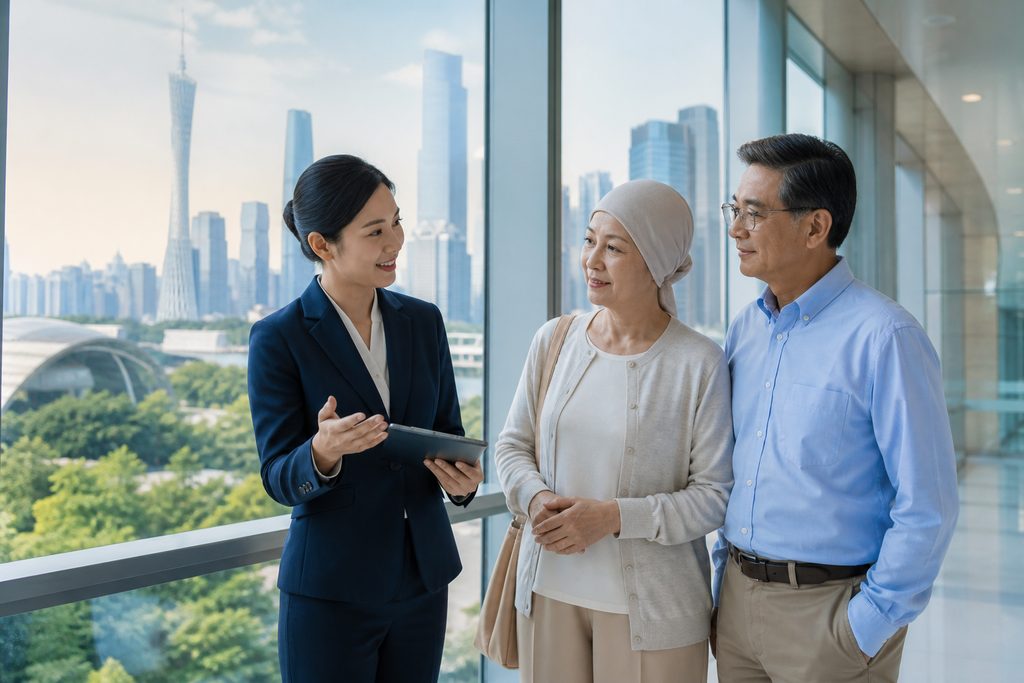
While a course of standard chemotherapy in the United States can easily exceed $30,000 per month, the same drug protocols at a top-tier Guangzhou hospital often start from $3,000. That gap is not a marker of lower quality. It reflects a fundamentally different economic structure. Our team has walked these hospital corridors. We know what that price difference actually buys you—and what it does not.
Key Takeaways
- A single chemotherapy cycle in Guangzhou can cost 80-90% less than in the US, with many drugs priced identically to their Western equivalents but without the facility-fee markups.
- Guangzhou hosts 10 hospitals ranked in the Fudan Top 100, including a dedicated cancer center whose annual patient volume dwarfs most Western institutions.
- Language and process navigation—not clinical quality—is the primary barrier. A standard public hospital registration desk does not operate in English, and an S2 visa requires specific hospital documentation.
- You cannot book a surgery package online like a hotel room. Legitimate treatment starts with a written second opinion and a video consultation, never a shopping cart.
The Problem: A Price Tag That Dictates Your Options
A 2024 study published in the Journal of Clinical Oncology tracked the financial toxicity of cancer care across 9 countries. The United States led every metric of patient bankruptcy risk. More than 42% of patients depleted their entire life savings within two years of diagnosis. The numbers are not abstract. They are a monthly invoice that arrives when you are too sick to work.
That same study found that direct medical costs in China, even at elite centers, averaged a fraction of the US burden. The reason is not a secret. Chinese public hospitals operate on a high-volume, low-margin model. A medical oncologist at Sun Yat-sen University Cancer Center may see 80 patients in a morning. The system is built for throughput, not for hand-holding. And that is precisely where the foreign patient gets stuck.
You cannot call the hospital and book an appointment in English. You cannot send an email and receive a treatment plan. The gate is open, but the path to it is not marked in any language you can read.
Why Guangzhou’s Oncology Ecosystem Delivers Results
Guangzhou is not a single-hospital town. It is a dense medical ecosystem that treats patients from across Southeast Asia, the Middle East, and increasingly, North America. The city’s top cancer center handles over 400,000 outpatient visits annually. That volume is not just a statistic. It means the oncologist reviewing your case has likely seen your exact subtype and mutation profile more times this month than a community oncologist in a Western suburb sees in a year.
Clinical Volume Drives Pattern Recognition
A thoracic surgeon at a major Guangzhou center performs roughly 300 lung cancer resections per year. The average American thoracic surgeon performs around 50, according to Society of Thoracic Surgeons database figures. Volume correlates with lower complication rates. This is not a theory. It is a well-replicated finding in surgical oncology literature spanning two decades.
For the patient, this means something concrete. When a tumor board in Guangzhou reviews your imaging, they are drawing on a collective experience pool that is simply larger than what most Western centers can offer. That matters most in complex cases—recurrent disease, rare mutations, patients who have failed first-line therapy.
The Real Cancer Treatment Cost Guangzhou Patients Face
Let us address the question everyone asks first. The cancer treatment cost Guangzhou hospitals charge foreign patients varies by drug, duration, and hospital tier. But the structural difference is consistent. A cycle of pembrolizumab (Keytruda) that bills at $15,000 in the US costs approximately $4,800 at a Guangzhou public hospital international wing. Chemotherapy regimens like FOLFOX or CHOP run between $800 and $2,500 per cycle.
The savings come from three sources. First, drug pricing—China’s national volume-based procurement negotiations have slashed prices on many oncology drugs by 50-70% since 2018. Second, physician labor costs are structurally lower. Third, hospital facility fees, which can triple a US bill, are minimal in the Chinese public system.
You should not interpret these numbers as a guarantee. They are benchmarks our team has observed across dozens of cases. Your specific cost depends on your regimen, your hospital choice, and whether you use the standard public channel or the international VIP department.
| Treatment | US Average Cost (USD) | Guangzhou Range (USD) |
|---|---|---|
| Chemotherapy (per cycle, standard regimen) | $10,000 – $30,000 | $800 – $2,500 |
| Immunotherapy (Keytruda, per cycle) | $15,000 | $4,800 |
| Radiation therapy (full course, IMRT) | $25,000 – $50,000 | $6,000 – $12,000 |
| Lung cancer resection (VATS lobectomy) | $35,000 – $55,000 | $8,000 – $15,000 |
| PET-CT scan | $3,000 – $6,000 | $400 – $800 |
Ranges reflect international patient pricing at public hospital international departments and private international hospitals. Actual costs vary by hospital and case complexity. These are reference figures, not quotes.
Matching Your Case to the Right Hospital: Not Every Top-Ranked Center Is Right for You
This is where the “best hospital” question breaks down. The best cancer hospital China for foreigners is not a single institution. It is the one whose department chair has published on your exact mutation. It is the center running a clinical trial that matches your resistance profile.
Guangzhou’s Fudan-ranked oncology strength concentrates in a few key centers. Sun Yat-sen University Cancer Center ranks among China’s top 10 for oncology. Its nasopharyngeal carcinoma program is a global reference center—this cancer is rare in the West but common in Southern China, so the experience pool is unmatched. The center’s hepatobiliary surgery team performs over 1,000 liver resections annually.
Nanfang Hospital, another Guangzhou powerhouse, runs a hematology program that is a national referral center for complex leukemias. Guangdong Provincial People’s Hospital leads in thoracic surgery and interventional radiology. The point is this: you do not pick the hospital. You pick the department and the specific team.
Our team maps your diagnosis, staging, and molecular profile against the actual subspecialty strengths of these departments. We do not send a lung cancer patient to a hospital famous for liver surgery just because it is highly ranked. That sounds obvious. It is not how most medical tourism referrals work.
How to Get Cancer Treatment in Guangzhou as a Foreigner: The Process No One Writes Down
There is a persistent myth that you can book a cancer treatment package China hospitals supposedly offer, like an all-inclusive resort. That is not how Chinese public hospitals operate. You cannot pay a flat fee online and show up for surgery. The legitimate path is more deliberate, and it exists to protect you from bad decisions made in desperation.
The process starts with a written second opinion. You send your existing medical records—pathology reports, imaging, treatment history, genetic testing results. The relevant department reviews them. A senior oncologist provides a written analysis: whether they agree with your current diagnosis and treatment plan, what alternatives they would consider, and whether they recommend coming for in-person evaluation.
This step alone filters out cases that should not travel. Sometimes the best advice is: stay where you are, your current treatment is appropriate. We have seen that happen. It is not a lost opportunity. It is an honest answer that saves you a trans-Pacific flight.
If the written opinion recommends coming, the next step is a video consultation. You speak directly with the treating team. You ask your questions. They explain their reasoning. Only after this conversation, with a clear recommendation in hand, do you make travel decisions.
Visa reality check: Medical treatment in China requires an S2 visa. Not an M visa—that is for commercial business. The hospital must provide a formal invitation letter and treatment confirmation. Our team guides you through the documentation, but we never guarantee visa approval. That decision rests solely with the Chinese embassy or consulate reviewing your case.
What a Medical Tourism Companion Service Actually Does on the Ground
You cannot legitimately book cancer treatment package China hospitals as a fixed-price product online. Any website offering a one-click purchase for a surgery or chemotherapy package is not representing a reputable Chinese public hospital. The legitimate path is a written second opinion, followed by a video consultation, followed by an in-person evaluation. Only after that evaluation will the hospital provide a treatment plan and cost estimate. Anyone promising otherwise is selling something that does not exist.
This happens more often than you might expect. The Chinese team may recommend a different chemotherapy regimen, a surgical approach your home team considered too aggressive, or a clinical trial that is open in China but not in your country. You are not obligated to follow their recommendation. You take their written opinion back to your home oncologist and make a joint decision. Our role is to ensure you understand both perspectives clearly. We do not push you toward one or the other.
Look at the Fudan University hospital rankings, which are China’s most authoritative. Guangzhou has 10 hospitals in the national Top 100, and Sun Yat-sen University Cancer Center ranks in the top 10 nationally for oncology. These rankings are based on peer reputation and clinical output, not marketing budgets. You can verify this independently on our top hospitals database. Cross-reference with published research output in PubMed. The top centers publish heavily in international journals. If a hospital has no English-language research footprint, walk away.
A hospital can decline to treat if, after in-person evaluation, they determine your case is not appropriate for their services—if you are too ill to travel safely, if your disease has progressed beyond what they can meaningfully treat, or if the written second opinion was based on incomplete records that gave a misleading picture. This is rare when the written opinion and video consultation steps are followed properly, but it is not zero. That is why we never advise patients to buy non-refundable tickets before the video consultation is complete and the treating team confirms they will accept the case.
Your Next Step
The decision to pursue cancer treatment in a foreign country is never easy. It sits at the intersection of hope, fear, and practical logistics. Our team does not make the decision for you. We make sure that when you do decide, you are working with accurate information, the right hospital for your specific diagnosis, and a clear understanding of what the process actually looks like on the ground. If you would like to explore whether Guangzhou is a viable option for your case, you can start with a free consultation through our patient companion service page. There is no obligation. There is no sales pitch. There is just an honest assessment of whether this path makes sense for you.
Frequently Asked Questions
Yes. The hospitals used for international patients are JCI-accredited and follow the same international safety standards as top hospitals in the US and Europe. Surgical teams perform high volumes of procedures — often more than their Western counterparts — which studies show leads to better outcomes.
Costs vary by procedure and hospital, but international patients typically save 40-80% compared to US prices — even when factoring in travel and accommodation. A consultation with our team will give you an exact, all-inclusive quote with no hidden fees.
Send us your existing medical reports to get started. We handle everything from hospital selection and appointment scheduling to visa assistance and post-operative recovery planning. Your medical records are reviewed by the specialist before you even book a flight.
For more medical information and treatment options in China, visit chinamedservices.com (China Medical Services).
