IVF Success Rates in China: Our Service Reviews Your Chances
Key Takeaways
- China’s top reproductive centers report live birth rates per embryo transfer of 45–55% for women under 35, comparable to leading US and European clinics.
- IVF cost China runs $4,000–$9,000 per standard cycle at public hospital international departments, versus $15,000–$25,000 in the United States.
- Language barriers and hospital navigation are the biggest practical hurdles for foreign patients — not clinical quality.
- Success depends far more on your age, embryo quality, and specific diagnosis than on which country you choose.
Have you ever stared at a spreadsheet of IVF prices and wondered whether the numbers even mean anything without knowing your actual odds? That question sits at the center of every serious fertility decision. The short answer: China offers IVF success rates that match Western benchmarks, at roughly one-third the cost. But your individual chances depend on data you already carry — your age, your ovarian reserve, your diagnosis. What a service review can do is translate those numbers into something you can act on.
This article breaks down what the published data actually shows, how Chinese clinics compare, what a realistic IVF cost China looks like, and how we help patients evaluate their specific situation before committing to travel.
The Problem: IVF Abroad Is Priced Like a Luxury, Not a Medical Necessity
A single IVF cycle in the United States now averages between $15,000 and $25,000 before medication, according to data compiled by the American Society for Reproductive Medicine. In the United Kingdom, the National Health Service restricts funded cycles by postcode and age, leaving many patients to pay £5,000–£8,000 privately. In Australia, out-of-pocket costs after Medicare rebates still run AUD $5,000–$10,000 per cycle. These are not one-time expenses. Most patients need two to three cycles to achieve a live birth.
That is the quiet crisis in fertility care: the treatment works, but the cumulative cost pushes it out of reach. A 2023 study published in Fertility and Sterility found that 38% of American patients reported delaying or abandoning IVF solely due to cost. The same study noted that patients who financed treatment through loans reported significantly higher stress scores than those who paid upfront.
Meanwhile, the clinical gap between “expensive” and “affordable” countries has narrowed dramatically over the past decade. China’s top reproductive medicine departments now operate the same blastocyst culture systems, time-lapse incubators, and preimplantation genetic testing platforms used in Boston or London. The difference is not technology. It is labor economics, facility overhead, and market pricing.
Why China Delivers Comparable IVF Outcomes at a Fraction of the Price
Clinical Volume Creates Reproducible Expertise
Large Chinese reproductive centers treat patient volumes that dwarf most Western clinics. A top-tier center in Shanghai or Beijing may complete 5,000–8,000 IVF cycles annually. By comparison, the average US fertility clinic performs fewer than 500 cycles per year, according to CDC reporting data. Volume matters in IVF. Embryologists who handle thousands of cases annually develop the kind of procedural consistency that directly affects fertilization rates, blastocyst formation, and cryopreservation outcomes.
The best fertility clinic Shanghai patients seek out typically operates within a university-affiliated hospital system. These departments publish their outcomes in peer-reviewed journals and participate in national quality registries. That transparency is not universal in China — which is exactly why clinic selection matters more than country selection.
Technology Parity Without the Marketing Premium
Chinese academic medical centers adopt assisted reproductive technologies on timelines that match Western adoption curves. Intracytoplasmic sperm injection, vitrification, time-lapse embryo monitoring, and preimplantation genetic testing for aneuploidy are all standard offerings at top centers. The equipment is the same — mostly imported from Japanese, German, and American manufacturers.
What is different is the cost structure. A Chinese embryologist’s salary is a fraction of a US counterpart’s. Hospital real estate in second-tier Chinese cities costs dramatically less than in Manhattan or San Francisco. Those structural savings flow directly into the price of a cycle.
How Much Is IVF Abroad? The Cost Gap Is Structural, Not a Quality Discount
Patients often ask us whether lower prices mean lower standards. The honest answer is no — but you must choose the right hospital tier. China’s healthcare system is stratified. Public hospital international departments serve foreign patients with English-speaking coordinators and Western-style private rooms, at prices 1.5–2 times the standard domestic rate. Even at that premium, the math still works in your favor.
| Cost Item | China (International Dept.) | United States | United Kingdom (Private) |
|---|---|---|---|
| Standard IVF cycle (excl. meds) | $4,000–$7,000 | $12,000–$18,000 | £4,000–£6,500 |
| Medications per cycle | $1,500–$2,500 | $3,000–$6,000 | £800–£1,500 |
| ICSI add-on | $500–$1,000 | $1,500–$2,500 | £800–£1,200 |
| PGT-A (up to 8 embryos) | $2,000–$3,500 | $4,000–$7,000 | £2,500–£4,000 |
| Frozen embryo transfer | $1,500–$2,500 | $3,500–$5,000 | £1,500–£2,500 |
Prices vary by hospital and case complexity. These are reference ranges, not quotes. But the pattern holds across every line item: you pay roughly one-third of US prices for clinically equivalent care.
China IVF Success Rates by Age: What the Data Actually Shows
Any clinic that promises you a specific success percentage is selling something. IVF outcomes are probabilistic, and the single biggest variable is the age of the person providing the eggs. Chinese reproductive centers report outcomes using the same metrics as Western registries: clinical pregnancy rate per transfer and live birth rate per transfer.
For women under 35 using their own eggs, published live birth rates per fresh embryo transfer at top Chinese centers typically run 45–55%. At ages 35–37, that figure drops to 35–42%. At 38–40, expect 20–30%. Over 40, the range is 8–15% per transfer with own eggs. These numbers align closely with SART (Society for Assisted Reproductive Technology) data from the United States and HFEA data from the United Kingdom.
What shifts the odds is embryo selection. Patients over 35 who use PGT-A to screen for chromosomal normality see higher implantation rates per transfer — but the screening itself does not create more normal embryos. It simply identifies which ones are viable. A 39-year-old patient might produce eight eggs, three blastocysts, and one euploid embryo. Transferring that one screened embryo gives a 50–60% chance of live birth. Transferring an unscreened embryo from the same cohort gives roughly half those odds.
This is the conversation we have with patients reviewing their chances: the data is not about China versus the West. It is about your age, your AMH level, your antral follicle count, and whether you are using own or donor eggs.
Is IVF in China Safe? Regulatory Oversight and Clinical Standards
China’s assisted reproductive technology sector is regulated by the National Health Commission, which licenses and audits all IVF centers. Unlicensed clinics exist, but they operate outside the legal framework and are not part of the legitimate medical system. The top-tier centers we work with are all government-accredited and many hold international quality certifications.
Safety concerns from Western patients usually fall into three categories: infection control, laboratory standards, and medication quality. On all three, China’s top academic centers operate at international benchmarks. Embryo labs follow cleanroom protocols comparable to JCI-accredited facilities. Medications are the same recombinant gonadotropins used globally — Gonal-f, Menopur, and their biosimilars are standard.
The real safety risk is not clinical. It is navigational. A foreign patient who walks into a crowded public hospital without Chinese language support will struggle. Registration queues, lab slips, pharmacy lines — none of it is in English. That is not a medical hazard, but it creates stress and delays that can affect a treatment cycle. Using the hospital’s international department, or working with a bilingual coordinator, eliminates most of that friction.
IVF Package Deals China: What They Include and What They Hide
Many Chinese fertility centers now market package pricing for international patients. A typical package covers the IVF cycle itself: monitoring ultrasounds, egg retrieval, laboratory fertilization, embryo culture, and fresh transfer. Some include a set number of frozen embryo transfers within a 12-month window. Others bundle accommodation and airport pickup.
Read the fine print. Packages rarely include medication costs, which can add $1,500–$2,500 per cycle. They may exclude PGT-A, ICSI, or blastocyst culture — all of which get billed as add-ons. Some packages apply only to patients under 38 with a minimum AMH threshold. Others require a minimum stay of 14–21 days.
Our team reviews these packages line by line before patients commit. The goal is not to find the cheapest option — it is to understand what you are actually buying. A $5,000 package that excludes medications and PGT-A may end up costing $9,000. A $7,000 package that includes both may be the better deal.
How We Review Your Specific Chances
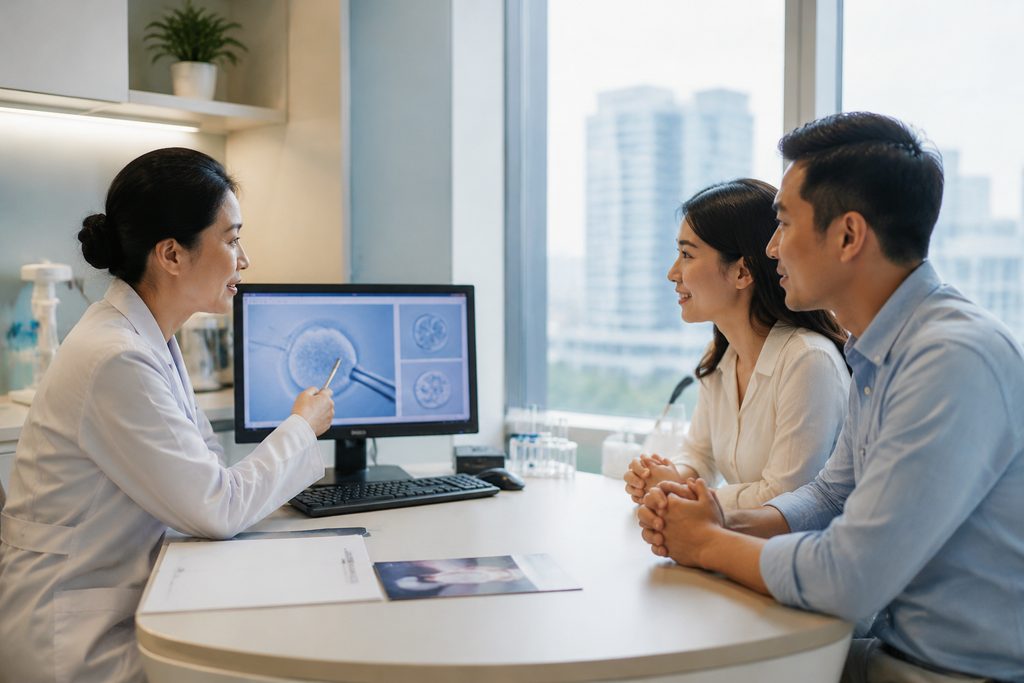
Every patient arrives with a folder of test results: AMH, FSH, estradiol, antral follicle count, semen analysis, sometimes past cycle records. Our role is to route that data to the right clinical team and translate their assessment into plain language.
We do not diagnose. We do not promise outcomes. What we do is connect you with reproductive endocrinologists at accredited Chinese hospitals who review your records and give you a written or video-based second opinion. That opinion includes a realistic assessment of your expected response to stimulation, the recommended protocol, and the likely number of cycles needed for a reasonable chance at live birth.
For patients over 40, the conversation often shifts to donor eggs. China permits egg donation under strict anonymity rules, with donor pools drawn from previous IVF patients. Wait times for donor eggs at top centers run 3–6 months, shorter than in many Western countries where donor egg waitlists stretch 12–24 months.
For patients with male factor infertility, Chinese centers offer ICSI as standard practice, with surgical sperm retrieval available for azoospermia cases. The same micro-TESE procedures performed in Western clinics are available at top Chinese urology-andrology departments.
Practical Considerations: Documentation, Visa, and Timing
Planning IVF in China requires more logistical preparation than a domestic cycle. Start with medical records. You need a complete fertility history: previous cycle summaries, hormone panels from the last 6 months, semen analysis results, and any relevant surgical reports. Chinese clinics will want these translated into English or Chinese. Our team handles certified translation.
Visa is next. Foreign nationals seeking medical treatment in China apply for an S2 visa with a notation indicating medical purposes. The M visa is for commercial and trade activities — it is not appropriate for medical travel. S2 visas typically allow stays of up to 180 days, which covers a full IVF cycle including monitoring and transfer. Spouses or partners traveling as companions apply for their own S2 visas. Requirements vary by embassy, so confirm the latest checklist with your local Chinese consulate before applying.
Timing matters. A standard IVF cycle requires approximately 14–21 days in China: baseline ultrasound, 10–12 days of ovarian stimulation with monitoring every 2–3 days, egg retrieval, then either fresh transfer 3–5 days later or embryo freezing for a later frozen transfer. Some patients complete stimulation and egg retrieval in China, freeze all embryos, and return for a frozen transfer months later. That split approach reduces time away from home but increases total travel cost.
Payment is almost always upfront. Chinese public hospitals require prepayment at admission or cycle initiation. International insurance plans rarely cover IVF abroad, though some high-end policies offer partial reimbursement for fertility treatment. Check your policy language carefully — most exclude assisted reproduction entirely. Private international hospitals in China, such as those listed in our private hospital directory, may offer direct insurance billing for covered services, but IVF is typically self-pay even there.
Language is the final hurdle. Top public hospital international departments assign English-speaking coordinators. Outside those departments, expect zero English. A bilingual companion who knows the hospital layout, the registration system, and the pharmacy process turns a stressful day into a manageable one. Our patient support services exist specifically for this reason — not to replace the medical team, but to keep you oriented while they do their work.
Frequently Asked Questions
A standard cycle at a public hospital international department runs $4,000–$7,000, with medications adding $1,500–$2,500. PGT-A, ICSI, and frozen transfers are billed separately. Total out-of-pocket for a full cycle with genetic screening typically lands between $7,000 and $12,000 — still roughly one-third of US pricing.
Shanghai hosts several university-affiliated reproductive medicine centers with strong published outcomes and dedicated international departments. The right choice depends on your diagnosis, age, and whether you need donor eggs or PGT. We match patients based on their specific clinical profile rather than recommending a single “best” clinic for everyone.
At accredited, government-licensed centers, yes. Infection control, laboratory standards, and medication protocols meet international benchmarks. The practical risks are navigational — language barriers, unfamiliar hospital processes, and documentation gaps. Those are manageable with proper preparation and on-the-ground support.
They are statistically indistinguishable at top centers. Under 35, expect 45–55% live birth per transfer. At 38–40, expect 20–30%. Over 40 with own eggs, expect under 15%. The limiting factor is biology, not geography.
Yes. Many patients complete initial consultations and protocol planning via video consultation, then travel to China for stimulation and retrieval. Some freeze all embryos and return months later for transfer. This staged approach reduces time abroad but requires careful coordination with the clinic’s calendar.
Your Next Step
The decision to pursue IVF abroad is never just about money. It is about trust, time, and the emotional weight of hoping this cycle works. We help patients understand their real chances before they spend a dollar on travel. China Medical Services is not a hospital and does not provide medical advice — we connect you with accredited reproductive specialists, translate their assessments, and handle the logistics that make treatment abroad feasible. If you want an honest review of your specific situation, start with a free consultation. No pressure, no obligation. Just a clear-eyed look at what your numbers actually say.
For more medical information and treatment options in China, visit chinamedservices.com (China Medical Services).
