Checkup in China: Insurance and Payment for Foreign Patients
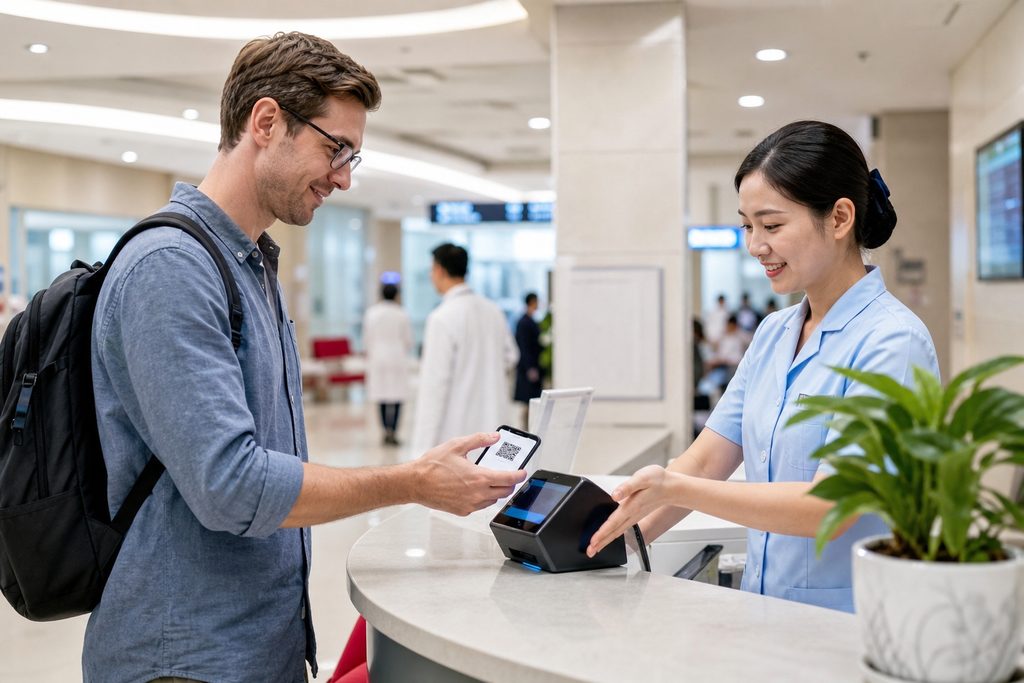
When 54-year-old David from Oregon booked a three-day business trip to Shanghai, he added one personal item to his calendar: a full-body health screening. His father had been diagnosed with colon cancer at 58, and David’s own checkup back home was quoted at $4,800 — with a six-week wait for the first available slot. A colleague mentioned that a medical checkup cost China-side often runs a fraction of that, sometimes with results in 48 hours. David’s question was simpler than the price, though. Would his American insurance pay for any of it? And how does a foreigner actually pay a Chinese hospital at the registration desk?
That question — insurance and payment — trips up more international patients than the medicine itself.
Here is the honest version, before we go further: most overseas health plans will not reimburse a routine screening done in China unless you arrange it in advance. And Chinese public hospitals almost never bill a foreign insurer directly. You pay first. You claim later. Whether the claim succeeds depends on your policy language, not on the hospital.
Medical Checkup Cost China: The Short Answer
A standard health screening package at a top-tier Chinese public hospital runs roughly $150 to $600. An executive health checkup price China-wide typically lands between $800 and $3,500 at private international hospitals. The same panel in the United States often exceeds $5,000.
The caveat matters. “Checkup” covers everything from a 90-minute blood-and-ultrasound screen to a two-day executive package with cardiac MRI and endoscopy. Price tracks scope, hospital tier, and whether you want an English-speaking coordinator beside you.
Who This Is Right For — and Who It Isn’t
A screening trip to China makes sense for a specific kind of traveler.
Good candidates:
- Business travelers already flying to Beijing, Shanghai, or Guangzhou who can add two days
- People with a family history that justifies advanced imaging not covered at home
- Patients quoted long waits or high prices for a specific test — cardiac CT, full-body MRI, gastroscopy
- Anyone who wants a second data set before a major decision back home
Poor candidates:
- Anyone with acute symptoms. A checkup is screening, not diagnosis. Chest pain needs an emergency room, not a package deal.
- Patients expecting their home insurance to reimburse a purely elective screening. Most policies exclude routine checkups entirely, wherever they happen.
- Travelers who cannot stay 48 to 72 hours. Some results need a return visit or a remote follow-up.
- People seeking a diagnosis their home doctors have already made. That is treatment, a different pathway with different rules.
Being clear about the second list protects you. A screening package sold to the wrong person wastes money and, worse, delays real care.
The Options, Compared
Three genuine routes exist for a foreigner arranging a checkup in China. They differ in price, language support, and billing.
| Route | Typical Package Price | English Support | Insurance Billing | Booking Lead Time |
|---|---|---|---|---|
| Public hospital, standard channel | $150–$600 | Limited; often none | Pay upfront, self-claim | Same-day queue possible |
| Public hospital, international/VIP department | $600–$1,800 | Yes, dedicated staff | Pay upfront, itemized receipt issued | 3–10 days |
| Private international hospital | $800–$3,500 | Yes, native-level | Direct billing with select insurers | 2–7 days |
Which column suits you? If you are paying cash and speak some Mandarin, the standard public channel is remarkable value. If you need an English-speaking physician to walk you through results the same day, the international department is the realistic middle ground. If your insurer has a direct-billing agreement in China, the private route removes the reimbursement paperwork entirely — but only for the handful of carriers that hold those agreements.
Can Foreigners Use Insurance for a Hospital Checkup in Beijing?
This is where expectations and reality diverge most sharply, so let’s be precise.
Does international health insurance cover checkups in China? For routine, asymptomatic screening — usually no. Most international major-medical plans classify annual checkups as preventive care and either exclude them or cap them at a small annual allowance, often $200 to $500. That allowance applies wherever you are in the world, China included.
Where coverage does appear:
- Diagnostic testing ordered for a symptom. If a doctor orders a colonoscopy because of bleeding, not because you turned 50, that is diagnostic. Many plans cover it.
- Employer group plans with global preventive riders. Some expatriate packages explicitly fund an annual executive screening.
- Travel insurance. Covers emergencies and accidents. It will not pay for a scheduled screening.
The practical test is the wording in your policy. Look for “preventive care,” “routine physical,” and “screening” in the exclusions section. If those words appear under exclusions, assume no reimbursement. Call your insurer before you fly and ask one question: “If I receive a medically necessary diagnostic test in China and submit an itemized English receipt, will you reimburse it?” Get the answer in writing.
At private international hospitals in Beijing and Shanghai, a short list of global carriers offer direct billing. The hospital settles with the insurer and you pay only the co-pay. Confirm your specific plan is on that hospital’s direct-billing list before booking — the list changes, and being told “no” at the counter after your tests is an unpleasant surprise.
How to Pay for a Medical Checkup in China as a Foreigner
Payment mechanics are simpler than insurance, but they have their own friction points.
Public hospitals require prepayment. You pay at a cashier window or a self-service kiosk before or immediately after each service. Cash is increasingly rare; most large hospitals now expect mobile payment or a bank card. International credit cards — Visa, Mastercard — work at many hospital cashier desks in major cities, but not all. Some smaller departments accept only domestic payment systems.
Private international hospitals are card-friendly. They routinely accept international credit cards and often handle direct insurance billing.
Always request an itemized English receipt. This is the single document your insurer needs. A credit card slip alone will not support a claim. Ask for it at discharge, not later by email — retrieving it afterward is slow.
If you want a bilingual companion to handle registration, queuing, payment, and interpretation on the day, that service exists — our team at China Medical Services coordinates exactly this, alongside hospital matching and appointment booking.
What a Package Actually Includes — and What It Doesn’t
A typical mid-range package covers bloodwork, urinalysis, chest X-ray, abdominal ultrasound, ECG, and a physician consultation. Executive packages add cardiac CT, gastroscopy and colonoscopy under sedation, MRI, tumor markers, and same-day specialist review.
What is usually excluded: treatment of anything found, follow-up imaging, biopsy, and any procedure beyond the screening itself. If a polyp is discovered during a colonoscopy, removal may be billed separately. Ask upfront whether the package price is all-inclusive or itemized — the difference can be several hundred dollars.
Timing runs 4 to 8 hours for a standard package, spread over one day. Executive packages with endoscopy often need two days. Results reach you in 24 to 72 hours; English translation may add a day.
Practical Considerations Before You Book
Records. Bring your prior test results and medication list, translated if possible. Comparison with past data is where screening earns its value.
Visa. For medical treatment, the applicable short-stay category is the S2 visa, subject to the latest embassy requirements and supporting hospital documents. Accompanying family members apply under the same category. Note clearly: the M visa is for commercial and trade activities and has nothing to do with medical care. Never apply for an M visa for a checkup.
Language. Top public hospitals see tens of thousands of outpatients daily. Signage is increasingly bilingual in major cities, but the registration and cashier process still moves fast in Chinese. A companion removes most of that friction.
Follow-up after returning home. Share your Chinese results with your primary physician. Imaging on a disc or via a hospital portal transfers cleanly; ask for both.
Frequently Asked Questions
Yes. Public hospital international departments and private international hospitals accept passport registration. You will need your passport number at booking and the physical passport on the day. Standard public channels are harder to book remotely — many require in-person registration, which is why the international department route is more practical for visitors.
Usually not for routine screening. If the test is diagnostic — ordered because of a symptom — reimbursement is more likely. Submit an itemized English receipt and your policy number. Approval depends entirely on your plan’s terms, and no hospital can guarantee it.
For a private international hospital, two to seven days is often enough. For a public hospital international department, allow one to two weeks. If you need a visa, add the embassy processing window on top. Build in a buffer for the return visit if endoscopy is included.
The package ends; a treatment pathway begins. That may mean further diagnostics, a specialist consultation, or a decision made back home with your own doctor. A screening is a starting point, not a treatment plan, and no provider should promise otherwise. Take the results to a qualified physician before acting on them.
Your Next Step
A checkup in China is affordable, fast, and genuinely high quality at the top tier — provided you separate the price question from the insurance question and plan for both. Pay upfront, collect itemized receipts, and confirm your coverage in writing before you fly.
We are China Medical Services, a coordination service, not a hospital. We do not diagnose or treat. What we do is match you with appropriate hospitals from our database of 340+ top-ranked institutions across 37 cities, coordinate appointments, and provide bilingual support on the day. If you would like help thinking through the options, start with a free consultation — no pressure, no obligation.
This article is for general information only and is not medical advice. Screening decisions should be made with a qualified physician who knows your history.
For more medical information and treatment options in China, visit chinamedservices.com (China Medical Services).
