Chengdu TCM Acupuncture for Foreigners: Costs, Booking & What to Expect
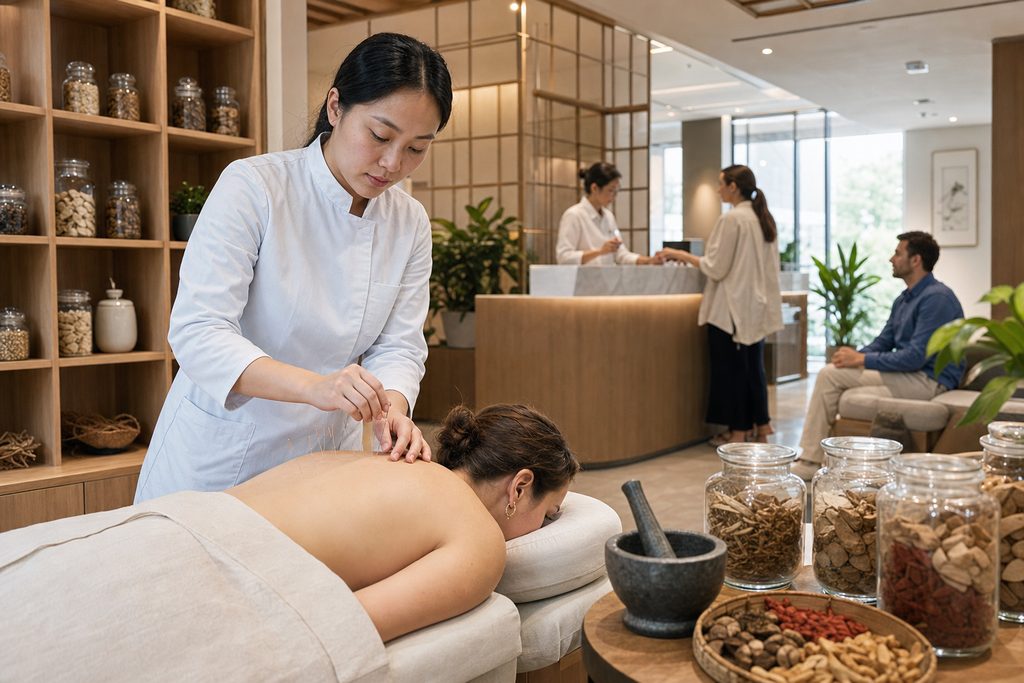
While a single acupuncture session at a private clinic in San Francisco runs $120 to $180, the same treatment at the Hospital of Chengdu University of TCM typically costs between $30 and $60 for international patients. That gap exists because China’s public TCM hospitals operate on volume, not premium pricing. But low cost means nothing if you cannot navigate the system. This guide breaks down the real acupuncture cost at Chengdu University TCM hospital for foreigners, how booking actually works, what happens during your first visit, and the safety questions that matter most.
Key Takeaways
- Acupuncture sessions at Chengdu University of TCM’s international department cost roughly $30–$60 per session, compared to $100–$180 at Western private clinics.
- The hospital is one of China’s leading TCM teaching hospitals, training acupuncturists who later practice worldwide — but English-speaking staff are concentrated in the international department, not the general outpatient floors.
- Foreigners cannot simply walk in and book a same-day appointment in most cases. Advance coordination through the international department or a medical concierge is the practical route.
- Acupuncture in China is regulated as a formal medical procedure, not a wellness add-on. Practitioners hold medical degrees and follow hospital protocols — but you should still bring translated medical records and a list of current medications.
The Problem: Acupuncture Abroad Is Expensive, Inconsistent, and Hard to Access
In the United States, the average cost of an initial acupuncture visit is $100 to $150, with follow-up sessions at $75 to $100. In the UK, private sessions run £50 to £80. In Australia, expect AUD 90 to AUD 120 per visit. Insurance coverage is patchy at best — most patients pay out of pocket. For chronic pain conditions requiring 8 to 12 sessions, that adds up fast.
But cost is only part of the frustration. Wait times for experienced acupuncturists in major Western cities stretch to three or four weeks. Practitioner qualifications vary wildly — some are licensed with 3,000 hours of training, others completed a weekend certificate course. And the regulatory environment differs from state to state, province to province. Patients often cannot tell whether they are seeing a genuinely skilled clinician or someone who took an online course.
Now consider the alternative. Chengdu, the capital of Sichuan province, is widely regarded as the spiritual and academic home of Traditional Chinese Medicine in China. The Hospital of Chengdu University of TCM sits at the center of that ecosystem. It is a teaching hospital attached to one of China’s oldest and most respected TCM universities. The practitioners here treat thousands of patients monthly. The acupuncture techniques they use — from classic filiform needling to electroacupuncture, moxibustion, and cupping — are taught and refined in an academic medical environment, not a strip-mall wellness studio.
Why Chengdu University of TCM Delivers Results for International Patients
Clinical Volume and Academic Depth
The Hospital of Chengdu University of TCM is a tertiary-level teaching hospital. That means its acupuncturists are not only treating patients — they are training the next generation of TCM physicians. The acupuncture department handles a patient volume that most Western practitioners will never see in a lifetime. This matters because acupuncture is a skill that improves with repetition. Needle placement, depth, angle, and stimulation technique all refine with practice. A practitioner who performs 40 or 50 treatments per day develops a tactile precision that a Western clinician doing 8 to 10 sessions daily simply cannot match.
The university’s TCM program is consistently ranked among the top in China. International students from Europe, North America, and Southeast Asia travel here specifically to study acupuncture and TCM theory. The hospital’s acupuncture department integrates classical meridian theory with modern rehabilitation protocols. Patients with stroke sequelae, Bell’s palsy, chronic low back pain, knee osteoarthritis, and migraine are routinely treated here — often with measurable improvement documented in the hospital’s own clinical research.
Acupuncture Cost Chengdu University TCM Hospital for Foreigners: The Numbers
Let us be direct about pricing. The acupuncture cost at Chengdu University TCM hospital for foreigners varies depending on which department you access. Here is what to expect:
| Service | Estimated Cost (USD) | Notes |
|---|---|---|
| Standard acupuncture session (general outpatient) | $15–$25 | Local pricing; requires Chinese language ability or bilingual companion |
| Acupuncture session via international department | $30–$60 | English coordination, prioritized scheduling, same-day registration support |
| Initial consultation with senior TCM specialist | $50–$100 | Includes TCM diagnosis, treatment plan, and first session in some cases |
| Package of 10 sessions (international department) | $280–$500 | Discounted per-session rate; varies by condition and practitioner seniority |
| Electroacupuncture add-on | $5–$10 per session | Often included in standard treatment for pain conditions |
| Moxibustion or cupping add-on | $5–$15 per session | Commonly combined with acupuncture for musculoskeletal issues |
These figures reflect 2025 pricing and should be treated as ranges, not fixed quotes. The final amount depends on the practitioner’s seniority, the complexity of your condition, and whether you need additional therapies. But even at the high end, ten sessions in Chengdu cost less than two sessions in Manhattan. That is the structural reality of Chinese healthcare economics.
Safety and Regulation: What Foreign Visitors Should Know
Is acupuncture in Chengdu safe for foreign visitors? The short answer is yes — with caveats. Acupuncture in China is practiced in a hospital setting under medical supervision. Needles are single-use, sterile, and disposed of after each treatment. The Hospital of Chengdu University of TCM follows national infection-control standards that are comparable to any accredited hospital in Europe or North America. Practitioners hold medical degrees in TCM and pass national licensing examinations.
But safety also depends on communication. If you cannot explain your symptoms accurately, or if the practitioner cannot understand your medical history, the risk of an inappropriate treatment increases. That is why the international department exists. It provides English-speaking coordinators who translate your concerns, review your medical records, and ensure the treating physician understands any medications you take, any surgeries you have had, and any conditions that might contraindicate needling — such as bleeding disorders, pacemakers, or pregnancy.
One practical point: bring a printed list of your medications with generic names. Bring any recent imaging reports or lab results. If you have a cardiac pacemaker or are taking anticoagulants, mention this before any needles touch your skin. These are standard precautions, but they are easier to manage when a bilingual professional is present.
How Acupuncture at Chengdu University TCM Hospital Works for International Patients
So how does acupuncture at Chengdu University TCM hospital work for international patients in practice? The process differs significantly from what you might experience at a private clinic in London or Los Angeles. Here is the step-by-step reality.
First, you do not simply walk in. The general outpatient department serves thousands of local patients daily. Registration is done through a hospital card system that requires a Chinese phone number and, in most cases, a Chinese national ID or passport. The queues are long. The signs are in Chinese. The staff at the general registration desk may not speak English. This is not a criticism — it is the reality of a public hospital serving a city of 21 million people.
The international department changes that experience. You book in advance, either directly through the hospital’s international office or through a medical coordination service. On the day of your appointment, you arrive at a designated time. A coordinator meets you, handles registration, and escorts you to the acupuncture department. You see a senior physician who conducts a TCM assessment — pulse diagnosis, tongue examination, and a detailed discussion of your symptoms. The physician then designs a treatment plan, which may include acupuncture alone or in combination with moxibustion, cupping, or herbal medicine.
A typical session lasts 30 to 45 minutes. You lie on a treatment table in a shared room — privacy is more limited than in Western clinics. The practitioner inserts needles at specific points, often 10 to 20 per session, and may manipulate them manually or connect them to a low-voltage electroacupuncture device. Most patients report a dull ache or tingling sensation, not sharp pain. After the needles are removed, you rest briefly and then leave. The whole visit, including consultation and treatment, takes about an hour to ninety minutes.
Follow-up sessions are usually scheduled two to three times per week for acute conditions, or once weekly for chronic issues. Your physician will tell you how many sessions to expect — commonly 6 to 10 for pain conditions, with reassessment after the first 4 to 6 treatments.
Booking Acupuncture Treatment at Chengdu University TCM as an International Patient
Can you book acupuncture treatment at Chengdu University TCM international patient department on your own? Yes. Is it straightforward? Not always. The hospital does have an international office, and when contacted by email, they can arrange appointments. Response times vary from a few days to over a week. You will need to provide your passport details, a brief description of your condition, and your preferred dates.
Where a medical coordination service adds value is in the details. The service can confirm which specific physician is available, arrange for a bilingual companion to accompany you, coordinate payment, and handle any changes to your schedule. For patients traveling from abroad, this reduces uncertainty significantly. The cost of a bilingual medical companion starts at $300 per day, which covers registration, queue management, translation, and navigation. For a patient who does not speak Chinese and is visiting for the first time, this is often the difference between a smooth experience and a stressful one.
Some patients ask about TCM acupuncture packages in China for overseas patients. These packages exist, typically offered by the hospital’s international department or by private TCM clinics in Chengdu. A package might include an initial consultation, 10 acupuncture sessions, and basic herbal medicine for a bundled price. The value is in the discount — usually 10 to 20 percent off the per-session rate. But be cautious: packages should always be tailored to your specific diagnosis. A generic “10-session acupuncture package” without a proper TCM assessment is a red flag. Any reputable provider will insist on an initial consultation before committing you to a treatment plan.
Practical Considerations: Visas, Payments, and Follow-Up
If you are traveling from abroad specifically for treatment, the correct visa is the S2 visa, which covers short-term private affairs including medical treatment. The hospital can provide a supporting letter confirming your appointment, which strengthens your application. Do not apply for an M visa — that is for commercial and trade activities and does not apply to medical travel. Processing times vary by country, so apply at least four to six weeks before your intended travel date.
Payment at the hospital is almost always in Chinese yuan. The international department may accept international credit cards, but this is not guaranteed. Carry sufficient cash or set up a payment method in advance. If you use a medical coordination service, they can often handle payment on your behalf and provide you with a consolidated invoice for insurance purposes.
Insurance reimbursement is another consideration. Some international insurers cover acupuncture when performed by a licensed physician in a recognized hospital. The Hospital of Chengdu University of TCM qualifies as a recognized medical institution, but you should confirm with your insurer before traveling. Request an itemized receipt and a treatment summary in English from the international department — both are essential for claims.
After you return home, follow-up is usually done via video consultation. The hospital’s international department can arrange remote sessions with your treating physician, typically priced between $100 and $300. This allows your practitioner to adjust your treatment plan, recommend herbal formulas, or advise on self-care practices like acupressure or qigong exercises.
One more thing worth knowing: the Hospital of Chengdu University of TCM is part of a broader TCM ecosystem in Chengdu. If you are exploring TCM hospitals in China, you will find that Chengdu’s academic TCM institutions are among the most respected. For a broader view of hospital options in the city, our Chengdu hospital guide covers both TCM and Western medical facilities. And if you are comparing this hospital against other top-ranked institutions nationwide, the top hospital rankings by city page provides useful context.
Frequently Asked Questions
Most general outpatient acupuncturists do not speak English. The international department assigns physicians who have experience treating foreign patients and provides English-speaking coordinators to translate during consultations. If you book through the general department without a bilingual companion, expect significant language barriers.
For acute pain, 6 to 10 sessions over three to four weeks is common. For chronic conditions like migraine or osteoarthritis, your physician may recommend 10 to 12 sessions with periodic reassessment. Some patients experience improvement after the first 3 to 4 sessions; others need the full course. No reputable practitioner will guarantee a specific outcome.
Yes. The hospital uses single-use sterile needles, follows national infection-control protocols, and employs licensed TCM physicians with medical degrees. The main safety risk for foreign patients is communication failure — not the procedure itself. Bringing translated medical records and using a bilingual coordinator mitigates this risk effectively.
Yes, but the process is slower. The international department accepts bookings by email. You will need to provide your passport information, a description of your condition, and your preferred dates. Expect a response within three to seven business days. If you need faster confirmation or specific physician requests, a medical coordination service can expedite the process.
A temporary worsening of symptoms — known in TCM as a “healing reaction” — occurs in a minority of patients, typically lasting 24 to 48 hours. Fatigue, mild soreness at needle sites, or a brief intensification of pain can happen. If symptoms persist beyond two days or are severe, contact the international department immediately. Your physician will adjust the treatment plan.
Your Next Step
Acupuncture at the Hospital of Chengdu University of TCM offers a combination that is rare elsewhere: academic rigor, high clinical volume, and prices that make a full course of treatment genuinely affordable. The trade-off is navigation. China’s public hospitals are not built for walk-in foreign patients. China Medical Services exists to bridge that gap — we coordinate appointments, arrange bilingual companions, and handle the logistics so you can focus on treatment. We are not a hospital and we do not provide diagnoses. But if you are considering acupuncture in Chengdu, start with a conversation. Tell us what you are dealing with, and we will help you figure out if this is the right path.
For more medical information and treatment options in China, visit chinamedservices.com (China Medical Services).
