Opening a Chinese Bank Account for Medical Tourists: Your Day-One Financial Setup Guide
What if the most stressful part of your medical trip to China isn’t the procedure itself, but figuring out how to pay for daily expenses without losing hundreds in foreign transaction fees? You’ve budgeted for the surgery. You’ve planned for the hospital deposit. But the moment you try to use your international credit card to buy a bottle of water at a local shop, the payment fails. That sinking feeling in your stomach is real. And it’s completely avoidable.
We see this scenario play out week after week. Patients arrive in Shanghai or Beijing with their medical visas in order, their hospital admissions confirmed, and a wallet full of foreign cards. They assume payments will be seamless. They’re wrong. China’s financial ecosystem runs on local rails — WeChat Pay and Alipay dominate daily life. Without a local bank account linked to these platforms, you’re effectively carrying cash in a largely cashless society. The question isn’t really whether you can get by without a local account. It’s how much friction you’re willing to endure while recovering from a major medical procedure.
Key Takeaways
- Medical tourists can legally open a Chinese bank account on a short-term visa, but the process requires specific documentation and in-person verification that catches most foreigners off guard.
- A day-one financial setup eliminates the 3% foreign transaction fees that compound over weeks of hospital stays, accommodation, meals, and post-operative care supplies.
- Walking into a bank branch without Chinese language support leads to an average of 2-3 failed attempts before a successful account opening — wasting precious recovery time.
- Not all Chinese banks accept medical visa holders equally. Bank of China and ICBC have the most established frameworks for short-term foreign account holders, but branch-level policy varies significantly.
The Real Cost of Not Having a Local Bank Account During Medical Treatment
International patients undergoing treatment in China stay for an average of 14 to 30 days for major procedures, and often longer for oncology protocols or rehabilitation. Every single day, you’re spending money — on hospital cafeteria meals, prescription pickups at the pharmacy, transportation to follow-up appointments, and basic necessities. If you’re relying on a foreign Visa or Mastercard, each transaction carries a foreign transaction fee of approximately 3% from your issuing bank. That’s $30 on every $1,000 spent. Over a three-week stay with moderate incidental expenses, you could easily lose $150 to $300 in fees alone.
But the cost runs deeper than the fees. Payment terminals in smaller pharmacies, local restaurants near hospitals, and even some hospital outpatient departments simply don’t accept foreign cards. The staff will shake their heads. You’ll need cash. And finding an ATM that accepts your foreign card reliably? That’s its own daily treasure hunt. We’ve had patients walk 20 minutes post-surgery to find a working ATM, only to discover a daily withdrawal limit of ¥2,500 (roughly $350 USD). For a family member buying post-operative supplies and three meals a day, that vanishes fast.
These aren’t hypotheticals. A 2024 report by the People’s Bank of China noted that while major hotels and hospitals in Tier-1 cities have improved foreign card acceptance, the vast majority of small and medium-sized merchants remain mobile-payment only. You need WeChat Pay or Alipay. Both platforms now allow linking foreign credit cards. That’s progress. But the functionality is limited — you can’t hold a balance, can’t receive refunds easily, and can’t transfer money to a local companion who’s helping you buy supplies. A local bank account solves all of this at the root.
Can Medical Tourists Open a Bank Account in China? The Short Answer Is Yes
The question “can medical tourists open a bank account in China” surfaces in almost every pre-arrival consultation we conduct. The answer is yes — but with conditions that trip up the unprepared. Chinese banking regulations permit foreign nationals on S2 visas (short-term private visit, which covers medical treatment) and S1 visas (long-term private visit) to open personal savings accounts. You do not need a work permit. You do not need a residence permit. What you do need is your passport with a valid visa, a local phone number registered in your name, and a temporary residence registration form from the local police station — often called the “Registration Form of Temporary Residence.”
Here’s where the friction builds. The temporary residence registration must be completed within 24 hours of arriving at your accommodation. If you’re staying at a hotel, the hotel typically files this for you. But if you’re in a serviced apartment or short-term rental arranged through a medical concierge, someone needs to physically go to the local police station with your passport and the rental contract. Miss this step, and the bank will turn you away. No exceptions.
Then there’s the phone number problem. Chinese banks require a local SIM card registered to your passport — not a prepaid tourist SIM bought at the airport without real-name registration. You need to visit a China Mobile, China Unicom, or China Telecom service hall with your passport to get this set up. The process takes about 30 minutes if you speak Chinese, and considerably longer if you don’t.
Day-One Financial Setup: Why Speed Matters for Medical Travelers
We’ve developed a “day one bank account China medical tourism service price” framework because we learned the hard way that delays compound. A patient who lands on Monday and opens their account on Wednesday has already lost two days of convenience and potentially paid unnecessary fees. A patient who lands and has their account operational within hours of arrival? They walk out of the hospital after their initial consultation, scan a QR code at a nearby noodle shop, and pay like a local. The psychological relief is significant. Medical travel is stressful enough without payment anxiety layered on top.
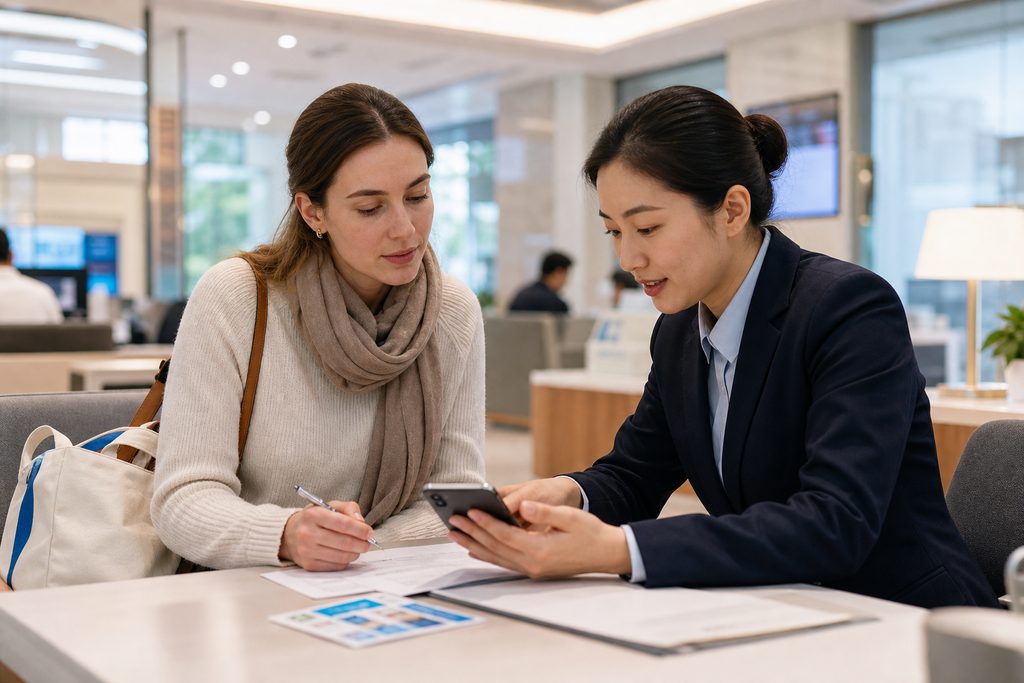
Our team coordinates the entire sequence in parallel while you’re en route. Before your flight lands, we’ve already scheduled the police registration appointment, prepared the bank branch that has a documented track record of processing foreign medical visa holders, and arranged for a bilingual coordinator to accompany you through every step. The actual bank visit takes 45 to 60 minutes. You sign forms. You set a PIN. You walk out with a UnionPay debit card and a fully functional account linked to WeChat Pay and Alipay. That’s the ideal. And it’s achievable when the groundwork is laid in advance.
Which Bank Is Best for Medical Visa Holders?
The “best China bank for medical visa holders setup service” isn’t a single institution — it depends on which city you’re in and which branch has staff who’ve processed foreign accounts before. That said, two banks consistently outperform others for short-term foreign account holders. Bank of China (BOC) has the most extensive experience with international clients and offers an English-language mobile banking interface. Their account opening forms are available in English at major branches in Beijing, Shanghai, and Guangzhou. ICBC (Industrial and Commercial Bank of China) has the largest branch network in the country and processes foreign account applications efficiently at their flagship locations.
Smaller joint-stock banks like China Merchants Bank offer excellent mobile apps but can be inconsistent with short-term visa holders. Some branches will flatly refuse. Others will process the application but restrict online banking functionality. We’ve mapped the branches near major top-ranked hospitals that have successfully opened accounts for our patients. That institutional memory saves you from being the test case at a branch that hasn’t handled a foreign medical tourist in months.
| Bank | English App Support | Foreign Medical Visa Acceptance | Typical Account Opening Time |
|---|---|---|---|
| Bank of China | Full English interface | High — established protocol | 45-60 minutes |
| ICBC | Partial English | High at major branches | 45-75 minutes |
| China Merchants Bank | Full English interface | Variable — branch-dependent | 60-90 minutes |
| China Construction Bank | Limited English | Moderate | 60-90 minutes |
What You’ll Actually Pay: The Open Bank Account China Medical Tourist Cost Breakdown
Let’s talk numbers. The account opening itself is free at all major Chinese banks. There is no government fee, no minimum deposit requirement for a basic savings account at BOC or ICBC. You’ll need to deposit a small amount to activate the account — typically ¥1 to ¥10 (less than $2 USD). The real costs come from the coordination required to make it happen smoothly.
If you attempt this independently, budget for the following: a local SIM card with real-name registration (approximately ¥100-200, or $15-30 USD, depending on the plan), transportation to the police station and bank branch (variable by city), and potentially a translator if you don’t speak Chinese. Professional translation services in major Chinese cities run $50-100 per hour. You’ll need at least 2-3 hours of support across the SIM card registration, police station visit, and bank appointment. That’s $150-300 in translation costs alone.
Our bilingual coordination service for the full day-one financial setup — including SIM card assistance, police registration accompaniment, and bank account opening with a dedicated coordinator — starts from $200 for a half-day engagement. That covers the complete sequence. You walk out of the bank with a working account, linked mobile payment apps, and the ability to transact like a local for the remainder of your medical stay. For a companion staying with a patient for two weeks or more, the avoided foreign transaction fees alone often exceed the coordination cost.
The Foreigner Bank Account Shanghai Hospital Package Reality
Shanghai deserves special attention because it’s China’s most popular medical tourism destination. The city hosts 18 of the Fudan-ranked top 100 hospitals, including Zhongshan Hospital, Huashan Hospital, and Ruijin Hospital. International patient volumes are high. You’d expect the banking infrastructure to be seamless for foreign patients. The reality is more nuanced.
The “foreigner bank account Shanghai hospital package” concept that some medical facilitators advertise is not a formal banking product. No Chinese bank offers a pre-packaged account specifically for medical tourists. What reputable coordinators provide is a pre-vetted pathway: a specific branch near your hospital that has processed medical visa holders before, a known contact person who understands the documentation requirements, and a companion who can translate the forms in real time. The “package” is the coordination, not the account itself. We’re transparent about this distinction because patients who’ve been promised a turnkey banking product elsewhere arrive confused when they’re still signing standard account opening forms.
Near Huashan Hospital in Jing’an District, for example, the Bank of China branch on West Nanjing Road has processed enough foreign medical visa holders that their staff don’t blink at an S2 visa. The ICBC branch near Ruijin Hospital in Huangpu District is similarly experienced. But walk into a random branch in a residential neighborhood with no foreign foot traffic, and you might spend two hours only to be told “the system is down” — a polite way of saying the staff doesn’t know how to process your application.
How to Set Up a Chinese Bank Account as a Foreign Patient: The Step-by-Step Reality
Understanding “how to set up Chinese bank account as foreign patient” requires acknowledging that the process is sequential and unforgiving. Miss one step, and you start over. Here’s the actual sequence we execute for every patient:
Step one happens before you leave home. We confirm your accommodation address and ensure it’s a property that can legally register foreign guests — not all short-term rentals can. Step two happens at the airport or immediately after: a local SIM card registered to your passport. Step three is the police registration, which must occur within 24 hours of check-in. Step four is the bank visit, armed with your passport, visa, police registration form, and local phone number.
At the bank, you’ll complete a personal account opening application. The form asks for your name exactly as it appears in your passport, your local address (from the police registration form), your tax identification number from your home country (required under CRS — Common Reporting Standard), and your contact information. You’ll set a six-digit PIN for your debit card. The card is issued on the spot. The account is active immediately for deposits. Online banking and mobile app access may take 24 hours to activate fully.
Why Coordination Matters More Than You Think
We’re not a bank. We don’t sell financial products. What we do is collapse the uncertainty that surrounds every step of this process. Our team has accompanied patients through account openings at over 30 bank branches across 37 cities. We know which branches ask for additional proof of employment (even though it’s not technically required for a basic savings account) and which ones process S2 visa holders without friction. We know that the Bank of China branch near Peking Union Medical College Hospital in Beijing will ask for your home country tax ID and that the ICBC branch near West China Hospital in Chengdu will want to see your hospital admission letter as supplementary documentation.
This institutional knowledge is what you’re paying for when you engage a coordination service. Not access. Not shortcuts. Just the accumulated experience of what works, where, and with whom. For a patient recovering from surgery, that’s the difference between a 45-minute errand and a half-day ordeal that ends in frustration.
Frequently Asked Questions
Yes. There is no minimum stay requirement for opening a personal savings account. As long as you have a valid visa, a local phone number, and a temporary residence registration, banks can process your application. The account remains active after you leave China, though inactivity for extended periods may trigger dormancy protocols — check with your specific branch.
Your account stays open. You can access it via the bank’s mobile app from abroad for basic functions like balance checks and internal transfers. International wire transfers out of China require additional documentation and are generally easier to handle before you leave. We recommend withdrawing or transferring your remaining balance before departure, keeping only a minimal amount if you plan to return for follow-up treatment.
Yes, if they hold their own S2 visa and complete the same documentation process — separate passport, separate phone number, separate police registration. Accounts cannot be shared or jointly held by foreign nationals on short-term visas. Each adult needs their own account.
Both platforms employ bank-grade encryption and are used by over a billion people daily. The security risk is comparable to linking a debit card to Apple Pay or Google Pay in Western countries. Set a strong payment password and enable biometric verification (fingerprint or face ID) on your phone for an additional security layer.
This happens. Branch-level discretion is real. If a bank refuses, ask for the specific reason in writing — they’re required to provide one. Often the issue is resolvable (a misspelled name on the police form, a phone number not yet active in the system). If the refusal is based on branch policy rather than a fixable error, we redirect to an alternative branch with a documented track record of processing foreign accounts. Having a bilingual coordinator who can advocate for you in real time is the single most effective safeguard against unnecessary refusals.
Your Next Step
Opening a Chinese bank account as a medical tourist isn’t complicated once you understand the sequence. But it is unforgiving. One missing document, one branch that’s never processed an S2 visa holder, one miscommunication about your accommodation address — and a straightforward task becomes a multi-day headache. The value of a coordinated day-one setup isn’t in the account itself. It’s in reclaiming the time and mental bandwidth you need for what actually matters: your health and recovery.
If you’re planning medical treatment in China and want to arrive knowing your financial infrastructure is handled — not hoping it will work out — our team can walk you through the exact documentation you’ll need and coordinate the entire setup on your arrival day. Get a
For more medical information and treatment options in China, visit chinamedservices.com (China Medical Services).
