Health Checkup in Guangzhou: Full Care Coordination for Foreigners
When 47-year-old Daniel from Manchester landed in Guangzhou for a business trip, he had one free day. His wife had been urging him for months to get a proper health screening. Back home, the NHS wait for a comprehensive executive panel was six weeks. In Guangzhou, he walked into a top-tier hospital’s international department at 8:00 a.m. and walked out at 2:30 p.m. with bloodwork, cardiac imaging, abdominal ultrasound, and a chest CT all completed. The full body checkup Guangzhou price came to roughly $420. The same panel in London would have cost him over £2,000 privately and taken three separate appointments. That gap explains why more foreigners are building health screenings into their China travel plans. But coordination matters. Without it, Daniel would have spent his day lost in a hospital the size of an airport terminal, unable to read a single sign.
We help international patients arrange exactly this kind of visit. Not as a luxury add-on. As a practical way to access one of China’s most underrated medical assets: fast, thorough, comparatively affordable diagnostics. Here is how the process actually works, what it costs, where to go, and what can go wrong if you try to wing it.
How This Actually Works, Step by Step
The sequence is straightforward, but each step has friction points that trip up first-timers.
You start by sending us your basic details: age, gender, any known conditions, medications, and what you want covered. Cardiac focus? Cancer screening emphasis? Full metabolic and organ panel? We translate this into a package recommendation. No medical advice — just matching your goals to what specific hospitals offer.
Then we contact the hospital’s international department or health management center directly. Public hospitals in China do not let overseas patients book standard outpatient appointments in advance. But executive health screening packages operate differently. These are self-pay, non-urgent, and designed for volume throughput — so pre-booking through the international channel is standard practice.
What comes back is a confirmed date, a package outline, and a preparation sheet. Fasting requirements. Medication instructions. What to bring. We handle the Chinese-language coordination and send you a clear English brief.
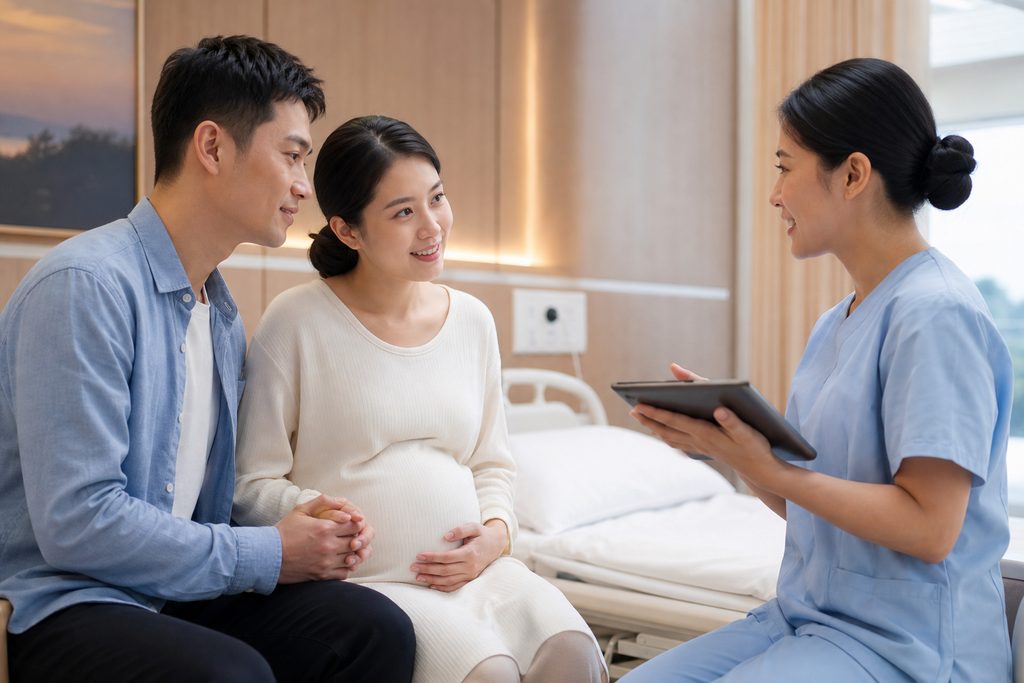
On the day, a bilingual companion meets you at the hospital entrance. They hold your queue numbers, walk you between stations, explain what each test measures, and make sure the phlebotomist knows about your needle anxiety or that you need a translator present during the doctor consultation. You are not handed a map and wished luck. You are escorted through a system built for Chinese-speaking locals at high volume.
Afterward, you get a written report — often within 48 to 72 hours for standard panels. If anything flags, we can arrange a follow-up video consultation with the reviewing physician or connect you to a specialist for a written second opinion.
What a Full Body Checkup in Guangzhou Actually Costs
Let us talk numbers, because the full body checkup Guangzhou price is the first thing most people ask about. Prices vary by hospital tier, package depth, and whether you go through a public hospital’s VIP wing or a private international clinic. The table below reflects typical ranges based on current self-pay rates for foreigners.
| Package Type | What It Includes | Typical Cost (USD) | Time Required |
|---|---|---|---|
| Basic Health Screening | Blood panel, urine, chest X-ray, abdominal ultrasound, ECG, basic physical | $150 – $300 | 3–4 hours |
| Standard Executive Package | Above plus cardiac ultrasound, carotid Doppler, tumor markers, thyroid panel | $350 – $600 | 4–6 hours |
| Comprehensive / Premium | Above plus low-dose chest CT, brain MRI or head CT, GI endoscopy (optional), full-body MRI in some centers | $700 – $1,500 | 1–2 days |
| Private International Clinic | Similar to executive package, Western-style environment, English-speaking physicians | $500 – $1,200 | Half day |
For comparison, a comparable executive health screening at a private London clinic runs £1,500–£3,000. In the U.S., a self-pay executive physical at a major academic center can hit $3,000–$6,000. The executive health screening China cost advantage is real, but it comes with trade-offs: you are navigating a foreign language, a different clinical culture, and a system that assumes you know how it works. That is where coordination earns its fee.
Hospital appointment coordination for a health checkup starts from $300, and bilingual medical companion services start from $300 per day. The final quote always depends on the hospital and package you choose.
Best Hospital for Health Checkup Guangzhou: Where to Actually Go
Guangzhou has ten hospitals on the Fudan Hospital Rankings Top 100 list — third in China behind Beijing and Shanghai. That is a deep bench. But “best” depends on what you are screening for and what kind of experience you want.
For comprehensive diagnostics with strong specialist backup, the First Affiliated Hospital of Sun Yat-sen University is a heavyweight. Its health management center runs high-volume executive screenings, and if something flags, you are already inside one of southern China’s most respected referral hospitals. The same logic applies to Nanfang Hospital and Guangdong Provincial People’s Hospital — both on the Fudan Top 100 list, both with dedicated VIP and international screening wings.
If you want a Western-style experience with English-speaking staff and direct insurance billing, Guangzhou has several JCI-accredited private international clinics. These are the United Family and Raffles-type facilities. Higher price, softer edges, less raw clinical firepower. For most foreigners doing a first-time screening, a public hospital international department is the sweet spot: top-tier diagnostic equipment, specialist access if needed, and a price that still makes the trip worthwhile.
Is Guangzhou good for medical checkup purposes specifically? The city has three structural advantages. First, hospital density — you are never far from a top-tier center. Second, imaging and lab throughput — these departments process thousands of patients daily, so same-day results for standard panels are common. Third, cost — Guangzhou prices run slightly below Shanghai and Beijing for equivalent packages.
A Realistic Timeline
People underestimate lead time. Here is what a real schedule looks like, not the optimistic version.
| Stage | What Happens | Typical Duration |
|---|---|---|
| Inquiry & package selection | You send basic health info; we match packages across 2–3 hospitals | 1–3 days |
| Hospital confirmation | International department confirms date and package; prep sheet issued | 2–7 days |
| Visa processing (if needed) | S2 visa application with hospital invitation letter; embassy processing time varies | 1–4 weeks |
| Travel & arrival | Flights, hotel near hospital, airport transfer if requested | 1–2 days |
| Screening day | Fasting tests first, imaging mid-morning, doctor consult afternoon | 4–8 hours |
| Report delivery | Written report in English (translation may take extra time) | 2–5 days |
| Follow-up if flagged | Video consult or specialist referral | 1–2 weeks |
The step people forget is document translation. If you bring prior medical records from home, they need to be translated into Chinese for the reviewing physician. That adds a few days. And if you are coming specifically for a screening, factor in the S2 visa timeline — this is the short-stay category used for private medical treatment in China, not the M visa, which is strictly for commercial and trade activities. We can provide the hospital invitation documentation to support your S2 application, but approval always rests with the embassy or consulate.
What Can Go Wrong — and What Happens Then
Let us be blunt about failure modes, because they happen.
You book a package, fly to Guangzhou, and wake up with a fever on screening day. The hospital will reschedule, but you may lose your slot and have to wait several days — or pay a rebooking fee. If you used a coordinator, we handle the rescheduling in Chinese and push for the earliest available alternative.
Your bloodwork flags an elevated tumor marker. This is common and usually benign — inflammation, a recent infection, even intense exercise can spike markers like CA-125 or CEA. But the report will say “abnormal.” Without a bilingual companion, you are left staring at a Chinese-language lab sheet with a number in red. With coordination, the reviewing physician explains what the marker means, what the false-positive rate is, and what repeat testing or imaging makes sense. No panic. No unnecessary biopsy.
The hospital loses your registration. It happens in high-volume centers. A companion who knows the system walks to the registration desk, sorts it out in five minutes, and gets you back in the queue. Without one, you are gesturing at a screen that only displays Chinese characters.
You want a copy of your imaging to take home. Chinese hospitals do not always hand over raw DICOM files automatically. You may need to request them formally, pay a small fee, and wait a day or two. We arrange this before you leave so you are not emailing a hospital in a language you do not speak from another continent.
How Long Does a Full Health Checkup Take in China — and What Slows It Down
The short answer: 4 to 6 hours for a standard executive panel, one full day for a comprehensive package with CT and specialist consults. But that assumes everything runs smoothly.
Fasting bloodwork happens first. Most centers open at 7:30 or 8:00 a.m. If you arrive later than 9:00, you are behind hundreds of local patients and your imaging slots slip. The ultrasound queue is usually the bottleneck — abdominal and cardiac ultrasound take 15–20 minutes per patient, and there are only so many machines.
Some packages include a GI endoscopy. That requires sedation, which means no driving afterward and a longer recovery room stay. Add 2–3 hours if endoscopy is on your list. Full-body MRI, offered by some private centers, takes 40–60 minutes in the scanner alone.
If you want results interpreted the same day, say so when booking. Standard practice is to release the written report within 48–72 hours. Same-day interpretation requires the reviewing physician to have a slot available — not always guaranteed, but often possible for morning screenings.
Practical Considerations: Records, Payment, Insurance, and Language
Bring any prior imaging on CD or USB, not just printed reports. Chinese radiologists often want to compare old and new scans directly. Bring a medication list with generic names, not brand names — brand names differ between markets.
Payment is upfront. Public hospitals in China operate on a prepayment model for self-pay international patients. You pay the package fee at registration, typically by card or WeChat Pay. Cash is accepted but discouraged for large amounts. Your home insurance will likely not be billed directly by a public hospital — you pay, then submit for reimbursement. Private international clinics in Guangzhou do offer direct billing with major insurers like Cigna, Aetna, and Allianz.
Language is the single biggest practical barrier. Even in “international” departments, the front-desk staff may speak limited English. The phlebotomist drawing your blood almost certainly does not. The ultrasound technician will not explain what they see — they are not allowed to. A bilingual companion bridges every one of these gaps, from registration to the final doctor consult.
After you return home, follow-up matters. If your screening flagged anything, you need a plan. We can arrange a video consultation with the reviewing physician or a relevant specialist so you are not left interpreting a foreign report alone. Any remote consultation fee you pay is credited in full toward on-the-ground coordination if you later return to China for treatment — a one-time credit applied to coordination fees only, never to hospital charges.
Frequently Asked Questions
Yes, through the hospital’s international department or health management center. Standard outpatient visits cannot be pre-booked from overseas, but executive screening packages are self-pay and designed for advance scheduling. We handle the booking and send you an English confirmation.
You apply for an S2 visa, which covers short-term private affairs including medical treatment. The hospital can provide an invitation letter to support your application. The M visa is for commercial and trade activities and is not appropriate for medical travel. Approval is always at the discretion of the embassy or consulate.
Most international insurers treat executive screenings as self-pay unless your policy specifically includes preventive care abroad. Public hospitals require upfront payment; you submit claims afterward. Some private international clinics in Guangzhou offer direct billing. Check your policy before booking.
You are already inside a top-tier hospital with full specialist access. We arrange a follow-up consultation with the relevant department — often within days, not weeks. If you prefer to return home for treatment, we provide your complete records and imaging in English so your local physician can take over.
Package prices at public hospital international departments are generally fixed. Private clinics sometimes adjust for group bookings or repeat visits. The price you are quoted is the price you pay; there are no hidden facility fees or surprise add-ons if the package scope is clear from the start.
Your Next Step
A health checkup in Guangzhou is not a luxury purchase. It is a practical way to get comprehensive diagnostics done quickly, thoroughly, and at a fraction of Western private costs. The full body checkup Guangzhou price ranges from roughly $150 for a basic panel to $1,500 for a premium package with advanced imaging — and the clinical quality at top-tier public hospitals is genuinely excellent.
We are China Medical Services. We match international patients with the right hospitals, handle booking and document translation, and put a bilingual companion beside you on screening day. We do not practice medicine and we do not guarantee outcomes. What we do is remove the friction — so you walk in clear-headed and walk out with answers you can actually read.
If you are considering a screening in Guangzhou, start with a free consultation. Tell us what you want checked, and we will tell you what it costs, where to go, and how long it takes. No pressure, no obligation. Just a clear plan.
Your health deserves a second look — and sometimes, that look is best taken 6,000 miles from home.
For more medical information and treatment options in China, visit chinamedservices.com (China Medical Services).
