Hearing Loss Check in China: How It Works, Step by Step
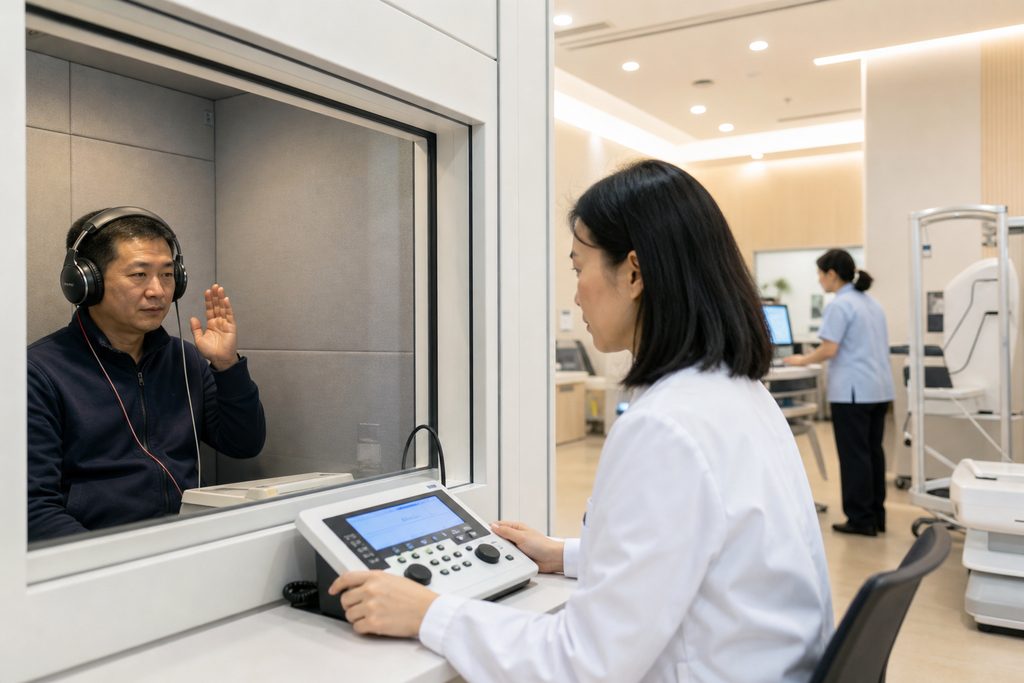
In the United States, a full audiology workup can run past $500 before insurance negotiations even begin. In China, the same battery of tests — pure-tone audiometry, tympanometry, otoacoustic emissions — often lands between $30 and $120 at a top-tier public hospital. That gap explains why so many international patients now ask us about a hearing loss test cost China comparison before they book anything. But cost is only the first question. The second is whether the process is safe, structured, and worth traveling for.
This guide walks through how hearing loss checks actually work in China, from the first email to the final report, and where the friction points hide.
How This Actually Works, Step by Step
Nothing about a hearing evaluation in China is mysterious once you see the sequence. The trick is knowing which steps happen remotely and which require you to be physically present.
Step one: you send records. Existing audiograms, MRI or CT scans of the temporal bone, ENT consultation notes, and any prior hearing aid fitting data. If you have none, that’s fine — most patients start here with nothing but symptoms.
Step two: a Chinese ENT or audiology department reviews the file. At a hospital like Peking Union Medical College Hospital or Shanghai’s Eye & ENT Hospital, the relevant specialty reads your history and decides what testing is actually needed. This is where a written second opinion earns its keep — you learn whether you need a basic screening or a full neuro-otologic workup.
Step three: remote consultation. You speak with the team by video. They ask about onset, asymmetry, tinnitus, vertigo, noise exposure, family history. Fifteen to thirty minutes, typically.
Step four: you travel, or you don’t. If the plan requires in-person testing, we coordinate an appointment. If your case can be managed closer to home, you’ll hear that too.
Step five: testing day. You arrive, register, and move through the audiology suite. Results are usually available the same day or within 48 hours.
Step six: interpretation and next steps. The ENT explains findings and options — monitoring, medication, surgery, or hearing aids.
What a Hearing Evaluation in China Actually Includes
Chinese tertiary hospitals follow international audiology standards. The equipment is the same brands you’d see in Germany or the US — Interacoustics, Otometrics, and similar. What differs is volume and speed.
A standard evaluation typically covers:
- Pure-tone audiometry (air and bone conduction) — the core threshold test
- Speech audiometry — word recognition scores
- Tympanometry and acoustic reflex testing — middle ear function
- Otoacoustic emissions (OAE) — cochlear hair cell screening
- Auditory brainstem response (ABR) — when retrocochlear pathology is suspected
For sudden sensorineural hearing loss, timing matters enormously. Steroid treatment started within 72 hours of onset has a meaningfully better prognosis than treatment started at two weeks. If you wake up with one-sided hearing loss, that is not a “wait and see” situation.
A Realistic Timeline
Here’s what the calendar actually looks like. Ranges, not best-case promises.
| Stage | Typical Duration | Notes |
|---|---|---|
| Record collection and translation | 2–5 business days | Medical records need certified translation if not in English or Chinese |
| Written second opinion | 3–7 business days | Depends on hospital response time |
| Video consultation scheduling | 3–10 days | Top specialists book out further |
| S2 visa application | 4–10 business days | Varies by consulate and season |
| Appointment lead time (public hospital) | 1–3 weeks | International department slots move faster |
| Testing day | Half day | Full workup can take 2–4 hours |
| Results and interpretation | Same day to 48 hours | ABR results may take longer |
| Treatment start (if indicated) | Immediate to 2 weeks | Sudden hearing loss is treated urgently |
Total realistic window from first contact to testing day: three to six weeks. Anyone promising you a hearing workup in five days is either skipping the visa or skipping the hospital queue.
What Can Go Wrong — and What Happens Then
Honest failure modes matter more than glossy success stories.
The appointment isn’t with the specialist you wanted. Public hospital general ENT clinics don’t let overseas patients pre-book a named professor. If you need a specific senior audiologist or otologist, that runs through the hospital’s international or VIP channel, and it costs roughly 1.5 to 2 times the standard fee. We can coordinate it, but we can’t guarantee a specific physician or date. If the requested appointment can’t be secured, the coordination fee is refunded in full.
Your records are incomplete. Half-translated audiograms, missing imaging, no medication history. This delays review by a week or more. Send everything, even if you think it’s irrelevant.
The visa takes longer than expected. S2 processing times shift with consulate workload. Never book flights before the visa is in hand.
Testing reveals something unexpected. An acoustic neuroma, a cholesteatoma, a vascular anomaly. This is not a failure — it’s the point of screening. But it changes the plan, sometimes significantly, and may require a second visit or a surgical consult.
How Much Does a Hearing Test Cost in China?
Costs vary by hospital tier, city, and how extensive the testing is. Here are realistic ranges for international patients at tertiary public hospitals.
| Service | China (USD) | US (USD) | UK Private (USD) |
|---|---|---|---|
| Basic pure-tone audiometry | $20–50 | $150–300 | $120–250 |
| Full audiology battery | $60–150 | $400–700 | $350–600 |
| Auditory brainstem response (ABR) | $80–200 | $500–1,200 | $400–900 |
| ENT consultation (international dept.) | $50–150 | $250–500 | $200–400 |
| MRI (internal auditory canal) | $150–400 | $1,500–3,500 | $800–2,000 |
These are reference ranges. Final pricing depends on the hospital and case complexity, and always confirm with the facility directly. A medical tourism hearing test China package that bundles consultation, testing, and interpretation often lands between $300 and $800 all-in at a top public hospital — before travel and accommodation.
For context on how these numbers compare across specialties, our database of 340+ top-ranked Chinese hospitals breaks down which facilities specialize in what.
Choosing a Clinic: What Actually Matters
The best hearing loss clinic Beijing or Shanghai offers isn’t necessarily the most famous name. It’s the one whose audiology department matches your specific problem.
Three things to check:
Volume and subspecialty. A hospital performing thousands of audiologic evaluations annually has calibrated equipment, experienced technicians, and standardized protocols. Fudan University’s specialty rankings list top hospitals by department — otolaryngology is one of the 45 ranked specialties.
Whether they handle your condition. Pediatric hearing loss, sudden sensorineural loss, noise-induced loss, and age-related presbycusis are different clinical pathways. Meniere’s disease and vestibular schwannoma require different workups entirely.
Language support. Public hospitals serve enormous patient volumes — some see over 10,000 outpatient visits daily. Without a Chinese-speaking companion, navigation is genuinely difficult. This is where a bilingual medical companion earns their fee: registration, queue management, payment, wayfinding, and real-time translation.
If you’re considering Shanghai specifically, our Shanghai city page lists hospitals with strong ENT and audiology departments.
Practical Considerations: Records, Visa, Payment, Follow-Up
Records. Bring original audiograms, imaging on disc, and a medication list. If your records are in a language other than English or Chinese, arrange certified translation before travel.
Visa. Medical travel to China uses the S2 visa, with a notation for medical treatment purposes. Family members accompanying you apply for S2 as well. Stays beyond 180 days require the S1 category. Requirements shift, so confirm current rules with your nearest Chinese embassy or consulate. Note that the M visa is for commercial and trade activity — it is not a medical visa.
Payment. Public hospitals require prepayment; insurance reimbursement happens afterward. Private international hospitals often bill insurance directly. Budget for the full amount upfront either way.
Follow-up. Ask for a written report with threshold values, interpretation, and recommendations. You’ll want this for your audiologist at home. Serial audiograms over time are how hearing loss is actually tracked — a single test tells you where you are, not where you’re heading.
Frequently Asked Questions
Yes. Audiometry, tympanometry, OAE, and ABR are non-invasive, painless tests with no radiation exposure. MRI uses the same equipment and protocols found in Western hospitals. The main safety consideration is not the testing itself but ensuring you’re evaluated at a properly equipped facility with calibrated instruments — which tertiary hospitals in China maintain to international standards.
A full audiology battery typically runs $60 to $150 in China versus $400 to $700 in the US. Even with travel costs added, patients often find the total trip comparable to or below what they’d pay domestically — particularly when imaging is included. Prices vary by hospital and case complexity, so request a specific quote.
General outpatient ENT appointments at public hospitals cannot be pre-booked from overseas — you register on arrival. To secure a specific time, specialist, or the international department, you need coordination through the hospital’s VIP or international channel. This is the pathway we help arrange, though we cannot guarantee a specific physician or date.
That’s a conversation with the treating physician, not with us. What we can do is make sure you understand the recommendation, have it in writing, and know your options — including whether the procedure could be done closer to home. No treatment decision should be made without a full in-person evaluation by the specialist who would perform it.
Your Next Step
A hearing loss evaluation in China is faster and substantially cheaper than most Western patients expect, and the clinical standards at top hospitals match international benchmarks. The real variables are logistics: records, visa timing, appointment access, and language. Those are solvable.
We’re China Medical Services — a coordination team, not a medical provider. We don’t diagnose, treat, or promise outcomes. We translate records, connect you with the right department, arrange appointments through official hospital channels, and put a bilingual companion beside you on testing day. If you’d like to understand what your specific situation would involve, start with a free consultation — no pressure, no obligation, just a clear picture of what’s possible.
For more medical information and treatment options in China, visit chinamedservices.com (China Medical Services).
