Heart Failure Cardiac Rehab Service China: Exercise Prescription and Lifestyle Modification
Key Takeaways
- China’s top cardiac centers deliver structured heart failure rehabilitation programs at approximately 70-85% less than equivalent US programs, with clinical outcomes published in peer-reviewed journals matching international benchmarks.
- The model integrates exercise prescription with Traditional Chinese Medicine modalities like Tai Chi and acupuncture — a dual approach rarely available in Western cardiac rehab settings.
- Navigating China’s hospital system independently is genuinely difficult. Language barriers, incompatible payment systems, and the inability to pre-book outpatient appointments from overseas create real friction that requires local coordination.
- Any heart failure patient considering travel for rehab must have medical clearance from their home cardiologist first. Cardiac rehab is not a substitute for acute heart failure management — it is a structured secondary prevention program for clinically stable patients.
The Problem: Cardiac Rehab Access Is Broken in Many Western Systems
Approximately 1 in 5 eligible heart failure patients in the United States actually enrolls in a formal cardiac rehabilitation program. That number comes from a 2020 analysis published in the Journal of the American Heart Association. The reasons are familiar to anyone who has tried to navigate this: insurance denials, co-pays that run $50-75 per session for a 36-session program, transportation logistics, and waitlists that stretch for weeks. In the UK, the National Audit of Cardiac Rehabilitation reported that only 52% of eligible heart failure patients even get referred. Referral is not enrollment. Enrollment is not completion.
For a patient with reduced ejection fraction, deconditioning accelerates quickly. Muscle wasting begins within days of inactivity. Peak VO2 — the single best predictor of survival in heart failure — drops measurably with every week of delay. The system knows this. The evidence for cardiac rehab is overwhelming: a 2016 Cochrane review found that exercise-based cardiac rehabilitation reduces heart failure-specific hospitalizations by 25% and improves health-related quality of life scores significantly. Yet access remains fragmented, expensive, and slow.
So patients start searching for alternatives.
Who We Are
We are not a hospital. We do not provide medical treatment, prescribe exercise regimens, or offer clinical diagnoses. Our team functions as a logistical bridge between international patients and China’s 340+ top-ranked hospitals across 37 cities. We handle the friction points — hospital selection based on your specific cardiac profile, appointment coordination through official international departments, bilingual medical companion services, visa guidance, and accommodation logistics. Think of us as case managers who translate your clinical needs into a workable treatment pathway in a system that was not built for foreign patients. We have been doing this long enough to know exactly where things break down, and we fix them before you ever board a plane.
Why China’s Cardiac Rehab Model Delivers Results for Heart Failure Patients
Volume Drives Protocol Refinement
Fuwai Hospital in Beijing performs over 14,000 cardiac surgeries annually — the highest volume of any cardiac center globally. That scale matters for rehab protocol development. When a rehabilitation team treats thousands of post-MI and heart failure patients each year, patterns emerge quickly. Which exercise progression protocols trigger adverse events? Which patient subgroups respond poorly to standard intensity prescriptions? High clinical volume accelerates protocol iteration in ways that lower-volume centers simply cannot replicate.
Chinese cardiac rehab programs generally follow a three-phase structure aligned with international guidelines from the American Association of Cardiovascular and Pulmonary Rehabilitation. Phase I begins during the inpatient stay — early mobilization, respiratory training, and patient education. Phase II is the supervised outpatient program, typically running 12 weeks with three sessions per week. Phase III is the long-term maintenance phase, often community-based. The difference is in the execution details: exercise prescriptions are frequently adjusted based on cardiopulmonary exercise testing results, with ventilatory threshold used to set training zones rather than estimated heart rate formulas. That precision matters for heart failure patients where beta-blockers blunt heart rate response and make formula-based prescriptions unreliable.
Integrated TCM Modalities Change the Adherence Equation
Western cardiac rehab focuses almost exclusively on aerobic and resistance training. Chinese programs often integrate Tai Chi and Baduanjin — both classified as mind-body exercises with moderate-intensity metabolic equivalents. A 2019 randomized controlled trial published in the Journal of the American Heart Association found that heart failure patients who practiced Tai Chi for 12 weeks showed significant improvements in 6-minute walk distance, quality of life scores, and B-type natriuretic peptide levels compared to standard care. These modalities are low-impact, require no equipment, and can be continued indefinitely after the formal program ends. For patients who find traditional gym-based rehab intimidating or unsustainable, this offers a genuine alternative pathway to long-term adherence.
Acupuncture is sometimes incorporated for symptom management — particularly for sleep disturbance and anxiety, both common in heart failure. It is not a replacement for evidence-based exercise prescription. It is an adjunct. The key point is that Chinese rehab teams are comfortable blending these approaches in ways that Western programs structurally cannot, given licensing and scope-of-practice restrictions.
The heart failure rehab cost China Advantage Is Structural, Not Compromised
Let us address the obvious question directly. A 12-week Phase II cardiac rehabilitation program at a top-tier Chinese public hospital typically ranges from $1,200 to $2,500 total for the full course of 36 supervised sessions. Equivalent programs in the United States bill between $8,000 and $15,000 before insurance adjustments. The cost difference is not a signal of lower quality. It reflects structural economics: lower labor costs for physical therapists and exercise physiologists, higher patient throughput per clinical space, and hospital operating models that are not built around insurance billing complexity.
Clinical outcomes from Chinese cardiac rehab programs have been published in international journals. A 2021 study from Zhongshan Hospital Fudan University in Shanghai reported that heart failure patients completing a 12-week supervised exercise program showed a mean improvement in peak VO2 of 3.2 mL/kg/min — comparable to the 2.5-3.5 mL/kg/min range typically reported in major Western trials. The numbers hold up.
For patients considering the question “can I do cardiac rehab in China after heart failure,” the answer is yes — provided you are clinically stable, have clearance from your home cardiologist, and work through a channel that ensures proper medical record transfer and bilingual communication. This is not medical tourism for acute care. It is structured secondary prevention for patients who understand their condition and want to optimize their long-term trajectory.
What Happens During a Chinese Cardiac Rehab Program
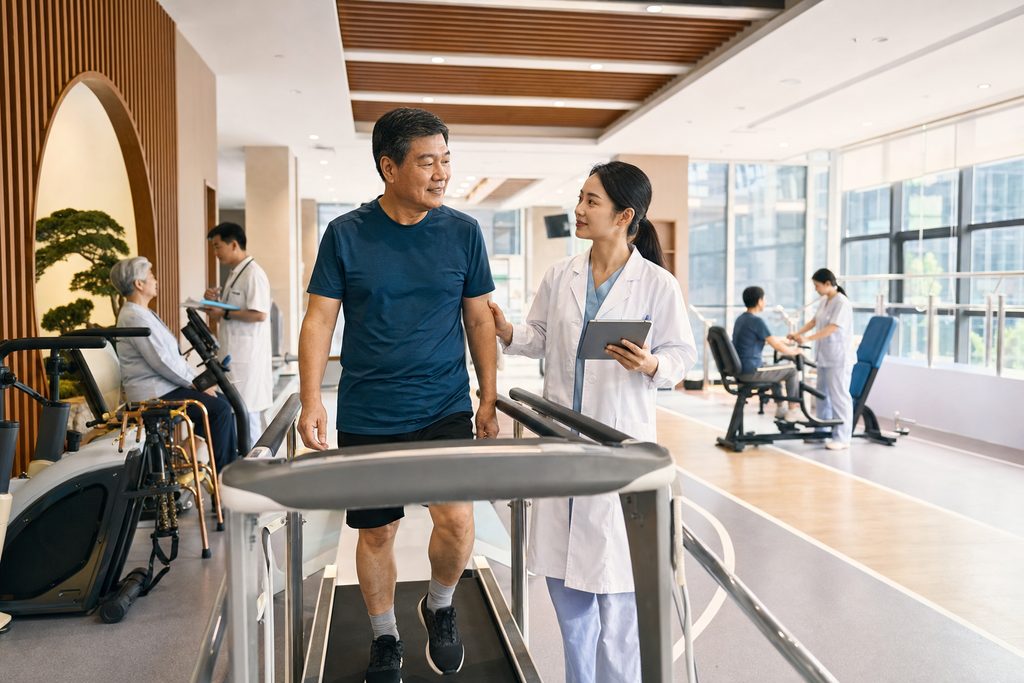
Program structure varies by hospital, but the core components are consistent across major centers. A typical Phase II program runs 12 weeks with three sessions weekly. Each session lasts 60-90 minutes and includes monitored aerobic exercise, resistance training, and patient education.
The intake process starts with a cardiopulmonary exercise test to establish baseline functional capacity and identify any exercise-induced arrhythmias or ischemic thresholds. This data directly informs the exercise prescription. Patients with heart failure with reduced ejection fraction typically start at 40-50% of heart rate reserve, with intensity progressed based on ratings of perceived exertion and hemodynamic response. Continuous ECG monitoring is standard during supervised sessions.
Resistance training begins with elastic bands and light dumbbells — usually 40-50% of one-repetition maximum — with a focus on major muscle groups. The emphasis is on functional strength: sit-to-stand transitions, stair climbing capacity, and activities of daily living. Patient education covers sodium restriction, fluid management, medication adherence, and early warning signs of decompensation. Some programs include psychological support for the depression and anxiety that frequently accompany heart failure diagnosis.
How long is heart failure rehab program in China? The supervised Phase II component is typically 12 weeks, matching international guidelines. Some hospitals offer extended maintenance programs up to 24 weeks for higher-risk patients. Phase III — the lifelong maintenance phase — can be continued through hospital-affiliated community programs or self-directed exercise with periodic check-ins.
What You Need to Know Before Going Alone
China’s hospital system is not designed for independent international patients. That is not a criticism — it is a structural reality. The system was built to serve a domestic population of 1.4 billion people, and foreign patients represent a rounding error in total volume. Here is what breaks if you try to navigate this alone:
- Outpatient Appointments Cannot Be Pre-Booked from Overseas: Public hospital outpatient registration is same-day, in-person, and conducted in Mandarin. You cannot email a cardiology department three weeks ahead and lock in a rehab intake assessment. The only pathway for pre-arranged appointments is through hospital international departments or VIP channels — which is exactly what our coordination service accesses.
- Payment Systems Are Incompatible: Chinese public hospitals do not accept international credit cards for outpatient services. Payment is typically made via WeChat Pay, Alipay, or UnionPay bank cards — all linked to Chinese bank accounts. Foreign patients without a local intermediary face a genuine transaction barrier. International hospital departments can process wire transfers or international card payments, but this must be arranged in advance.
- Medical Records Must Be Translated Professionally: A Chinese cardiologist reviewing your rehab intake will need your echocardiogram reports, BNP levels, medication list, and cardiopulmonary exercise test results translated into medical-grade Mandarin. Google Translate is not sufficient for clinical documentation. Errors in medication names or dosage units carry real risk.
How We Help You Navigate This
Our process starts with a clinical intake review. You send us your medical records — echocardiogram, stress test, discharge summary, current medication list. Our team translates these documents and presents your case to the international department of the cardiac center best matched to your profile. We do not choose the hospital arbitrarily. A patient with ischemic cardiomyopathy and a complex revascularization history may be better served at Fuwai Hospital. A patient with heart failure with preserved ejection fraction and multiple comorbidities may benefit from the integrated cardiology and internal medicine approach at Peking Union Medical College Hospital. The match matters.
Once the hospital confirms they can accept your case, we coordinate the intake appointment, arrange a bilingual medical companion for your hospital visits, and provide guidance on S2 visa documentation. The companion handles registration, payment logistics, interpretation during exercise sessions, and any communication with the rehab team. You focus on your rehab. We handle everything around it.
For patients searching for a way to book cardiac rehab Shanghai for heart failure, the pathway runs through Zhongshan Hospital Fudan University or Ruijin Hospital — both have established cardiac rehabilitation programs with published outcomes. Shanghai also offers the advantage of a large expatriate community and English-speaking infrastructure that makes extended stays more manageable than in smaller Chinese cities.
After the program concludes, we coordinate the discharge summary translation and ensure your home cardiologist receives a complete record of your exercise prescription, progress metrics, and recommendations for ongoing maintenance. The goal is continuity, not a disconnected episode of care.
Frequently Asked Questions
No. Cardiac rehabilitation is contraindicated for patients with unstable angina, uncontrolled arrhythmias, symptomatic severe aortic stenosis, acute myocarditis or pericarditis, and decompensated heart failure requiring IV diuresis. Any patient considering travel for rehab must have medical clearance from their treating cardiologist confirming clinical stability. Our team requires this documentation before initiating any hospital coordination. We do not override clinical judgment.
A 12-week program requires a stay of approximately 13-14 weeks. Budget $1,200-2,500 for the rehab program itself, $3,000-6,000 for accommodation depending on city and standard, $1,500-2,500 for round-trip airfare, $1,500-2,500 for living expenses, and $1,500-2,500 for our coordination and companion services. Total all-in costs typically range from $9,000 to $16,000. This compares to $8,000-15,000 for the rehab program alone in the US, before any travel or accommodation costs. The economics work differently for different patients — we are transparent about the full picture so you can make an informed decision.
You are exercising in a hospital setting with continuous ECG monitoring and a crash cart within immediate reach. The supervising team includes physicians and nurses trained in advanced cardiac life support. If a serious event occurs, you are already inside the hospital that would treat you — not in a community gym or remote rehab center. That said, emergency care in China operates on a pay-before-treatment model for uninsured foreign patients. We strongly recommend travel medical insurance that covers cardiac events and medical evacuation. We can recommend insurers familiar with medical travel to China, but we do not sell insurance and receive no commissions from any provider.
Most “packages” marketed to international patients bundle the clinical rehab program with accommodation, airport transfers, translation services, and sometimes cultural activities or dietary support. The clinical component is typically the same program that local patients receive — the package adds the logistical wrapper that foreign patients need. Be cautious of any package that promises outcomes or guarantees specific improvements in ejection fraction. Legitimate programs describe their protocol and let the published evidence speak for itself. We help patients access hospital-based programs directly, not third-party wellness retreats that may lack proper cardiac monitoring capabilities.
Your Next Step
Heart failure rehabilitation works. The evidence is settled. The problem has always been access — cost, wait times, geography, and system fragmentation. China’s top cardiac centers offer a structurally different model: high-volume, protocol-driven, cost-efficient, and increasingly integrating evidence-based TCM modalities that support long-term adherence. It is not the right pathway for every patient. For clinically stable patients who understand their condition and want to take an active role in their recovery, it is an option worth serious evaluation.
If you would like to understand whether this pathway fits your clinical situation, contact our team for a free consultation. We will review your medical records, discuss your goals, and help you determine whether a Chinese cardiac rehabilitation program makes sense for you — without pressure, without promises, and with full transparency about what is realistic.
For more medical information and treatment options in China, visit chinamedservices.com (China Medical Services).
