Low-Dose CT Lung Scan: Cost, Safety & How to Book One in China
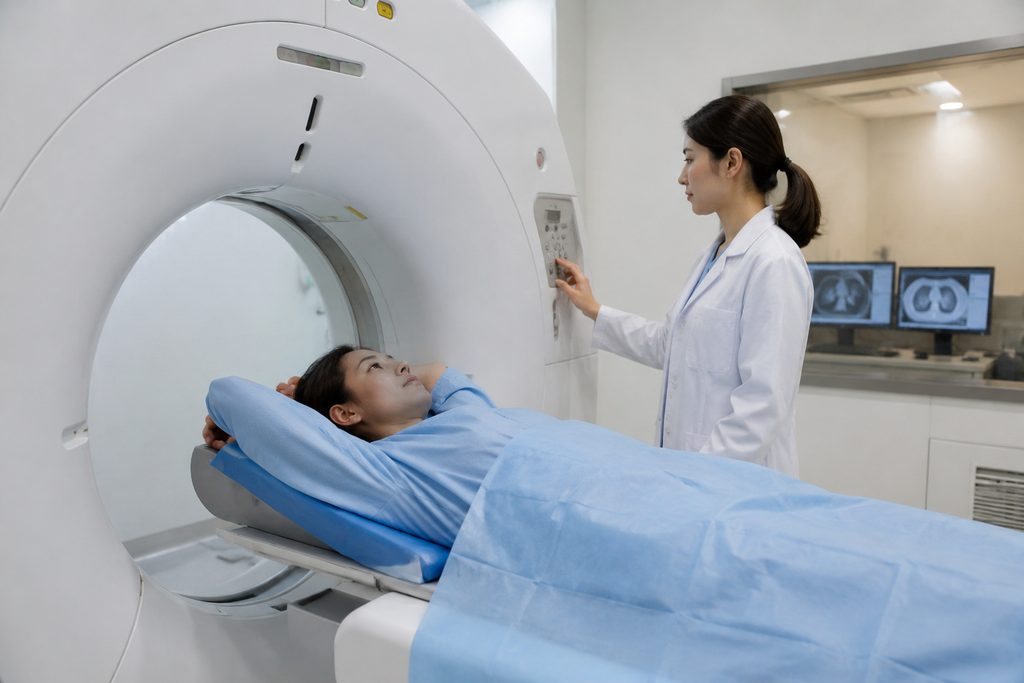
While a lung cancer screening CT in the United States routinely runs between $300 and $1,000 without insurance, the same low-dose protocol at a top-tier Chinese hospital typically costs between $80 and $250. That price gap exists because of structural cost differences, not a compromise on equipment. Hospitals in Shanghai and Beijing operate the same Siemens and GE scanners found in major Western centers, often with shorter booking lead times for self-pay international patients.
So what is a low-dose CT lung scan, exactly? It is a computed tomography examination that uses roughly 75% less ionizing radiation than a standard chest CT while still producing images detailed enough to detect nodules as small as 2–3 millimeters. The scan itself takes under 10 seconds of actual imaging time. No contrast dye. No needles. You lie on a table, hold your breath once, and it is done.
For high-risk individuals — long-term smokers, people with occupational asbestos exposure, or those with a family history of lung cancer — this single test remains the only screening method proven in randomized trials to reduce lung cancer mortality. The U.S. National Lung Screening Trial reported a 20% reduction in lung cancer deaths among high-risk patients screened with low-dose CT compared to chest X-ray.
Our team at China Medical Services regularly coordinates these scans for international patients who want a fast, affordable baseline or a follow-up after an incidental finding. The process is more straightforward than most people assume, but there are real logistical details worth understanding before you book a flight.
How This Actually Works, Step by Step
You do not need a referral from a Chinese doctor to initiate the process. But you do need a clear entry point, and that is where the sequence matters.
First, you send us your basic information: age, smoking history, any prior chest imaging reports, and your preferred city. If you have existing CT images from your home country, even better — a radiologist will want to compare them. We then match you with a hospital from our database of 340+ top-ranked hospitals across 37 cities. For lung screening, that typically means a major public hospital’s international medical department or a JCI-accredited private hospital.
The hospital confirms an appointment slot. You receive a date and time, usually within 3 to 7 business days of your request. On the day of the scan, a bilingual medical companion meets you at the hospital, handles registration and payment, translates your history for the technician, and stays with you through the entire visit. The scan itself takes about 15 minutes from check-in to completion.
Results are typically available within 24 to 48 hours. A radiologist issues a written report in English. If a nodule is found, the report will classify it by size, density, and morphology using the Lung-RADS system — the same standardized framework used in the U.S. and Europe. From there, you decide whether to pursue a follow-up scan, a written second opinion, or a video consultation with a thoracic specialist.
That is the whole pathway. No hospital admission. No overnight stay. Most patients schedule the scan on day two of their trip and spend the rest of the week however they like.
What Is a Low-Dose CT Lung Scan for Smokers — and Who Should Get One
The evidence on this is specific, and it matters. The U.S. Preventive Services Task Force recommends annual low-dose CT screening for adults aged 50 to 80 who have a 20 pack-year smoking history and currently smoke or quit within the past 15 years. A pack-year means smoking one pack per day for one year. Two packs a day for ten years? Also 20 pack-years.
China’s own screening guidelines are broader in some respects. The National Cancer Center of China has piloted screening programs that include younger age thresholds and lower pack-year cutoffs, reflecting the country’s lung cancer burden. Lung cancer has been the most common cancer in China for over a decade, with approximately 820,000 new cases diagnosed annually. That volume has pushed Chinese radiology departments to become exceptionally efficient at high-throughput lung CT interpretation.
But screening is not for everyone. If you are under 50 with no smoking history and no symptoms, a low-dose CT is unlikely to change your management — and it will expose you to radiation you do not need. That is a conversation to have with a doctor, not a decision to make from a Google search.
For smokers who do meet criteria, the scan answers one question: is there a nodule that warrants closer follow-up? Most nodules found on first screening are benign. Roughly 95% of detected nodules are not cancer. The point is to establish a baseline and then track any changes over time.
A Realistic Timeline
Here is what a typical international patient experiences, from first inquiry to completed scan and report.
| Stage | What Happens | Typical Duration |
|---|---|---|
| Day 1–2 | Initial inquiry; you send medical history and any prior imaging | 1–2 days |
| Day 3–5 | Hospital matching and appointment confirmation | 2–3 days |
| Week 1–2 | Visa application (S2 for medical treatment) if not already held | 5–10 business days |
| Week 2–3 | Travel to China; scan performed at the hospital | 1 day on-site |
| Day after scan | Radiology report issued in English; images provided on CD or via secure link | 24–48 hours |
| Week 3–4 | Optional follow-up: written second opinion or video consultation with a specialist | 3–7 days |
The step people forget is document translation. If you bring prior CT images or reports in a language other than English or Chinese, those need to be translated before the radiologist can meaningfully compare them. Budget an extra 2–3 days for that if it applies.
Visa timing also deserves attention. The S2 visa is the appropriate category for short-term medical treatment in China. Processing times vary by embassy and nationality, but plan for at least two weeks of buffer. We provide the hospital invitation letter and supporting documents, but we never guarantee visa approval — that decision rests entirely with the consulate.
What Can Go Wrong — and What Happens Then
Let us be direct about the failure modes, because pretending they do not exist helps no one.
The most common issue is an incidental finding. The scan detects a nodule that turns out to be benign, but now you need a follow-up in 6 or 12 months. That means either returning to China or getting a comparable scan at home. If you choose the latter, we can send your images and report in DICOM format to any hospital you designate.
Another failure mode: the appointment gets rescheduled. It happens. A hospital’s radiology department may shift your slot by a day or two due to equipment maintenance or emergency cases. Our team rebooks and adjusts your itinerary. This is rare in our experience, but it is not zero.
Language friction is real in Chinese public hospitals. The international medical departments have English-speaking staff, but the imaging technicians and front-desk clerks may not. Without a bilingual companion, a self-pay foreign patient can lose an hour just finding the right floor. That is not an exaggeration; it is the daily reality of navigating a hospital that sees 10,000+ outpatient visits per day.
And then there is the question of what the scan cannot tell you. A low-dose CT shows morphology — size, shape, density. It does not diagnose cancer. If a suspicious nodule is found, the next step is usually a PET-CT, a biopsy, or short-interval follow-up. We can coordinate those, but they are separate procedures with separate costs and separate risks.
Is Low-Dose CT Scan Safe in China? Standards, Equipment, and Radiation Dose
The short answer is yes, with qualifications. The radiation dose from a modern low-dose chest CT is typically 1 to 1.5 millisieverts (mSv). For context, natural background radiation exposes you to about 3 mSv per year. A standard diagnostic chest CT delivers around 7 mSv. So the low-dose protocol cuts exposure by roughly 80%.
Chinese hospitals that serve international patients use the same equipment brands found in Western academic centers: Siemens SOMATOM, GE Revolution, Canon Aquilion. The JCI-accredited private hospitals in Shanghai and Beijing follow international radiation safety protocols, including automatic exposure control and iterative reconstruction algorithms that reduce dose without sacrificing image quality.
What should give you pause is the variability across the broader Chinese hospital system. There are 35,000+ hospitals in China. The top 5% — the ones in our database — are ranked by Fudan University’s hospital rankings or hold JCI accreditation. Those are the ones we work with. A low-dose scan at an unranked, non-accredited facility may use older equipment with higher radiation output. That is not a risk we would advise anyone to take.
So the safety question is less about “China” as a monolith and more about which hospital you choose. Pick a Fudan-ranked or JCI-accredited institution, and the safety profile matches international standards. Pick a random hospital without vetting, and you are gambling.
Low-Dose CT Lung Scan Cost China: A Realistic Price Breakdown
Let us talk numbers, because that is what most people searching this topic actually want to know.
| Item | Typical Cost in China (USD) | Typical Cost in the U.S. (USD) |
|---|---|---|
| Low-dose chest CT (self-pay, public hospital international dept.) | $80–$150 | $300–$1,000 |
| Low-dose chest CT (JCI private hospital) | $150–$250 | $500–$1,200 |
| Radiology report in English | Usually included | Often included |
| Bilingual medical companion (half day) | from $300 | N/A |
| Written second opinion from a top specialist | $300–$500 | $500–$2,000+ |
The low dose ct lung scan cost China offers is not a promotional gimmick. It reflects lower labor costs, higher patient throughput, and a healthcare financing system that does not inflate imaging prices the way the American insurance billing model does. The scan itself is the same test.
What is not included in that base price: your flight, your hotel, your visa fee, and the cost of any follow-up procedures. If the scan finds a nodule requiring a PET-CT, that adds another $500–$1,000. If you need a biopsy, the price climbs further. Budget for the scan, but do not assume the scan is the end of the road.
If you want to book low dose ct scan Beijing package, the practical route is to contact us with your dates and medical history. We confirm availability at a specific hospital, send you a written quotation, and lock the appointment once you approve. There is no obligation to proceed with anything beyond the scan itself. And if you later decide to pursue treatment in China, any consultation fees you paid are credited in full toward the on-the-ground coordination service within 90 days.
Best Hospital for Lung Cancer Screening Shanghai: How to Evaluate Your Options
Shanghai has several institutions with strong thoracic imaging and oncology programs. Fudan University-affiliated hospitals dominate the Fudan specialty rankings for oncology and respiratory medicine. Zhongshan Hospital, affiliated with Fudan University, is consistently ranked among China’s top hospitals for thoracic surgery and pulmonary care. Shanghai Chest Hospital is a dedicated specialty center focused entirely on lung and esophageal disease — a rarity even internationally.
But “best” is the wrong frame if you only need a screening scan. A low-dose CT is a standardized protocol. The variation between a good hospital and an excellent hospital for this specific test is small. What matters more is logistics: English-language support, appointment availability, and clean image export for follow-up at home.
For screening purposes, any of the Fudan-ranked public hospital international departments or a JCI-accredited private hospital in Shanghai will serve you well. If the scan finds something that requires intervention, then the hospital choice becomes critical — and that is a conversation worth having with a thoracic surgeon, not a website.
You can browse our ranked hospital database to see which institutions in Shanghai and elsewhere meet the Fudan or JCI bar. And our oncology department rankings show which hospitals lead in lung cancer specifically.
Practical Considerations: Records, Visa, Payment, and Follow-Up
Bring every prior chest image you have. Not just the reports — the actual DICOM files on CD or USB. A radiologist comparing a new nodule to a scan from two years ago can often tell you immediately whether it is stable or changing. That single comparison can save you a biopsy.
For the visa, apply for an S2 visa with a letter from the hospital confirming your appointment. The S2 is the correct category for short-term medical treatment and private affairs. Processing takes 5 to 10 business days at most consulates. Do not book a non-refundable flight until the visa is in your passport.
Payment at Chinese public hospitals is upfront. You pay for the scan before it is performed. International medical departments accept credit cards and sometimes international insurance, but reimbursement is between you and your insurer. Private JCI hospitals like United Family or Jiahui often bill international insurers directly.
After the scan, get the images in DICOM format, not just a PDF report. If you later want a second opinion from a U.S. or European radiologist, they will want the raw images. We provide them to you on a USB drive or via secure download link before you leave the hospital.
And one honest note: if the scan is clean, you will not hear from us again unless you reach out. We do not run retention email campaigns for patients who got what they came for.
Frequently Asked Questions
Yes. In China, self-pay patients can book a low-dose CT directly through a hospital’s international medical department or a private JCI hospital. You do not need a referral from a Chinese physician. However, if you have a known lung condition or prior abnormal findings, we strongly recommend a pre-scan consultation so the radiologist knows what to look for.
The protocol is different. A low-dose CT for lung cancer screening uses approximately 1 to 1.5 mSv of radiation, compared to about 7 mSv for a standard diagnostic chest CT. The images are optimized to detect small pulmonary nodules rather than to evaluate the heart or mediastinum in detail. For screening purposes, the low-dose protocol is the standard of care.
At a Fudan-ranked or JCI-accredited hospital, yes. The radiation dose is comparable to what you would receive at a Western academic center. The equipment is the same. The variable is hospital selection — stick to the top 5% of Chinese hospitals, and the safety profile is consistent with international standards.
Expect to pay $80 to $150 at a public hospital’s international department and $150 to $250 at a JCI private hospital. This is the self-pay price, with the English-language radiology report typically included. The price varies by hospital and case complexity, but it is consistently a fraction of U.S. self-pay rates.
Most nodules are benign. If the radiologist identifies a nodule, the report will classify it using the Lung-RADS system, which guides next steps. A small, solid nodule may simply need a follow-up scan in 12 months. A larger or suspicious nodule may warrant a PET-CT or biopsy. We can coordinate those follow-up procedures in China, or you can take the DICOM images back to your home physician.
Your Next Step
A low-dose CT lung scan is one of the highest-value screening tests in modern medicine — and the cost difference between China and Western countries makes it accessible to people who might otherwise skip it. The key is doing it at the right hospital with the right coordination.
We are China Medical Services. We match international patients with top
For more medical information and treatment options in China, visit chinamedservices.com (China Medical Services).
