Nanjing Rehab Ranked 2nd in China: Real Cost and Quality for International Patients
Key Takeaways
- Jiangsu Province Hospital‘s Rehabilitation Medicine Center is ranked 2nd nationally in China’s most authoritative hospital ranking system, placing it above 99% of all Chinese hospitals for this specialty.
- Inpatient rehabilitation costs at this center run a fraction of equivalent Western programs — structural economics, not quality compromises, drive the difference.
- The hospital operates on a massive scale within China’s public system. Navigating it without Mandarin fluency and local process knowledge is genuinely difficult.
- Remote evaluation through a written second opinion or video consultation is the logical first step. It confirms whether your specific case matches this center’s strengths before you commit to travel.
The Problem: When Rehab Wait Times and Costs Block Recovery
Stroke remains a leading cause of long-term disability worldwide. In the United States alone, approximately 795,000 people suffer a stroke each year, according to the CDC. For survivors, the clock starts ticking immediately. The first three to six months post-stroke represent a critical window for neuroplasticity — the brain’s ability to rewire itself. Delay intensive rehabilitation during this period, and functional recovery potential diminishes sharply.
But accessing that intensive therapy is a struggle in many Western healthcare systems. Inpatient rehabilitation facilities in the US often carry price tags exceeding $1,500 to $2,000 per day. Even with insurance, out-of-pocket costs can be ruinous. In countries with public systems like the UK’s NHS or Canada’s provincial plans, the barrier is not cost but time. Patients can wait weeks or months for a bed in a specialized inpatient rehabilitation unit. The window narrows while the patient waits at home or in an acute-care bed not designed for intensive therapy.
For a family watching a loved one lose mobility, speech, or independence day by day, that waiting period is agonizing. The question becomes: is there a way to access world-class rehabilitation immediately, at a cost that doesn’t drain a lifetime of savings?
Why Nanjing Jiangsu Province Hospital’s Rehab Program Delivers Results
Jiangsu Province Hospital, also known as the First Affiliated Hospital of Nanjing Medical University, is not a niche boutique clinic. It is a massive, 136-year-old institution with over 5,000 beds. Its Rehabilitation Medicine Center operates at a scale and clinical density that creates a self-reinforcing cycle of expertise. The center’s ranking — 2nd in China in the Fudan University hospital specialty rankings — reflects peer recognition of both clinical output and research influence.
Clinical Volume Drives Pattern Recognition
Rehabilitation is a specialty where therapist experience correlates directly with patient outcomes. A therapist who has guided 500 stroke patients through hand-function recovery sees patterns and adjusts protocols in ways a therapist handling 50 cases simply cannot. At this center, the patient volume is extraordinary. The rehabilitation department manages a continuous flow of complex neurological cases — stroke, traumatic brain injury, spinal cord injury — alongside orthopedic and cardiopulmonary rehabilitation. That concentrated case volume means the team encounters and solves rare complications regularly. For the patient, it means the rehabilitation plan isn’t theoretical. It is battle-tested.
Integrated Traditional and Modern Techniques Under One Roof
The center combines conventional Western rehabilitation — physical therapy, occupational therapy, speech-language pathology — with evidence-based Traditional Chinese Medicine modalities. Acupuncture for spasticity management and motor recovery has a substantial body of clinical research behind it. The center’s ability to integrate both approaches within a single inpatient stay removes the fragmentation patients often face when seeking complementary therapies separately. One care team, one unified treatment plan, one set of clinical records.
Cost Advantage Without Quality Compromise
This is the objection every international patient raises, and it deserves a direct answer. How can a top-ranked rehabilitation center charge significantly less than a US or European facility? The answer is structural, not qualitative. Chinese hospital pricing is set by provincial health authorities, not by market negotiation with insurers. Physician and therapist salaries in China’s public system are a fraction of Western levels — not because of lower skill, but because of different labor-market economics and a public-service model. The hospital’s massive scale spreads fixed costs across a huge patient base. The result: inpatient rehabilitation costs at this center run approximately $200 to $400 per day, depending on therapy intensity and ward class. Comparable programs in the US routinely bill $1,500 to $2,500 daily. The clinical staff are board-certified specialists publishing in international journals. The equipment is modern. The cost difference is a function of economics, not a signal of lower quality.
What a Typical Inpatient Rehab Stay Actually Looks Like
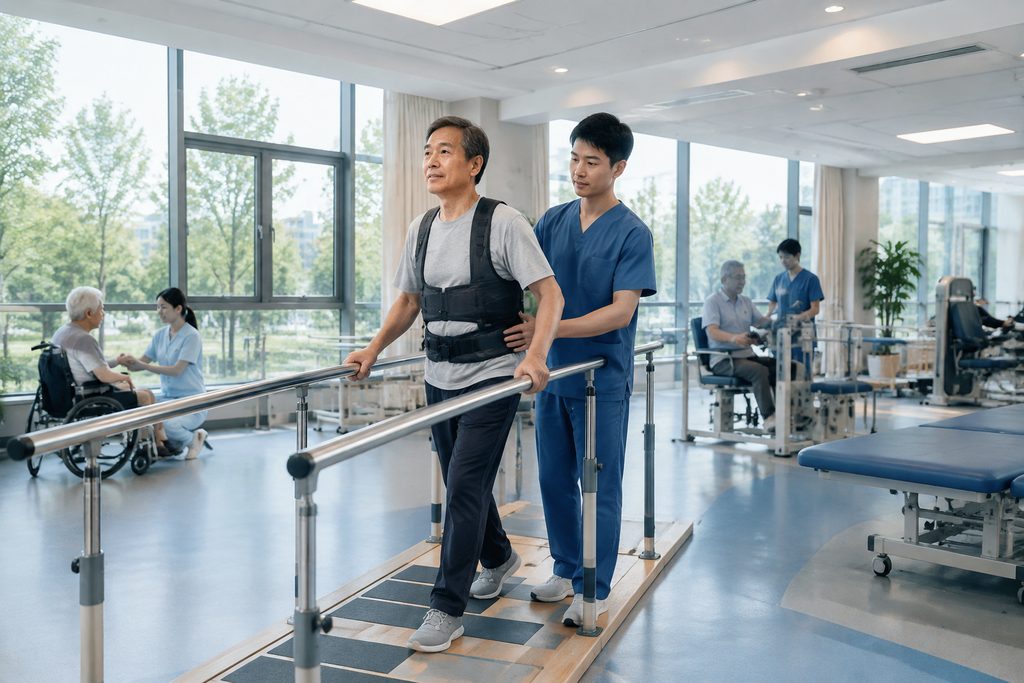
If you are considering this center, you need to understand the daily rhythm — not just the ranking and the price. A typical inpatient day starts early. Morning therapy sessions begin around 8:00 AM and run through noon. A patient recovering from a stroke might spend the first hour with a physical therapist working on gait training and balance. The second hour shifts to occupational therapy — fine motor skills, activities of daily living like dressing and feeding. After a lunch break and rest period, afternoon sessions often include speech therapy or acupuncture, depending on the individual treatment plan.
Therapy intensity is high. Patients commonly receive three to four hours of direct, one-on-one or small-group therapy daily. This is not a passive, rest-heavy convalescence. The center’s philosophy emphasizes active patient participation and measurable functional gains tracked weekly. Family members are encouraged — and sometimes expected — to participate in training sessions so they can support the patient after discharge. Inpatient stays typically range from two to six weeks, with the exact duration determined by progress against specific functional goals, not by an arbitrary insurance-day limit.
The hospital environment is a public Chinese hospital. That means shared wards are standard, though private rooms in the international or VIP wing are available at a higher cost. Meals are Chinese hospital food — nutritious but not Western. Family members often supplement meals. English-speaking staff exist within the rehabilitation department, but they are not ubiquitous. Relying on charades and translation apps for complex discussions about treatment goals is a recipe for frustration and miscommunication.
Who This Center Is — And Is Not — Right For
This is not a wellness retreat. It is a serious medical rehabilitation facility inside one of China’s largest and busiest hospitals. The best candidates are patients with clear, documented neurological or orthopedic conditions who are medically stable and ready for intensive therapy. Stroke survivors in the subacute phase — roughly two weeks to six months post-event — are the core patient group where this center’s expertise aligns most strongly. Spinal cord injury patients, traumatic brain injury survivors, and patients recovering from complex orthopedic surgeries also fit well.
Who should think twice? Patients with unstable medical conditions requiring frequent acute interventions. The rehabilitation center is not an ICU step-down unit. Patients who cannot tolerate three-plus hours of daily physical activity will not benefit from the program’s intensity. And patients or families who expect a Western-style private hospital experience with gourmet meals and spa-like amenities will be disappointed. This is a clinical powerhouse, not a luxury destination. The value proposition is expertise and outcomes per dollar spent, not comfort and pampering.
| Cost Comparison: Inpatient Neurological Rehabilitation | Estimated Cost Per Day (USD) | Typical Length of Stay |
|---|---|---|
| Jiangsu Province Hospital (Standard Ward) | $200–$300 | 3–6 weeks |
| Jiangsu Province Hospital (VIP/International Ward) | $350–$500 | 3–6 weeks |
| United States (Inpatient Rehab Facility) | $1,500–$2,500 | 2–4 weeks |
| United Kingdom (Private Rehab Hospital) | £800–£1,200 ($1,000–$1,500) | 4–8 weeks |
| Germany (Neurological Rehab Center) | €400–€700 ($430–$750) | 4–6 weeks |
These figures are estimates based on publicly available pricing data and patient-reported costs as of 2025. Actual costs vary by case complexity, therapy intensity, and ward selection. The Chinese hospital figures do not include international patient coordination, translation, or visa-related expenses.
Practical Considerations: Records, Visas, and Payment
Walking into Jiangsu Province Hospital as a foreign patient without preparation is a mistake. The hospital does not have a walk-in international rehabilitation intake desk. You need a plan. Start with medical records. The rehabilitation team needs to see detailed documentation: the original brain or spine imaging (MRI/CT on CD or cloud link), the acute-care discharge summary, current medication list, and ideally a brief video showing the patient’s current functional status — walking, using hands, speaking. These records must be translated into Chinese. Machine translation is not sufficient for medical documents.
For the visa, international patients seeking medical treatment in China apply for an S2 visa, with the purpose noted as medical treatment or private affairs. The hospital can provide an invitation letter and treatment confirmation once a treatment plan and dates are agreed upon. Do not apply for an M visa — that is strictly for commercial and trade activities and does not cover medical treatment. S2 visa processing times vary by embassy, but plan for at least two to four weeks. Family members accompanying the patient apply for their own S2 visas.
Payment is upfront. Chinese public hospitals require a deposit upon admission, typically covering an estimated two weeks of treatment, with periodic top-ups as the stay continues. The hospital accepts UnionPay cards, Chinese bank transfers, and some international credit cards at the international wing, but do not count on Visa or Mastercard working smoothly in the standard wards. Cash in RMB is reliable but carries its own logistical burden. Most international patients wire funds to a Chinese bank account or use a coordination service that handles payment logistics. US and European private health insurance rarely provides direct billing with Chinese public hospitals. You pay the hospital, then seek reimbursement from your insurer with detailed receipts and translated medical records.
Frequently Asked Questions
Yes. The Fudan University Hospital Rankings, published annually by the Hospital Management Institute of Fudan University in Shanghai, are China’s most authoritative hospital evaluation. In the rehabilitation medicine specialty ranking, Jiangsu Province Hospital (First Affiliated Hospital of Nanjing Medical University) consistently places 2nd, behind only Huashan Hospital of Fudan University. This ranking is based on peer reputation surveys of clinical specialists nationwide combined with research output metrics. It is not a marketing award.
Standard ward inpatient rehabilitation costs run approximately $200 to $300 per day. The VIP or international ward, which offers private rooms and more English-speaking staff, ranges from $350 to $500 per day. A six-week stay in the international ward would total roughly $15,000 to $21,000 for the hospital portion alone. This does not include flights, local accommodation for family, meals, visa fees, or any coordination or translation services. Compared to a six-week US inpatient rehab stay that can exceed $80,000, the cost advantage is substantial. But it is not free, and patients must budget realistically for the total cost of a multi-week stay in a foreign country.
This is a legitimate concern that deserves a straight answer. Jiangsu Province Hospital is a full-service tertiary hospital with every medical specialty on-site. If a rehabilitation patient develops a medical complication — an infection, a cardiac event, a neurological deterioration — the acute-care team can intervene within the same hospital. You are not in a standalone rehab facility that must transfer you elsewhere for emergencies. That said, rehabilitation outcomes are not guaranteed. Some patients plateau. Some progress more slowly than hoped. The rehabilitation team adjusts the treatment plan based on weekly assessments, but the hard truth is that neurological recovery has biological limits that no hospital can override. Having realistic expectations, based on a pre-arrival review of your records by the center’s specialists, is essential.
For more on how China’s top-ranked hospitals compare across specialties, see our overview of China’s top-ranked hospitals by Fudan University ranking. If you are weighing rehabilitation against other neurological treatment options in China, our specialty-specific hospital rankings provide additional context.
Your Next Step
This center’s ranking and cost structure make it a serious option for patients who need intensive rehabilitation without the financial devastation or wait times they face at home. But the right move is not to book a flight and show up. The right move is to have the rehabilitation team review your case before you travel. A written second opinion — where our team translates and submits your records to the department for specialist review — confirms whether your specific condition, functional level, and recovery goals match what this center does best. That step costs a fraction of a plane ticket and prevents the worst outcome: arriving in Nanjing only to learn the program cannot accept your case.
For more medical information and treatment options in China, visit chinamedservices.com (China Medical Services).
