Nasopharyngeal Cancer Care in China: How the Pathway Works
Key Takeaways
- Nasopharyngeal cancer care in China usually begins with a records-based review, not a flight booking: imaging, pathology and blood results are assessed remotely before any travel decision is made.
- China carries unusual clinical depth in this disease because nasopharyngeal carcinoma is far more common in southern China than in Europe or North America, so high-volume centers see it routinely rather than occasionally.
- The hard part is not finding a hospital — it is the sequence: public hospital registration generally cannot be secured from abroad in advance, surgery and radiotherapy are scheduled only after an in-person consultation, and language barriers inside very large hospitals are real.
- Understand before committing: no provider can promise admission, a specific appointment date, or an outcome, and quoted prices vary by hospital, stage and treatment plan.
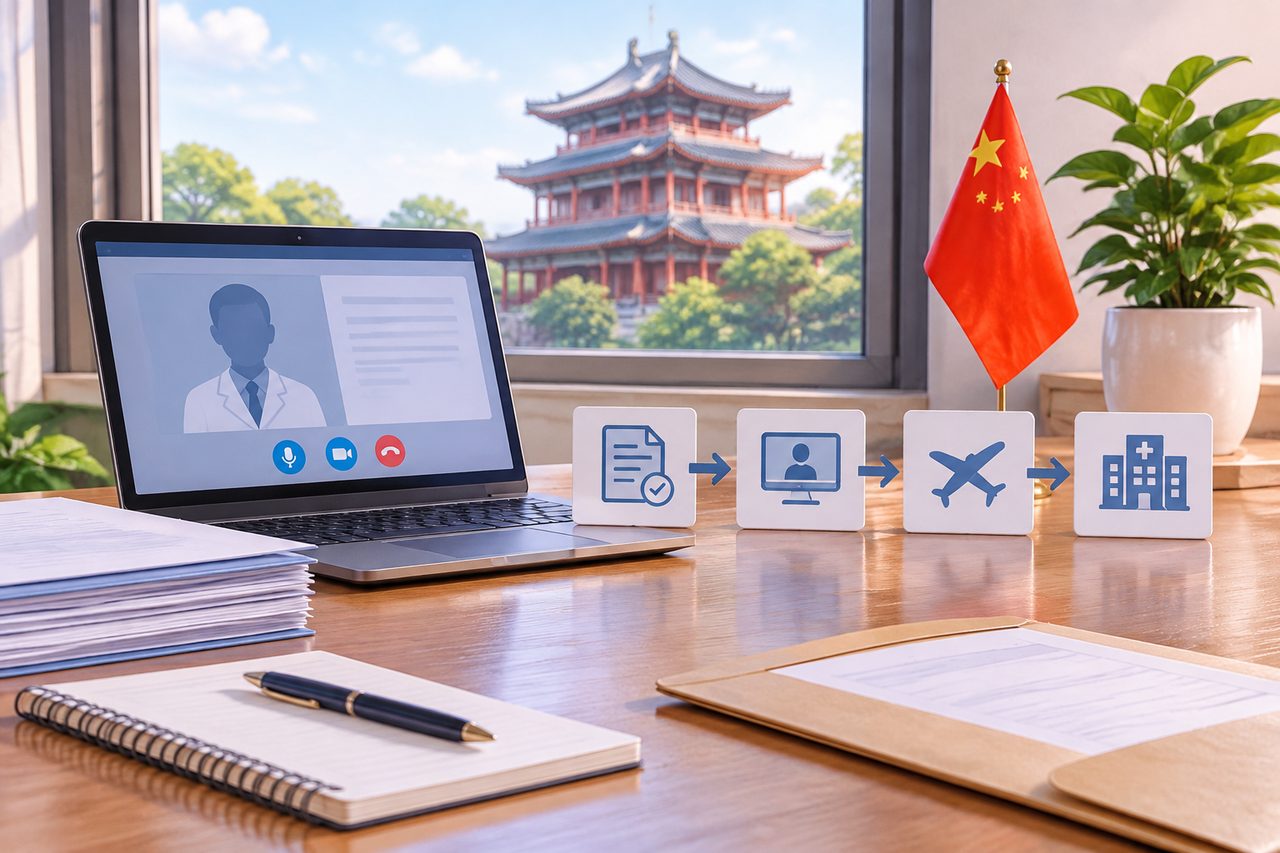
Nasopharyngeal cancer care in China follows a staged pathway: you send existing examination reports for a written second opinion or video consultation with a Chinese specialty team, you agree on a feasible plan, and only then do you travel for in-person consultation, imaging review and treatment scheduling. Nothing about that pathway guarantees admission or a particular date — but it does let you decide with real information instead of a guess.
This article explains how that pathway actually runs for nasopharyngeal carcinoma (NPC), what makes Chinese centers relevant for this specific cancer, and where the friction points sit. It is written for international patients and families who are weighing options and want the mechanics, not a sales pitch.
The Problem: A Rare Cancer With a Long, Uncertain Path
Nasopharyngeal carcinoma is uncommon in most Western countries. Incidence in the United States and much of Western Europe is estimated at well under one case per 100,000 people per year, while parts of southern China and Southeast Asia report rates many times higher. The practical consequence for a patient in, say, Ohio or Manchester is that the nearest treating team may see only a handful of NPC cases a year. That is not a criticism of those teams — it is arithmetic. Familiarity with a cancer’s imaging subtleties, radiotherapy planning and follow-up patterns tends to track case volume.
The second problem is time and money. A new diagnosis typically triggers weeks of appointments: an MRI of the nasopharynx and neck, a PET-CT or CT staging scan, a biopsy reviewed by a pathologist, then a multidisciplinary discussion about whether the plan is radiotherapy alone, chemoradiotherapy, or induction chemotherapy followed by radiotherapy. In many systems those steps queue behind each other. Meanwhile the patient is managing symptoms, fear and, often, a family budget.
China enters the picture for two reasons patients mention most: depth of experience with this particular cancer, and cost. Neither is a reason to skip diligence. Both are reasons to understand the pathway before you commit to it.
Why China Is Relevant for Nasopharyngeal Carcinoma Specifically
Case volume concentrated where the disease is common
Because NPC is endemic in parts of southern China, major centers in Guangdong and neighboring provinces evaluate and treat it continuously. That volume shapes everything downstream: imaging protocols tuned to nasopharyngeal anatomy, radiation oncology teams who plan nasopharyngeal targets routinely, and multidisciplinary meetings where NPC is a standing agenda item rather than an occasional one. When you look at China’s specialty rankings, oncology and radiotherapy departments at southern institutions appear consistently among the strongest. Our department-by-department rankings for oncology and related specialties list the top hospitals by specialty reputation, which is a more useful filter for a rare cancer than a general hospital ranking.
Radiotherapy and imaging capacity at scale
Modern NPC treatment is fundamentally a radiotherapy problem, usually intensity-modulated radiotherapy (IMRT), often combined with chemotherapy. That means the quality of the plan, the precision of daily setup and the imaging used to define targets matter enormously. Large Chinese centers run high-throughput radiation oncology departments with contemporary linear accelerators and in-house planning. The operational detail worth knowing: at big public hospitals, simulation, planning and treatment slots are sequenced through the department itself, and the schedule is set after the treating team has seen you and reviewed your imaging in person.
Cost structure that differs from Western systems
Patients frequently ask about cost first. The honest answer is that a definitive figure cannot be given before your stage, histology and treatment plan are known, and any number quoted without those details should be treated with suspicion. What can be said is structural: hospital charges in China’s public system are set administratively and are generally lower than comparable Western charges for imaging, radiotherapy and inpatient care, while private international departments price higher — often described as roughly 1.5 to 2 times the standard public pathway — in exchange for English-language service and more direct scheduling. For context on how Chinese public hospital pricing compares in another high-complexity area, our article on medical treatment in China outlines the general cost landscape. Ask for an itemized estimate in writing once a plan exists.
| Pathway element | Standard public hospital | International / VIP department |
|---|---|---|
| Registration from abroad | Generally not available in advance; same-day queue | Usually arrangeable through the department |
| Language | Predominantly Chinese | English-speaking staff commonly available |
| Relative cost | Lower | Roughly 1.5–2× standard charges |
| Payment | Prepayment required; insurance reimbursed afterward | Some accept direct insurance billing |
| Scheduling certainty | Set after in-person consultation | More coordinated, still not guaranteed |
How the Pathway Works, Step by Step
Here is the sequence as it typically runs, with realistic time markers. Timelines vary by hospital and by how complete your records are.
Step 1 — Assemble records (days 1–7). You need the diagnostic biopsy report with histology, imaging reports and, where possible, the images themselves on disc or via a cloud link, plus recent blood work including EBV DNA if it has been done. Missing pathology slides are the single most common cause of delay.
Step 2 — Remote review (days 7–21). A written second opinion from a Chinese specialty team, or a video consultation where you speak with the team directly, establishes whether the case is straightforward, what additional imaging would be needed, and roughly which treatment approach applies. Our written second opinion service is priced from $300–500 and is explicitly for reference, not a prescription. Video consultations with a standard or private international department run $100–300; top-specialist video consultations $500–800; multidisciplinary team reviews $1,500–2,000. These are service fees, billed separately from any hospital charges, and they are not deductible against later treatment costs.
Step 3 — Decide and prepare (weeks 3–6). If you proceed, the practical work begins: choosing the city and hospital, gathering visa documents, and planning accommodation near the hospital. For medical travel, the applicable short-stay visa category is S2, used for medical treatment and private affairs and subject to the latest embassy or consulate requirements and supporting hospital documents; stays beyond 180 days fall under S1. Accompanying family members apply under the same category. Approval is never guaranteed, and requirements change, so verify with the consulate before booking anything.
Step 4 — Arrival and in-person consultation (week 6 onward). This is the step patients underestimate. At public hospitals, the treating physician must see you and review your imaging before radiotherapy or any procedure is scheduled. Expect repeat or confirmatory imaging, a planning CT and simulation, and a treatment start date set by the department — not by you and not by any coordinator.
Step 5 — Treatment and follow-up. A typical definitive radiotherapy course runs over roughly six to seven weeks of daily sessions, with chemotherapy added depending on stage. Plan for a stay that covers treatment plus recovery, and discuss with the treating team how follow-up scans will be handled once you return home.
Choosing a Center and Avoiding Common Mistakes
The first mistake is choosing by city familiarity rather than by case volume in this disease. A hospital that is excellent in cardiac surgery may be an average choice for NPC. Use specialty-level information: which departments are ranked among China’s top ten for oncology or radiotherapy, how many NPC patients they treat, and whether they have a dedicated head-and-neck multidisciplinary team. Our directory of top-ranked hospitals grouped by city lets you compare institutions in Guangzhou, Shanghai, Beijing and elsewhere before narrowing down.
The second mistake is assuming an appointment can be locked in from overseas at a standard public clinic. It generally cannot. What can be arranged is coordination through an international department, or a proxy visit in which someone presents your records in person at a hospital you designate — with any later admission still subject to hospital rules.
The third mistake is treating a quote as a contract. Radiotherapy pricing depends on technique, number of fractions, chemotherapy regimen and inpatient days. Ask for the estimate broken into imaging, radiotherapy planning, daily treatment, drugs and bed fees, and ask what happens financially if the plan changes mid-course.
Be cautious with any provider that promises a specific surgeon, a guaranteed start date, or a success rate before reviewing your pathology and imaging. Those commitments cannot honestly be made for nasopharyngeal carcinoma.
Practical Considerations: Visas, Payment, Language and Follow-Up
On documentation, bring original pathology reports and slides if they can be released, imaging on disc, and a translated summary in English or Chinese. Hospitals will re-review rather than simply accept outside reads.
On payment, public hospitals require prepayment, with insurance reimbursed afterward; some private international hospitals bill insurers directly. Confirm with your insurer in advance whether they reimburse overseas treatment at all — many policies exclude or limit it.
On language, be realistic. Top Chinese hospitals are enormous, with outpatient volumes in the thousands per day, and wayfinding, registration, payment and pharmacy counters operate in Chinese. Bilingual medical companion support, from $300 per day for a half or full day, covers queueing, registration, payment, navigation and interpretation. It does not guarantee access to a named specialist.
On follow-up, ask before treatment starts who will review your post-treatment MRI and EBV DNA monitoring, and request copies of all imaging and planning documents to carry home.
Frequently Asked Questions
At standard public clinics, generally no — registration happens on the day. International departments can often coordinate a visit in advance, and a proxy consultation lets your records be reviewed in person at a hospital you choose. Admission and treatment dates are always set by the hospital after evaluation.
There is no single figure. Charges depend on stage, radiotherapy technique, chemotherapy and length of stay, and public versus international department pricing differs substantially. Request an itemized written estimate after your records have been reviewed rather than relying on general ranges.
Treatment plans do change, and Chinese treating teams adjust them as scans dictate. Discuss contingency planning with the team early, keep your insurer informed, and ensure you have copies of all records. No coordinator can guarantee a clinical course, but a clear plan reduces the chance of being caught unprepared.
Your Next Step
The core message is simple: nasopharyngeal cancer care in China is a staged process that starts with your records, not your passport, and the quality of the first review shapes everything after it. We are a coordination service, not a hospital — we do not diagnose or treat, but we connect you with Chinese specialty teams, arrange written second opinions and video consultations, and handle the logistics once a plan exists. If you would like an initial conversation about whether this pathway fits your situation, you can request a free consultation and we will tell you honestly what is and is not possible.
This article is for general information only and does not constitute medical advice. Treatment decisions should always be made with a qualified physician who has reviewed your individual case.
For more medical information and treatment options in China, visit chinamedservices.com (China Medical Services).
