Post-Surgery Infection Monitoring: How We Track Your Recovery Safety After Discharge
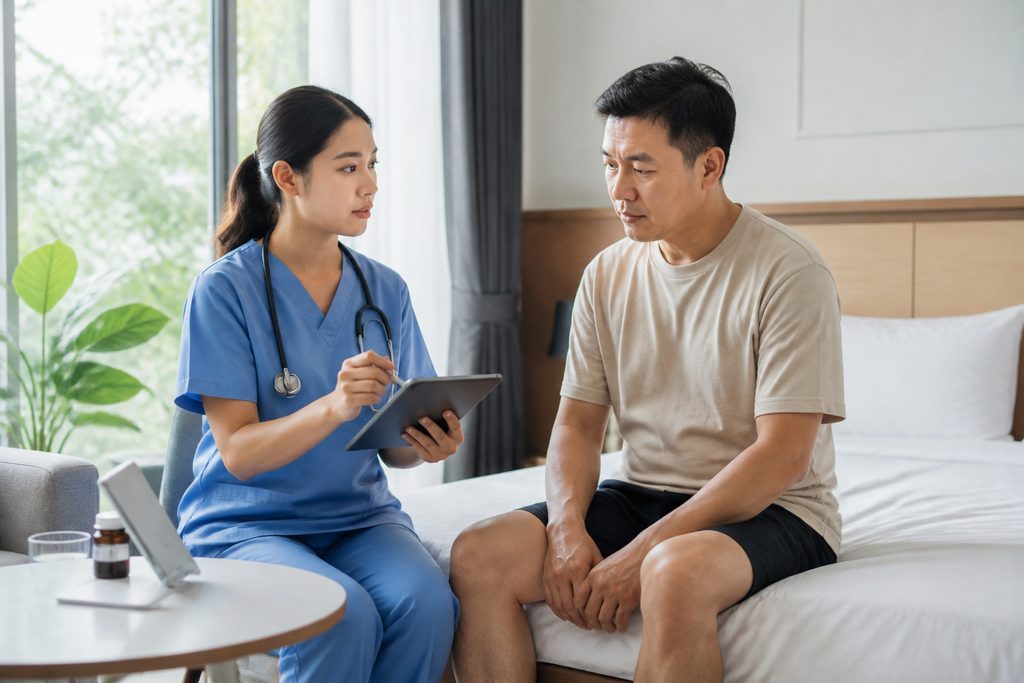
When 57-year-old David left the cardiac unit at Fuwai Hospital in Beijing, his sternum was healing well. The incision was clean. His vitals were stable. But three days later, in a serviced apartment near the embassy district, he noticed something that made his stomach drop. The skin around the lower edge of the wound looked pinker than it had that morning. Not red. Not hot. Just… different. He didn’t have a fever. He didn’t feel sick. But he was 6,000 miles from his primary care physician in Manchester, and the question that hit him was immediate: who checks this?
That question is why we built our post-treatment infection monitoring and reporting protocols. Not because complications are common. They aren’t. But because the window between discharge and full recovery is where vigilance matters most. And being far from home shouldn’t mean being far from clinical oversight.
What does post surgery infection monitoring China price actually cover? It’s not a single line item. It’s a sequence of checkpoints, lab draws, imaging reviews, and communication channels that extend from the operating theater to your flight home. This article walks through how that sequence works, what it costs, and how we make sure nothing gets missed.
How This Actually Works, Step by Step
The monitoring protocol begins before you leave the hospital.
Step one happens at discharge. Your attending surgeon’s team provides a structured handoff document. This is not a generic after-visit summary. It specifies the exact procedure performed, suture type and removal date, implant identifiers if applicable, prophylactic antibiotic course completed, and three specific clinical markers to watch based on your surgery type. For orthopedic cases, that might be peri-incisional tissue firmness. For abdominal surgeries, it’s often rebound tenderness parameters. The document is bilingual — English and Chinese — so any clinician anywhere can read it.
Step two is the 48-hour check. A member of our clinical coordination team contacts you. Not a chatbot. A person who has already reviewed your discharge summary. They run through a structured questionnaire: wound appearance, pain character, temperature trend, mobility tolerance. If anything flags — even something subtle — we escalate.
Step three is the in-person wound check, typically at day 5 or 7 depending on surgery type. This happens at the hospital’s international department or a partner clinic. A nurse or surgeon examines the site, removes sutures if scheduled, and orders labs if indicated. C-reactive protein and white cell count with differential are standard if there’s any suspicion. Results come back within hours, not days.
Step four is the reporting loop. Every assessment generates a written report in English. That report goes to you, to your surgeon’s team at the treating hospital, and — with your consent — to your doctor back home. Nothing falls through a crack because there are no cracks. Three parties see the same data at the same time.
Step five continues until departure. Depending on your procedure, we may schedule a second in-person check at day 10 or 14. Between visits, daily text-based check-ins track temperature and wound photos if you’re comfortable sharing them. The threshold for calling you back in is deliberately low. We’d rather rule out ten false alarms than miss one early infection.
What We’re Actually Watching For — and Why Timing Matters
Surgical site infections don’t announce themselves with a megaphone. They start quietly.
Superficial incisional infections typically appear between day 5 and day 10 post-op. You’ll see spreading erythema, maybe some serous drainage. It’s uncomfortable but usually manageable with oral antibiotics and local wound care if caught early. Miss it, and it can tunnel deeper.
Deep incisional infections hit the fascial and muscle layers. These tend to emerge between day 7 and day 30. The wound might partially dehisce. You’ll likely run a fever. This requires reopening, culture-guided antibiotics, and sometimes vacuum-assisted closure. Recovery time doubles.
Organ-space infections are the ones that keep surgeons up at night. After abdominal surgery, an intra-abdominal abscess can brew for two to four weeks before declaring itself. After joint replacement, a periprosthetic infection might not culture positive for three months. These are rare — affecting approximately 1% to 3% of clean surgical cases in top-tier Chinese hospitals — but they’re serious when they happen.
Our monitoring protocol is timed to catch each category in its early window. The day-5 wound check targets superficial infections. The day-10 to day-14 follow-up screens for deepening processes. And the ongoing check-in rhythm through week four creates a safety net for late-presenting complications. We’re not waiting for you to self-report. We’re actively looking.
This approach mirrors China hospital infection tracking after discharge protocols used in their Joint Commission International-accredited facilities. These aren’t ad hoc arrangements. They’re structured surveillance programs. At hospitals like Peking Union Medical College Hospital and Huashan Hospital, surgical site infection surveillance extends through 30 days post-discharge for most procedures — and 90 days for implants. The data feeds into national nosocomial infection reporting systems. Transparency isn’t optional. It’s regulatory.
A Realistic Timeline
Here’s what post-discharge infection monitoring actually looks like on a calendar. This assumes an uncomplicated recovery. If anything deviates, the schedule compresses.
| Timepoint | What Happens | Who’s Involved | Typical Duration |
|---|---|---|---|
| Day of discharge | Structured handoff document created; monitoring protocol explained; emergency contact numbers provided | Attending surgeon, ward nurse, our coordinator | 30–45 minutes |
| 48 hours post-discharge | Telephone or video check-in: wound status, pain score, temperature, mobility, oral intake | Our clinical coordination team | 15–20 minutes |
| Day 5–7 | In-person wound examination; suture removal if indicated; labs drawn if any suspicion; written report generated | Hospital international department or partner clinic | 60–90 minutes on site; report within 24 hours |
| Days 8–13 | Daily text-based check-in: temperature, wound photo (optional), any new symptoms | Our coordination team; escalation to surgeon if needed | 5 minutes daily |
| Day 10–14 | Second in-person check if surgery type warrants it; final wound assessment; clearance documentation for travel | Treating surgeon or designated follow-up clinician | 45–60 minutes |
| Day 14–30 | Weekly check-ins via messaging; any concerns trigger immediate in-person recall | Our team; surgeon on standby | Ongoing |
| Day 30–90 (implant cases only) | Monthly check-ins; optional remote consultation with treating surgeon; coordination with home-country physician | Our team, surgeon, patient’s local doctor | Monthly touchpoints |
One thing people consistently underestimate: the gap between “I feel fine” and “the labs say I’m fine.” You can feel completely well and still have a rising CRP. That’s why the day-5 visit includes labs if there’s any equivocal finding on exam. It’s also why we don’t let “I feel okay” override a scheduled check. The whole point of monitoring is finding things before you feel them.
What Can Go Wrong — and What Happens Then
Let’s be direct about failure modes. They exist. Pretending otherwise would be dishonest.
The most common problem is language friction in the gap between discharge and follow-up. You’re in an apartment, not a hospital. You don’t have a nurse call button. If something feels wrong at 11 PM, who do you call? Our protocol addresses this with a 24-hour English-language hotline staffed by coordinators who can reach your surgeon’s team directly. Not a general hospital switchboard. A specific number that goes to a person who knows your case.
Another failure mode: the wound looks fine externally but there’s a deeper collection. This is why our day-5 check includes a low threshold for ultrasound. It’s a five-minute scan that can rule out a subclinical fluid pocket. If we find one, you go straight back to your surgeon’s clinic — same day, not next week. Percutaneous drainage might resolve it in twenty minutes. Wait a week, and you’re looking at a return to the operating room.
A third scenario: you need to fly home, but the wound isn’t quite ready. Maybe there’s a small area of delayed healing. Not infected. Just slow. In that case, we coordinate a direct handoff to your home physician. That means a live phone call or video conference between your surgeon in China and your doctor at home, with a shared written summary and wound photos. You don’t become a medical mystery to your own GP. They know exactly what was done, what they’re looking at, and what to watch for.
The rarest but most serious failure mode is a rapidly progressive deep infection. It happens in less than 2% of clean surgical cases at top-tier Chinese hospitals, but it happens. If you spike a fever above 38.3°C with wound changes, our protocol triggers immediate readmission evaluation — not an appointment next week, not a “let’s watch and wait.” You go back to the hospital now. The international department has beds reserved for exactly this scenario. It’s not a guarantee of zero complications. No one can promise that. It’s a guarantee that when something goes wrong, the system responds without delay.
This is the honest answer to is post operative care safe in China. Safety isn’t about zero complications. It’s about what happens when complications occur. At the hospitals in our network — the top 5% of China’s 35,000+ medical institutions, ranked by Fudan University’s hospital assessment and JCI accreditation — post-operative surveillance is systematic, not optional. Surgical site infection rates are tracked, reported, and benchmarked. When rates rise, root cause analysis follows. That’s the same standard you’d expect at a major Western academic medical center.
How to Evaluate a Monitoring Program Before You Commit
Not all post-discharge monitoring is created equal. Here’s what to look for when you’re comparing options — whether through a medical concierge service or directly with a hospital’s international department.
First, ask about the handoff document. If the answer is “we’ll give you a discharge summary,” that’s insufficient. You need a structured, bilingual document with specific monitoring parameters. Generic instructions like “watch for signs of infection” are useless. You need “if the skin around your incision is firm, warm, or spreading redness beyond 2 cm from the wound edge, call this number.”
Second, ask who does the checking. Is it a clinician or an administrator? A nurse or surgeon examining your wound is different from a coordinator asking how you feel. Both have roles. But the in-person checks should involve someone who can distinguish a normal healing ridge from an early abscess. At our partner hospitals, follow-up wound checks are done by the surgical team or a dedicated wound-care nurse — not a general practitioner who’s never seen your operation type.
Third, ask about the escalation pathway. “Call the hospital if you have concerns” is not a pathway. A real pathway specifies: who you call, what happens when you call, how quickly you’ll be seen, and who makes the clinical decision. Our protocol includes a named escalation contact, a 60-minute callback guarantee for non-urgent concerns, and a direct-to-clinic route for anything urgent.
Fourth, ask about data sharing with your home physician. If the monitoring program can’t or won’t send reports to your doctor at home, you’re creating a gap in your longitudinal record. This matters especially for implant surgeries, where late infections can occur months later. Your orthopedist in London needs to know exactly which prosthesis was implanted and what the early post-op course looked like.
Finally, ask about medical tourism infection reporting services cost transparency. Some programs bundle monitoring into a flat fee. Others charge per visit. Neither is inherently better, but you need to know what you’re paying for. Our post-discharge monitoring packages start from $800 for a standard 14-day protocol including two in-person visits, daily check-ins, and all reporting. Complex cases requiring extended monitoring through 30 or 90 days are priced based on the specific surgery and surveillance requirements. That cost is separate from the hospital’s own follow-up charges, which are billed directly by the hospital at their standard international department rates.
Practical Considerations: Records, Visas, and Payment
Post-discharge monitoring has logistical dimensions that matter as much as the clinical ones.
Your medical records need to travel with you — and ahead of you. Before discharge, we ensure your complete operative report, anesthesia record, implant logs, and discharge summary are digitized and shared securely with you and your home physician. These aren’t scanned photocopies. They’re certified English translations of the original Chinese documents, formatted to be legible to any clinician worldwide. If you need to book follow up care after surgery China, having these records ready eliminates the “we don’t know what was done” problem that plagues cross-border care.
Visa duration matters more than people realize. A standard S2 visa for medical treatment typically allows a stay that covers your hospitalization plus a reasonable recovery period. But if your monitoring protocol extends to day 30 or beyond, you need to plan for that from the start. We advise patients to request a visa duration that covers surgery, initial recovery, and the full monitoring window — plus a one-week buffer. Visa extensions within China are possible but inconvenient. Getting it right upfront saves stress.
Payment for monitoring services is straightforward. Our coordination fees are invoiced in advance and can be paid via wire transfer or credit card. Hospital charges for follow-up visits, labs, and imaging are paid directly to the hospital at the time of service. If you have international health insurance, we provide the documentation needed for reimbursement — but most insurers treat post-discharge monitoring as part of the surgical episode, which means it’s often covered under the same pre-authorization.
Language remains the invisible barrier. Even if your surgeon speaks English, the ultrasound technician, the phlebotomist, and the wound-care nurse might not. That’s why our monitoring protocol embeds bilingual coordination at every touchpoint. When you show up for your day-5 wound check, a coordinator is present to translate clinical observations in both directions. You’re never guessing what was said. You’re never nodding along to a conversation you don’t fully understand.
Frequently Asked Questions
How do I check for infection after surgery when I’m recovering abroad?
You watch for four specific signs: spreading redness beyond the immediate incision line, increasing pain rather than decreasing pain, cloudy or foul-smelling drainage, and temperature above 38°C. But self-monitoring has limits. You can’t see your own CRP level. You can’t palpate your own deep tissues objectively. That’s why structured follow-up with a clinician matters. Our protocol combines daily self-checks using a simple four-question assessment with scheduled in-person examinations. If you’re ever unsure, you call. The threshold for getting checked is deliberately low.
What does post surgery infection monitoring cost in China?
Our coordination fees for a standard 14-day monitoring protocol start from $800, covering two in-person wound checks, daily remote check-ins, bilingual reporting, and escalation management. Hospital charges for the actual clinical visits, labs, and any imaging are separate and paid directly to the hospital — typically ranging from $150 to $400 per visit at international departments, depending on what’s performed. Extended monitoring for implant surgeries through 90 days is priced case by case. Compared to equivalent monitoring programs in the US or Europe, the cost is roughly 60% to 70% lower, reflecting the broader cost advantage of Chinese healthcare.
Can I book follow-up care after surgery in China if I’ve already gone home?
Yes, but the model shifts from in-person to remote. If you’ve returned to your home country and need follow-up with your Chinese surgical team, we can arrange a video consultation. Your surgeon reviews any new imaging or labs you’ve had done locally, discusses your recovery progress, and provides written recommendations. The cost for this ranges from $100 to $300 depending on the specialist. It’s not a replacement for local care — you still need a physician who can examine you — but it ensures continuity with the team that knows your case best.
Is post-operative care safe in China for international patients?
At the hospitals we work with, yes. These are institutions in the top 5% of China’s 35,000+ hospitals, many with JCI accreditation and surgical site infection surveillance programs that meet international benchmarks. Post-operative infection rates for clean surgical cases at these hospitals run approximately 1% to 3% — comparable to major Western centers. What makes care safe isn’t the absence of complications. It’s the presence of systematic monitoring, rapid escalation pathways, and clinicians who practice at high volume. A surgeon who does 500 knee replacements a year has seen
For more medical information and treatment options in China, visit chinamedservices.com (China Medical Services).
