Proton Beam Therapy Cost in China: 2026 Price Ranges and Hospital Access
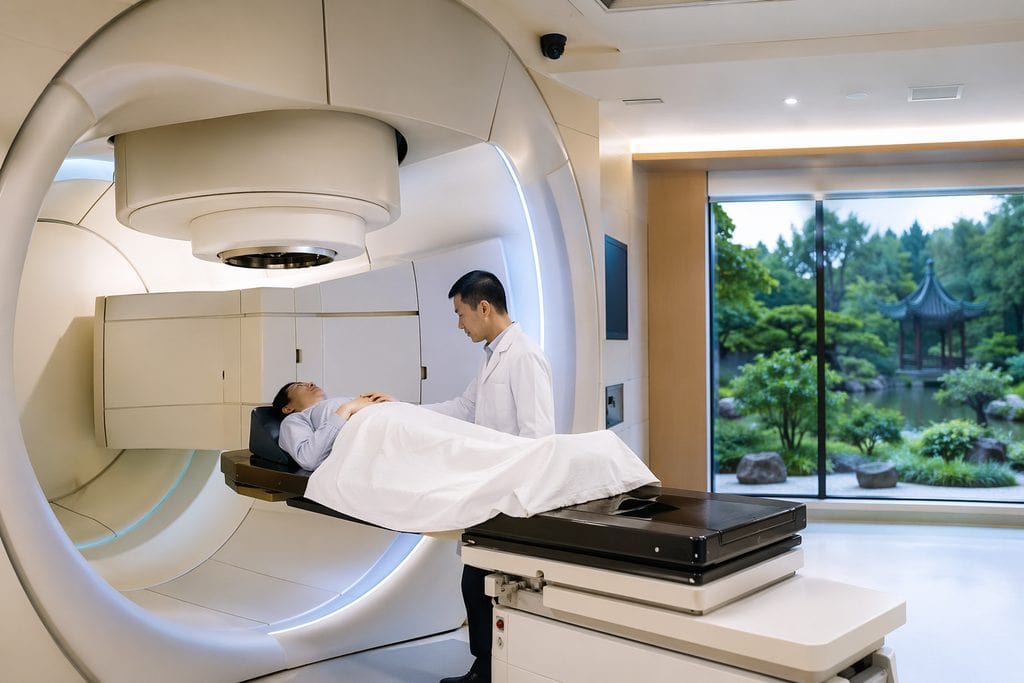
Proton beam therapy cost China figures sit far below Western price tags — but the number depends on the hospital, the tumor type, and the number of fractions your radiation oncologist prescribes. At China’s proton centers, international patients typically pay between $25,000 and $45,000 for a full course of treatment. In the United States, the same course at a comparable facility usually runs $100,000 to $200,000 or more. That gap is why so many families now search for proton therapy medical tourism China options, and why the question of whether proton beam therapy is available in China has moved from niche curiosity to mainstream research.
The short answer: yes, it is available, at a small number of specialized centers, and the cost advantage is real. The longer answer involves candidacy rules, waiting logistics, and a few honest caveats. Here is what our team has learned guiding international patients through the process.
Key Takeaways
- A full proton beam course in China generally costs $25,000–$45,000, versus $100,000–$200,000+ in the US — roughly a 70–80% saving.
- China operates a limited number of dedicated proton facilities, concentrated in major cities like Shanghai and Beijing, so availability depends heavily on tumor type and timing.
- Not every cancer qualifies. Proton therapy suits specific solid tumors near sensitive organs, and the final decision always rests with the treating radiation oncologist.
- Costs vary by hospital and case complexity, and you should confirm a written estimate before committing to travel.
The Problem: Proton Therapy Is Excellent — and Priced Like It
Proton therapy is one of the most precise forms of radiation available. Instead of passing through healthy tissue and exiting the far side of the body, a proton beam deposits most of its energy at a controlled depth. That spares surrounding organs in ways conventional X-ray radiation cannot always match.
The catch has always been money. A single proton treatment room costs tens of millions of dollars to build, and the machines require specialist staff and heavy maintenance. Those costs land on the patient. In the United States, a prostate cancer course frequently exceeds $150,000. For a pediatric brain tumor, where proton therapy is often the preferred option, families can face bills above $200,000 before insurance negotiations even begin.
Insurance coverage is inconsistent. Many US insurers approve proton therapy only for a narrow list of indications, and appeals can take months. Meanwhile, the patient’s treatment clock keeps ticking. That combination — clinical need plus financial and bureaucratic friction — pushes thousands of patients each year to look overseas.
Why China Has Become a Serious Option
China did not build its proton infrastructure overnight. The country now operates a small but growing network of proton and heavy-ion centers, several of them inside top-ranked academic hospitals. For international patients, three structural advantages stand out.
Clinical Volume Produces Deep Experience
Chinese radiation oncology teams treat enormous patient volumes. A single major cancer center may see more cases in a year than many Western hospitals handle in several. That volume translates into pattern recognition — teams have seen the rare presentations, the difficult anatomies, the edge cases. Proton centers attached to these hospitals inherit that institutional experience. The physicians running the gantry are often the same specialists who sit on national guideline committees.
Technology at Scale, Not Technology as Novelty
Newer Chinese proton facilities were built with current-generation equipment from the start. That matters. Some older Western centers still operate first-generation systems with narrower beam capabilities. Several Chinese installations use pencil-beam scanning, the technique that allows intensity-modulated proton therapy and sharper dose shaping around irregular tumors. The operational workflow is also built for throughput: imaging, simulation, planning, and daily treatment are co-located, which shortens the gap between consultation and first fraction.
Cost Advantage Without a Quality Trade-Off
This is the objection every patient raises, and it deserves a straight answer. Lower prices in China do not come from cutting corners on the machine or the physics team. They come from labor economics, hospital efficiency, and government investment in the facilities themselves. A radiation oncologist’s salary in China is a fraction of a US counterpart’s, and the capital cost of the equipment was often subsidized. The clinical protocols — fractionation schedules, dose constraints, immobilization — follow international standards because Chinese teams publish in the same journals and attend the same conferences as everyone else.
You are not buying a discount version of proton therapy. You are buying the same physics in a market where the price of delivering it is lower.
Proton Beam Therapy Cost in China: Real Numbers by City and Tumor Type
Prices below reflect ranges our team has seen quoted to international patients at major Chinese proton centers. They are estimates only. Final pricing depends on the number of fractions, the complexity of planning, whether anesthesia is needed, and the hospital’s international department rates.
| Treatment Scenario | Typical Fractions | Estimated Cost in China | US Comparison |
|---|---|---|---|
| Prostate cancer, localized | 20–39 | $28,000–$40,000 | $100,000–$150,000 |
| Pediatric brain tumor | 28–33 | $35,000–$45,000 | $150,000–$200,000+ |
| Head and neck cancer | 30–35 | $32,000–$44,000 | $120,000–$180,000 |
| Skull base tumor (e.g., chordoma) | 35–40 | $38,000–$45,000 | $150,000–$200,000 |
| Lung cancer, early stage | 15–30 | $25,000–$38,000 | $90,000–$140,000 |
For readers specifically asking how much proton therapy costs in Beijing versus proton therapy price in Shanghai, the honest answer is that the two cities land in similar territory. Beijing centers tend to price slightly higher at the top end because demand from international patients is heavier. Shanghai facilities sometimes offer more competitive packages for longer fractionation schedules. Neither city is dramatically cheaper than the other. The bigger variable is your tumor type and how many fractions your plan requires.
Is Proton Beam Therapy Available in China for International Patients?
Availability is the question that trips people up. China has proton centers. What China does not have is unlimited capacity, and international patient slots are a subset of total capacity.
Here is how the pathway actually works. You submit your existing imaging, pathology reports, and treatment history for review. A radiation oncologist at the proton center evaluates whether your case fits accepted proton indications. If it does, the hospital provides a treatment plan and a cost estimate. Only then does scheduling begin.
Two practical realities deserve emphasis. First, most Chinese public hospitals cannot be booked for a specialist consultation from overseas in the way a Western clinic can. You generally cannot simply reserve a proton slot online. Second, proton therapy almost always requires an in-person evaluation before the treatment plan is finalized — imaging must be repeated on the hospital’s own equipment for planning purposes.
This is where a structured remote consultation changes the experience. Sending records for a written second opinion or a video consultation with the radiation oncology team lets you learn whether you are a candidate, what the plan would look like, and what it would cost — before you buy a plane ticket. If you want to understand the broader hospital landscape first, our overview of China’s top-ranked hospitals by city shows which institutions anchor the country’s cancer care.
Who Qualifies — and Who Should Look Elsewhere
Proton therapy is not universally superior to conventional radiation. For many cancers, modern photon techniques like IMRT produce equivalent outcomes at lower cost and with wider availability. Choosing proton therapy for the wrong indication means paying more for no clinical benefit.
Broadly accepted indications include pediatric solid tumors, where sparing growing tissue matters enormously; skull base and spinal tumors adjacent to the brainstem or optic structures; certain head and neck cancers; prostate cancer in patients prioritizing bowel and bladder sparing; and recurrent tumors in previously irradiated areas. Some liver and lung tumors also qualify when motion management is feasible.
Cases that usually do not qualify: widespread metastatic disease requiring systemic therapy as the primary approach, tumors in locations where proton dosimetry offers no meaningful advantage, and patients whose overall health makes a multi-week daily treatment schedule impractical. A radiation oncologist makes this call — not a website, and not a facilitator.
Be cautious of any service that promises a proton slot before a physician has reviewed your records. Candidacy is a medical determination. No coordination service can guarantee it.
Practical Considerations: Visas, Payment, and Follow-Up
International patients coming to China for medical treatment typically enter on an S2 visa, which covers short-stay medical treatment and private affairs, with accompanying family members applying under the same category. For stays exceeding 180 days, S1 applies. Requirements shift, so confirm current documentation with the nearest Chinese embassy or consulate — and note that hospital-issued invitation or treatment confirmation letters are usually part of the application package.
Payment at public hospitals is generally upfront, with insurance reimbursement pursued afterward by the patient. Private international hospitals more often offer direct billing with certain insurers. Bring a payment method that works in China; international card acceptance has improved but is not universal, and large transactions may hit bank limits. For the visa specifics, see our guide to the medical travel process and support services.
Follow-up is the piece patients underestimate. Proton therapy involves daily sessions over several weeks. Plan for a stay of six to eight weeks including evaluation, planning, treatment, and initial recovery checks. Ask before you commit how the hospital will share imaging and treatment records with your home oncologist afterward, and confirm that a written treatment summary in English will be provided.
Frequently Asked Questions
Yes, substantially. A full course in China typically runs $25,000–$45,000 against $100,000–$200,000+ in the US. The saving comes from lower labor and facility costs, not from reduced treatment quality. Exact pricing varies by hospital and case complexity.
Usually not as a simple online booking. Most centers require record review and an in-person evaluation before finalizing a treatment plan. A remote consultation is the standard first step, and it tells you whether you qualify before you travel.
Plan on six to eight weeks. That covers initial evaluation, imaging and planning, the daily treatment course itself, and a short recovery observation period. Fractionation schedules vary by tumor type.
Coverage depends entirely on your insurer and policy. Some international health plans reimburse overseas treatment; many do not. Public Chinese hospitals typically require upfront payment with documentation provided for later reimbursement claims. Verify with your insurer before committing.
Your Next Step
The core message is simple: proton beam therapy in China offers the same physics at roughly a quarter of the Western price, but candidacy and scheduling are medical decisions that require a physician’s review. Our team at China Medical Services connects international patients with the right hospitals — we are not a hospital and we do not diagnose or treat anyone. What we do is help you get your records in front of the appropriate specialists, understand the realistic cost, and navigate the logistics if treatment goes ahead. If you would like a clear picture of your options, start with a conversation through our patient consultation page — no obligation, and no pressure.
This article is for general information only and does not constitute medical advice. Treatment decisions should always be made with a qualified physician who has reviewed your individual case.
For more medical information and treatment options in China, visit chinamedservices.com (China Medical Services).
