Rotator Cuff Repair Revision in China: Why Peking University Third Hospital Leads in Failed Shoulder Surgery Recovery
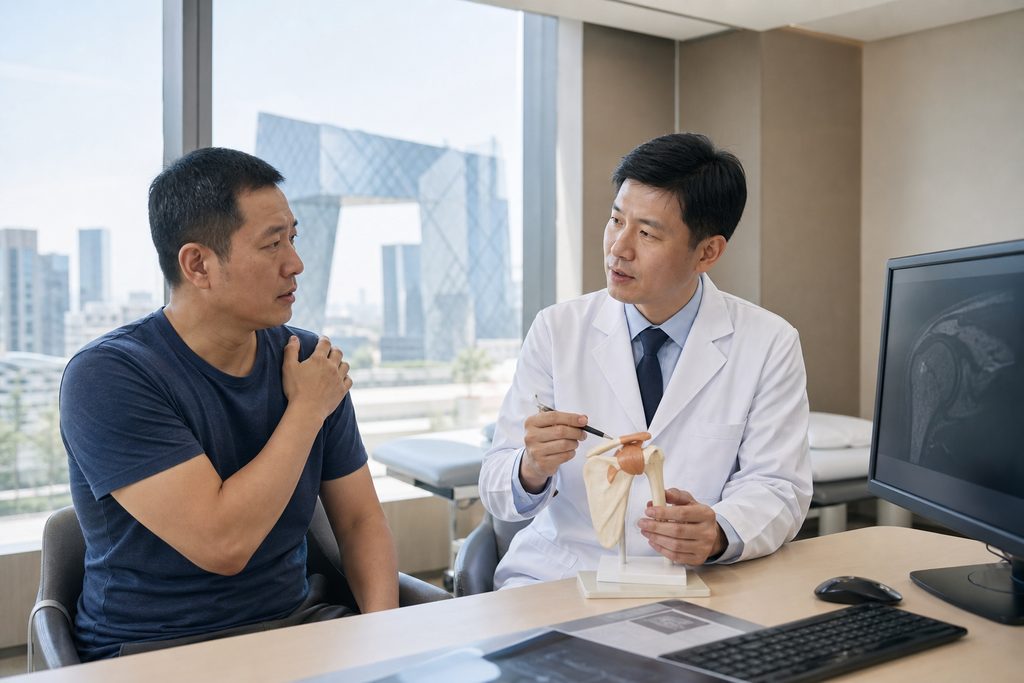
When 49-year-old David, an engineer from Manchester, felt the familiar sharp pain return six months after his rotator cuff surgery, the disappointment hit harder than the physical ache. His local surgeon had been optimistic. The MRI told a different story: a full re-tear. The NHS wait for a revision consultation stretched past four months, and a private quote for a complex arthroscopic redo approached £14,000. He started searching for alternatives. What he found challenged his assumptions about where world-class orthopedic care happens.
David’s situation is not rare. Rotator cuff repair failure affects between 13% and 68% of patients depending on tear size, tissue quality, and patient age, according to a meta-analysis published in the *Journal of Shoulder and Elbow Surgery*. For large and massive tears, the failure rate sits stubbornly at the higher end of that range. A failed repair means more than pain. It means weakness, sleep disruption, and the creeping fear that the shoulder will never be right again. For patients facing this reality, the question shifts from “what went wrong?” to “where do I go now?”
The answer for a growing number of international patients lies in Beijing.
Who We Are
We are China Medical Services. We are not a hospital. We do not provide medical treatment, clinical diagnoses, or surgical opinions. What we provide is precision logistics. Our team bridges the gap between you and China’s top-tier hospitals—translating medical records, coordinating with hospital international departments, securing appointments, and placing a bilingual medical companion at your side through every step of the process. We operate across 340+ top-ranked hospitals in 37 cities. When a patient needs revision shoulder surgery, we know exactly where to direct them.
The Problem: When a Shoulder Repair Fails, Time Works Against You
A failed rotator cuff repair is not simply a surgical complication. It is a progressive structural problem. The tendon retracts further. The muscle atrophies. Fatty infiltration—where muscle tissue is replaced by fat—advances with each passing month. A 2021 study in *Arthroscopy: The Journal of Arthroscopic & Related Surgery* demonstrated that patients who underwent revision rotator cuff repair more than 12 months after symptom onset showed significantly worse functional outcomes and higher re-tear rates than those treated earlier.
This creates a cruel equation. Public health systems in the UK, Canada, and parts of Europe impose wait times that directly conflict with the biological window for optimal revision surgery. Private care eliminates the wait but introduces a financial barrier that stops many patients cold. In the United States, a revision rotator cuff repair typically costs between $25,000 and $50,000 depending on complexity, implant choice, and facility fees. Even with insurance, out-of-pocket costs frequently exceed $10,000.
The patient is caught between two unacceptable options: wait too long or pay too much.
And yet there is a third path.
Why Peking University Third Hospital Delivers Results Where Others Could Not
Peking University Third Hospital—known throughout China as PKU Third Hospital—houses one of the highest-volume sports medicine and shoulder surgery departments in the world. The department performs over 8,000 sports medicine procedures annually, with shoulder arthroscopy representing a significant and growing share. This is not a general orthopedics unit that does shoulders on the side. This is a dedicated sports medicine center where revision shoulder surgery is a core competency, not an occasional case.
Volume Breeds Pattern Recognition
Revision rotator cuff repair is fundamentally different from primary repair. The anatomy is distorted by scar tissue. Anchors from the first surgery may have pulled out, leaving bone defects. The tendon stump is often retracted and of poor quality. Identifying the failure mechanism—biological, mechanical, or technical—requires a surgeon who has seen hundreds of failure patterns, not dozens.
A surgeon at a high-volume center like PKU Third Hospital’s sports medicine department may perform 150 to 250 shoulder arthroscopies per year. Compare this to the average US orthopedic surgeon, who performs roughly 30 to 50 shoulder scopes annually according to data from the American Board of Orthopaedic Surgery. For revision cases specifically, the gap widens further. Most general orthopedists in Western community hospitals see fewer than ten revision rotator cuff cases per year. At PKU Third Hospital, the sports medicine team encounters revision cases weekly.
This matters because revision shoulder surgery rewards experience. A 2023 systematic review in the *American Journal of Sports Medicine* found that surgeon volume was independently associated with lower complication rates and better functional outcomes in revision rotator cuff repair. The surgeons who do this work every day simply see things others miss.
Technology Deployed at Scale
The hospital’s sports medicine operating theaters are equipped for the full spectrum of revision techniques. Standard arthroscopic revision with suture anchor re-fixation is the baseline. When the tendon cannot be mobilized adequately due to retraction, surgeons here routinely perform superior capsule reconstruction using dermal allograft or autograft techniques. For cases with irreparable tears and significant arthritis, reverse total shoulder arthroplasty is available as a salvage procedure—all within the same department, by surgeons who perform these operations regularly.
Diagnostic capability matters just as much. PKU Third Hospital operates high-field 3T MRI units with dedicated shoulder protocols. Post-operative imaging interpretation is nuanced; distinguishing a partial re-tear from normal post-surgical change requires radiologists who read shoulder MRIs daily. The hospital’s musculoskeletal radiology team provides exactly that expertise.
Cost Without Compromise
This is where the economics shift decisively in the patient’s favor.
A revision rotator cuff repair at Peking University Third Hospital through the international patient pathway typically costs between $8,000 and $15,000. The range depends on complexity: a straightforward arthroscopic revision with anchor replacement sits at the lower end; a procedure requiring superior capsule reconstruction or extensive bone grafting moves toward the upper end. Even at the high end, the cost runs roughly one-third to one-half of equivalent private care in the United States or United Kingdom.
These figures include surgeon fees, hospital charges, anesthesia, and standard implant costs. They do not include travel, accommodation, or our coordination services—but those are additive costs measured in thousands, not tens of thousands.
Why the difference? Not because of lower quality. Chinese hospital pricing reflects different structural economics. Physician salaries are lower relative to Western benchmarks. Hospital overhead is leaner. The volume-driven operational model squeezes inefficiency out of the system. Implant costs are lower due to domestic manufacturing and different supply chain dynamics. The clinical outcomes, as measured by re-tear rates and functional scores, are comparable to top Western centers. The cost difference reflects economics, not corner-cutting.
| Procedure | China (PKU Third Hospital) | US Private | UK Private |
|---|---|---|---|
| Arthroscopic Revision Rotator Cuff Repair | $8,000 – $12,000 | $25,000 – $40,000 | £10,000 – £16,000 |
| Revision with Superior Capsule Reconstruction | $12,000 – $15,000 | $40,000 – $55,000 | £16,000 – £22,000 |
| Reverse Shoulder Arthroplasty (Salvage) | $15,000 – $20,000 | $50,000 – $70,000 | £18,000 – £25,000 |
All figures are estimates and vary by hospital and case complexity. China prices reflect international patient pathway rates, not local standard pricing.
Can a Failed Rotator Cuff Repair Be Fixed in China? The Evidence Says Yes
The short answer: in most cases, absolutely. The longer answer requires understanding what makes a revision succeed or fail.
Revision rotator cuff repair succeeds when three conditions are met. First, the failure mechanism must be correctly identified—was it a traumatic re-injury, poor tendon healing, anchor pullout, or an unrecognized tear pattern from the start? Second, the revision technique must address that specific mechanism, which may require a different approach than the primary surgery. Third, the post-operative rehabilitation protocol must be tailored to the revision context, which typically means slower progression and longer protection of the repair.
PKU Third Hospital’s sports medicine team approaches revision cases systematically. Pre-operative workup includes high-resolution MRI with intra-articular contrast when indicated, CT scanning to assess bone stock and anchor position, and a detailed physical examination to distinguish cuff dysfunction from stiffness, nerve injury, or cervical spine referral. The surgical plan is built around the specific failure mode, not a generic “redo” approach.
What about outcomes? What is the success rate of revision rotator cuff surgery abroad? Published data from high-volume centers—including PKU Third Hospital’s own published series—report patient satisfaction rates in the 75% to 85% range for revision rotator cuff repair, with re-tear rates of 15% to 25% depending on tear size and patient factors. These numbers align with outcomes reported from major Western centers. The surgery is demanding and not every revision succeeds perfectly, but the majority of appropriately selected patients achieve meaningful pain relief and functional improvement.
The best sports medicine surgeon Beijing shoulder redo specialists are not hiding their results. The department has contributed to the international literature on revision techniques, including publications on double-row fixation for revision cases and biologic augmentation strategies. This is not a black box. The expertise is documented, peer-reviewed, and transparent.
What You Need to Know Before Going Alone
Traveling to China for revision shoulder surgery is not as simple as booking a flight and showing up. Several structural barriers make independent navigation genuinely difficult.
- Visa Requirements: Medical treatment in China requires an S2 visa with a notation specifying the treatment purpose. The application requires an invitation letter from the treating hospital, a detailed treatment plan, and proof of financial means. Hospitals issue invitation letters only after confirming the patient’s suitability for treatment—which requires medical records review first. The process has a logical sequence, but missing a step means starting over. Family members accompanying the patient also need S2 visas. The M visa is for commercial business and has no relevance to medical travel.
- Hospital Access and Registration: Peking University Third Hospital is a public institution serving a massive domestic patient population. The standard outpatient registration system operates in Mandarin, requires a Chinese ID number or local phone number for account creation, and releases appointment slots that fill within minutes. Walk-in registration without language support is effectively impossible. The international patient pathway bypasses this system, but it must be arranged in advance through the hospital’s international department—not by showing up at the front desk.
- Payment and Logistics: Chinese public hospitals operate on a pre-payment model. You deposit funds before admission, and services are drawn against that balance. International credit cards are not universally accepted. Hospital billing is in Chinese; itemized statements for insurance reimbursement require translation. The hospital campus is enormous—PKU Third Hospital spans multiple buildings—and signage is predominantly in Chinese. A patient navigating this alone, one-armed and post-operative, faces a genuinely difficult experience.
These barriers are real. They are not insurmountable, but underestimating them leads to frustration, delays, and in the worst case, arriving in Beijing without a confirmed surgical slot.
How We Help You Navigate This
Our role is not to perform surgery or offer medical opinions. Our role is to remove every logistical obstacle between you and the surgical care you need.
The process begins before you travel. You send us your medical records—operative notes from the primary surgery, imaging studies, physical therapy records, and any correspondence with your treating surgeon. We have these translated into clinical Chinese by medical translators who understand orthopedic terminology. We submit the translated records to the international department at Peking University Third Hospital and coordinate a formal review by a sports medicine specialist.
If the surgeon determines you are a candidate for revision, we receive a treatment plan and a cost estimate. We share both with you in English. You make the decision. We do not push. We do not sell. We present what is possible and let the clinical facts speak.
Once you decide to proceed, we handle the hospital invitation letter needed for your S2 visa application. We provide detailed guidance on the visa process, including document checklists and timelines. We book your initial consultation appointment through the international patient channel—a confirmed slot, not a hope.
When you arrive in Beijing, a bilingual medical companion meets you. This person handles registration, payment deposits, queue navigation, and translation during every clinical encounter. You speak with your surgeon through someone who understands both languages and the medical context. You are never left guessing what was said or what happens next.
During the surgical admission, your companion remains available. After discharge, we coordinate follow-up appointments, imaging, and rehabilitation guidance. When you return home, we facilitate remote follow-up communication with the surgical team if questions arise post-operatively.
The cost for our coordination service—covering hospital appointment arrangement, document translation, visa invitation processing, and bilingual companion support—starts from $300 for appointment coordination, with full companion packages from $200 per day. For patients seeking end-to-end management, our VIP coordination package ranges from $5,000 to $8,000. These are coordination fees only; hospital treatment charges are separate and paid directly to the hospital.
Frequently Asked Questions
How do I know if my failed repair can be revised at Peking University Third Hospital?
The determining factors are the size of the re-tear, the degree of tendon retraction, the quality of the remaining tendon tissue, and the presence or absence of significant arthritis in the shoulder joint. The surgical team reviews your MRI and clinical history before accepting a case. Some tears are not reconstructable and require alternative procedures like tendon transfers or reverse arthroplasty. You receive an honest assessment, not a guarantee. The remote written second opinion process, priced from $300 to $500, provides that assessment before you commit to travel.
What is the Peking University Third Hospital shoulder revision cost compared to staying in my home country?
For most international patients, the total cost—including surgery, hospital stay, travel, accommodation, and our coordination fees—runs 40% to 60% less than private surgery in the US or UK. A revision that costs $35,000 in the US might total $14,000 to $18,000 all-in through the PKU Third Hospital international pathway. The exact figure depends on procedural complexity, implant requirements, and length of stay. We provide a detailed cost breakdown after the surgical team reviews your case.
What happens if the revision surgery does not work?
Revision rotator cuff surgery carries a documented failure rate of 15% to 25%, and no ethical surgeon guarantees success. If the revision fails, the treatment pathway depends on the failure mode. Some patients benefit from a second revision attempt. Others are better served by a tendon transfer procedure or reverse shoulder arthroplasty. PKU Third Hospital’s sports medicine department offers the full range of salvage options. The key is having a surgeon who can recognize failure early and pivot to the appropriate next step—which is precisely the capability a high-volume revision center provides.
How long do I need to stay in Beijing for revision shoulder surgery?
Plan for approximately two to three weeks. The first few days involve pre-operative consultation, examination, and any repeat imaging the surgeon requires. The surgery itself typically requires a two to three-day inpatient stay. The remaining time allows for wound checks, suture removal, and initial post-operative rehabilitation instruction before you are cleared to fly. Some patients stay longer if they wish to complete early rehabilitation under the surgical team’s supervision, but two weeks is the practical minimum.
Do I need to speak Chinese to receive treatment at PKU Third Hospital?
Through the standard public hospital pathway, yes—navigating the system without Mandarin proficiency is extremely difficult. Through the international patient pathway with a bilingual medical companion, no. Your companion translates all clinical conversations, handles administrative tasks, and ensures you understand every step. The surgeons in the sports medicine department have experience working with international patients and are comfortable operating through a translator. The system works because we bridge the language gap at every point of contact.
Your Next Step
A failed rotator cuff repair closes one door. It does not close all of them. Peking University Third Hospital offers revision expertise built on high surgical volume, specialized shoulder surgeons, and a systematic approach to failure analysis—at a cost that makes treatment accessible to patients who would otherwise face impossible waits or unaffordable bills.
If you are considering revision shoulder surgery and want to understand whether PKU Third Hospital is a viable option for your specific case, start with a conversation. We review your records, coordinate a surgical assessment, and provide an honest, evidence-based recommendation. No pressure. No sales pitch. Just the information you need to make an informed decision about your shoulder and your future.
Request a free consultation to discuss your case with our patient coordination team.
Medical Disclaimer: This article is for informational purposes only and does not constitute medical advice. Surgical outcomes vary by individual patient factors including tear size, tissue quality, age, and comorbidities. Always consult a qualified orthopedic surgeon for personalized assessment and treatment recommendations. China Medical Services does not provide medical treatment or clinical opinions.
For more medical information and treatment options in China, visit chinamedservices.com (China Medical Services).
