West China Hospital Radiology: China’s #1 Diagnostic Imaging and Intervention Center
Key Takeaways
- West China Hospital‘s radiology department handles over 1.4 million imaging studies annually — a clinical volume that drives diagnostic accuracy few Western centers can match.
- Interventional radiology procedures at West China Hospital typically cost 60-80% less than equivalent procedures in the United States, with published outcomes comparable to major academic medical centers.
- The hospital’s public outpatient system cannot be booked from overseas — imaging appointments require in-person registration and a Chinese-speaking physician’s order, creating a genuine barrier for international patients.
- Understanding the cost structure, appointment workflow, and documentation requirements before you travel prevents wasted days and unnecessary repeat scans.
The Problem: Diagnostic Uncertainty Should Not Cost a Year’s Salary
A brain MRI with contrast at a major US hospital runs $3,000 to $7,000 without insurance. A PET-CT scan can exceed $5,000. For patients with high-deductible plans or no coverage at all, a single diagnostic workup becomes a financial crisis. Approximately 43% of American adults report delaying medical care due to cost, according to a 2022 Kaiser Family Foundation survey. That delay is not abstract. It means a suspicious lung nodule goes uninvestigated for six months. It means a spine condition deteriorates while a patient saves money for imaging.
The math gets worse when intervention enters the picture. A uterine fibroid embolization in the United States costs $15,000 to $30,000. A transarterial chemoembolization for liver cancer can hit $40,000. These are not luxury procedures. They are standard-of-care treatments that interventional radiologists perform daily. The price tag alone forces patients into impossible choices.
West China Hospital sits at the intersection of two realities: it operates one of the largest and most technically equipped radiology departments in the world, and it does so within a cost structure that reflects China’s healthcare economics — not America’s. For patients who need answers and cannot afford to wait, that intersection matters.
Who We Are
We are not a hospital. We do not provide medical treatment, read scans, or offer clinical diagnoses. Our team functions as your logistical bridge to China’s top-tier medical institutions — including West China Hospital. We coordinate appointments, arrange bilingual medical companions who physically accompany you through registration and examination, and ensure your imaging studies and reports are delivered in a format your home physician can use. We handle the friction so you can focus on getting answers.
Why West China Hospital Radiology Delivers Results
Clinical Volume at a Scale That Sharpens Diagnostic Accuracy
The radiology department at West China Hospital performs more than 1.4 million imaging examinations each year. That figure places it among the highest-volume academic radiology departments globally. A radiologist here reads more chest CTs in a month than many community radiologists in the West read in a year. Volume does not guarantee accuracy by itself — but it correlates strongly with pattern recognition. A 2019 study published in Radiology found that radiologists who interpret higher annual volumes of screening mammography demonstrate significantly better cancer detection rates and lower false-positive rates. The same principle applies across modalities. When a department sees rare presentations regularly, rare presentations become recognizable.
The department is also the official National Clinical Research Center for Geriatrics imaging hub and a designated training base for the Chinese Medical Association’s radiology residency program. It is not simply a high-throughput scanning center. It is where China’s radiology standards are set.
Equipment That Matches Any Academic Medical Center in the World
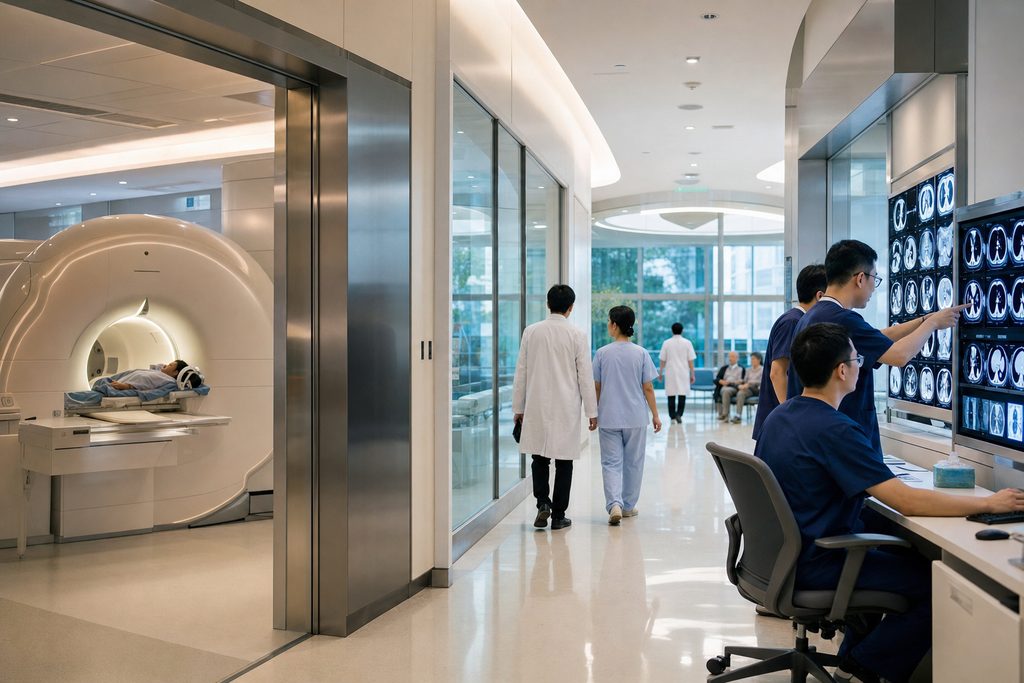
Walk through the imaging floors at West China Hospital and you will see familiar names: Siemens, GE Healthcare, Philips. The department operates multiple 3.0 Tesla MRI units, dual-source CT scanners capable of cardiac imaging without beta-blockers, and a fleet of interventional angiography suites. The PET-CT and SPECT-CT installations support both oncology staging and functional brain imaging.
This is not a department making do with outdated hardware. Equipment refresh cycles are aggressive. The hospital is a flagship site for several manufacturers, meaning new technology often debuts here before reaching smaller markets. For international patients accustomed to top-tier imaging at institutions like Massachusetts General Hospital or Charité in Berlin, the technical environment at West China Hospital will feel familiar — because it is the same equipment.
Interventional Radiology: High Volumes, High Complexity
The interventional radiology division handles approximately 30,000 procedures annually. That covers the full spectrum: transarterial chemoembolization (TACE) for hepatocellular carcinoma, radiofrequency and microwave ablation for liver and lung tumors, uterine artery embolization, vertebroplasty and kyphoplasty, percutaneous biliary drainage, and complex vascular interventions including aortic stent-graft placement.
China carries a disproportionate share of the global liver cancer burden — approximately half of all new cases worldwide. West China Hospital sits in Sichuan province, a region with historically high hepatitis B prevalence and corresponding liver cancer incidence. The IR team manages an extraordinary caseload of TACE and ablation procedures. A typical interventional radiologist here may perform 300-500 TACE procedures per year. That concentrated experience is difficult to replicate in Western centers where liver cancer volumes are distributed across many smaller programs.
For patients asking “is West China Hospital radiology department good” — the answer depends on what matters to you. If you value a department that sees more of your specific condition in a month than your local hospital sees in three years, the answer is yes. If you require English-speaking staff at every touchpoint, the answer is more complicated — which is exactly where coordination support becomes essential.
West China Hospital Radiology Cost: What International Patients Actually Pay
Let us address the question directly. West China Hospital radiology cost structures reflect China’s public hospital pricing regulations, not international market rates. Here is what patients can expect for common imaging studies and interventional procedures as of 2024:
| Procedure | West China Hospital (USD) | US Average (USD) | Savings |
|---|---|---|---|
| Brain MRI with contrast | $180–$350 | $3,000–$7,000 | ~90% |
| Chest CT (low-dose) | $60–$120 | $500–$1,500 | ~85% |
| PET-CT (whole body) | $400–$800 | $2,500–$5,500 | ~80% |
| Ultrasound (abdominal) | $30–$60 | $400–$1,200 | ~90% |
| Uterine fibroid embolization | $3,000–$6,000 | $15,000–$30,000 | ~75% |
| TACE (liver cancer) | $5,000–$10,000 | $25,000–$40,000 | ~75% |
| CT-guided lung biopsy | $600–$1,200 | $4,000–$8,000 | ~80% |
These figures represent the hospital’s charges for the procedure itself — the technical fee, contrast media, and basic supplies. They do not include international patient coordination services, bilingual companion support, or travel and accommodation. They also assume the patient is paying out-of-pocket at the hospital’s standard public rate. VIP and international department pathways carry different pricing, typically 1.5 to 2 times the amounts shown above. All prices vary by case complexity.
The interventional radiology price China offers is structurally lower for reasons that have nothing to do with quality. Physician salaries, hospital overhead, equipment amortization, and malpractice insurance costs all differ dramatically from Western benchmarks. The clinical protocols — the embolization technique, the ablation parameters, the sterility standards — are the same. The economics are not.
How to Get Imaging at West China Hospital: The Reality Check
Here is where the conversation gets honest. West China Hospital is a public institution serving a massive domestic patient population. Its outpatient hall processes over 20,000 patient visits daily. The system is not designed for international walk-ins.
To book an MRI scan at West China Hospital Chengdu through the standard public channel, a patient must first register at the hospital, obtain a hospital-issued patient card, see a specialist physician who orders the scan, pay at the cashier window, and then schedule the appointment at the radiology department’s booking counter. Every step requires Chinese language capability. The registration kiosks display Mandarin prompts. The physician consultation happens in Sichuan-accented Mandarin. The radiology scheduling desk does not accept overseas phone calls or emails.
Appointment wait times vary wildly. A routine non-contrast MRI may be available within 3-7 days. A PET-CT or specialized interventional procedure may require 2-4 weeks. Urgent cases with a physician’s priority stamp move faster. None of this can be arranged from abroad without local representation on the ground.
This is not a design flaw. It is a system optimized for 1.4 billion domestic citizens. International patients are an exception, not the target user. Recognizing that upfront saves you from showing up at the hospital entrance with a stack of foreign medical records and no clear path forward.
What You Need to Know Before Going Alone
- Imaging orders must come from a West China Hospital physician: Your home doctor’s referral letter, no matter how detailed, does not translate into a scannable order. A West China Hospital specialist must evaluate your case, confirm the indication, and issue the imaging request through the hospital’s electronic medical record system. This means your first appointment will always be a clinical consultation — not a scan.
- Payment is upfront and out-of-pocket: The hospital does not accept foreign insurance for direct billing in the public channel. You pay the full amount at the cashier before the scan. You receive a printed receipt and a formal invoice (fapiao) that you submit to your insurer for reimbursement. If your insurer requires pre-authorization, secure it before you travel. The hospital will not negotiate with your carrier on your behalf.
- Reports and images require specific handling: The radiology report will be issued in Chinese. The DICOM imaging files are available on CD or via the hospital’s internal system, but exporting them in a format your home radiologist can read — and translating the report accurately — requires deliberate effort. A bilingual medical companion who understands imaging terminology is not optional here. It is the difference between leaving with usable data and leaving with a disc your doctor cannot open.
How We Help You Navigate This
These barriers exist for structural reasons. They are not arbitrary. But they are surmountable with the right coordination. Our process follows the patient journey from decision to recovery.
Before you travel, we review your existing imaging, medical records, and clinical question. We identify the specific study or interventional procedure you need and confirm that West China Hospital’s radiology department is the appropriate destination — not every case is. For some patients, a different hospital within China’s top-tier network offers a better match. We connect you with the right institution, not just the most famous one. We also coordinate the clinical consultation that must precede any imaging order. That means securing an appointment with a relevant specialist who can evaluate your case and authorize the scan.
On the ground, a bilingual medical companion meets you at the hospital entrance. This person handles registration, navigates the payment counters, accompanies you through the physician consultation, walks your imaging order to the radiology scheduling desk, and stays with you through the scan itself. They translate what the technologist is saying in real time. They ensure your claustrophobia concerns are communicated before you enter the MRI bore. They collect your CD and printed report, arrange certified translation of the findings, and transmit the DICOM files to your home physician through secure channels.
After you return home, we remain available. If your local radiologist has questions about the protocol used or needs additional sequences from the raw data, we facilitate that communication. If a follow-up interventional procedure is indicated, we begin the coordination cycle again.
For patients exploring interventional radiology price China options, it is worth knowing that any remote consultation fee — whether a video consultation or written second opinion — is credited in full toward on-the-ground coordination services if you proceed with treatment within 90 days. This is a one-time credit applied to our coordination fee. It never applies to hospital treatment charges.
Frequently Asked Questions
No. The public hospital system does not accept overseas pre-booking for imaging. You must first see a West China Hospital physician in person, obtain an imaging order, and then schedule the scan. Our team can arrange the physician consultation in advance so that your first hospital visit is productive — but the scan itself cannot be scheduled until the doctor issues the order through the hospital system.
That depends entirely on your policy. Many international insurers and some US-based plans with out-of-network benefits will reimburse medically necessary imaging performed at recognized academic hospitals abroad. West China Hospital qualifies as a recognized institution under most plans. You will need to pay upfront, obtain the official hospital invoice (fapiao), and submit it with the translated radiology report and procedure codes. We strongly recommend confirming pre-authorization with your insurer before traveling. We can provide the hospital’s institutional documentation to support your pre-auth request.
In many cases, yes. If a diagnostic scan reveals a condition requiring interventional radiology treatment — a tumor suitable for ablation, a vascular malformation amenable to embolization — the interventional radiology team can often schedule the procedure within days, assuming clinical urgency and bed availability. This is one structural advantage of a high-volume department: the IR schedule is built for throughput. That said, some complex cases require multidisciplinary discussion before proceeding. We manage the coordination across departments so you do not spend weeks navigating internal referrals alone.
The equipment is equivalent — Siemens, GE, and Philips scanners running current-generation software. The technical protocols follow international standards. The variable is interpretation. West China Hospital radiologists are highly trained and subspecialized, but their reports are written in Chinese and follow a structured format that may differ from what your home physician expects. Certified translation and, in some cases, a second read by a radiologist in your home country are prudent steps. We facilitate both. For interventional procedures, the technical outcomes — complication rates, technical success rates — are published in peer-reviewed literature and compare favorably with Western centers. The volume argument is real: a team that performs 500 TACE procedures annually has seen complications and anatomical variants that a lower-volume operator encounters rarely.
West China Hospital ranks at the top of China’s national radiology reputation standings and is particularly strong in interventional oncology, neuroimaging, and cardiothoracic imaging. But China has multiple world-class radiology departments. Peking Union Medical College Hospital in Beijing excels in rare disease imaging. Zhongshan Hospital in Shanghai handles enormous liver imaging volumes. The best diagnostic imaging hospital China offers for your specific case depends on your clinical question, your travel logistics, and the interventional capabilities you may need. Our initial consultation assesses these factors before recommending a destination. We have no incentive to send you to the wrong hospital — our reputation depends on matching patients to the right institution the first time.
Your Next Step
West China Hospital’s radiology department offers something genuinely rare: diagnostic imaging and interventional radiology at a scale and cost structure that does not exist in Western healthcare. The trade-off is a system that was never designed for international patients. That gap is bridgeable. If you have imaging studies gathering dust because the quoted price at home is unmanageable, or if you need an interventional procedure your local hospital performs only occasionally, West China Hospital deserves a serious look. Start with a conversation about your specific case. No commitment. No pressure. Just clarity on whether this path makes sense for you.
Explore our database of top-ranked Chinese hospitals or review specialty-specific rankings across 45 clinical departments. When you are ready to discuss your imaging needs, request a free consultation — our team will help you understand your options before you make any decisions.
For more medical information and treatment options in China, visit chinamedservices.com (China Medical Services).
