China Remote Case Review: Get a Treatment Plan Before You Fly
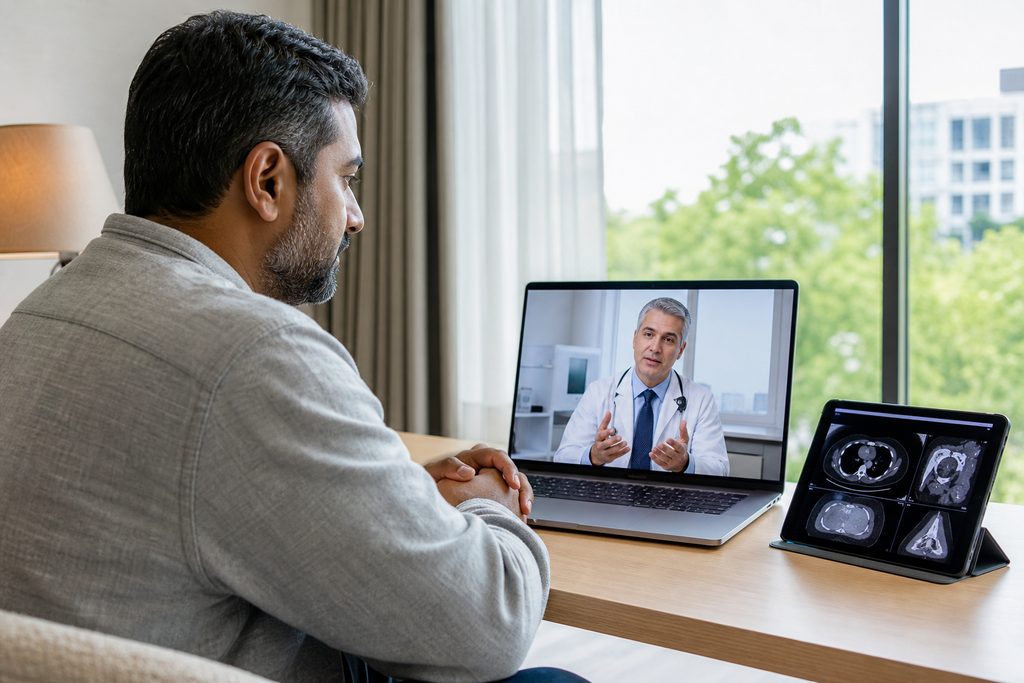
Have you ever stared at a quote for international airfare and hospital deposits, wondering whether the treatment plan you were promised will actually hold up once you land? That anxiety is rational. Flying across the world on a verbal assurance is a gamble most people would rather not take. A second opinion from Chinese doctors online changes the math entirely. You send your existing records. A specialist at a top-ranked Chinese hospital reviews them. You receive a written analysis and a proposed treatment direction before you spend a single dollar on a plane ticket.
We coordinate this every week for patients from the US, UK, Australia, and the Gulf states. The process is not magic. It is structured, document-driven, and surprisingly fast when the records are complete. Here is exactly how it works, what it costs, what can go wrong, and how to decide whether it makes sense for your case.
How This Actually Works, Step by Step
You already have imaging, lab results, and a diagnosis from your home country. That is the starting point. The remote review does not replace those records; it builds a second layer of analysis on top of them.
Step 1: You gather what you have. MRI or CT scans in DICOM format, pathology slides, blood work, surgical notes, discharge summaries. If documents are not in English, we arrange translation. Most patients send between 15 and 60 pages of material.
Step 2: We match your case to the right department. Not just the right hospital — the right specialty team. A cardiac valve case goes to a cardiac surgery department, not a general cardiology clinic. A spinal tumor goes to a neurosurgery or orthopedic oncology team, depending on the imaging. This matching step is where most self-directed attempts fail.
Step 3: The specialist reviews your records. This is a real clinical review, not a customer-service call. The doctor looks at your scans, compares your current treatment plan against Chinese clinical guidelines, and identifies where the approaches converge or diverge.
Step 4: You receive a written report. The output is a structured document: summary of findings, assessment of your current plan, suggested adjustments, and — critically — a statement of whether the hospital would accept your case for treatment and what that treatment would likely involve.
Step 5: You decide. The report gives you leverage. You can take it back to your local doctor. You can use it to make a go/no-go decision on travel. Or you can proceed to a video consultation with the same Chinese team for a live discussion.
That is the entire loop. Most patients complete it in 7 to 14 days from the moment records are received.
What a Remote Case Review Actually Tells You
The title of this article asks a specific question: can you get a treatment plan before you book a flight? The honest answer is yes, with a caveat. What you receive remotely is a proposed treatment plan. It is not a binding surgical schedule. Chinese public hospitals cannot finalize a surgery date without an in-person consultation. That is a hard rule across the system.
But a proposed plan is far more than nothing. It tells you:
- Whether the hospital considers your case treatable with their available techniques
- Which specific procedure or therapy they would recommend
- How long you would likely need to stay in China
- What the estimated cost range would be
- What additional tests would be required upon arrival
For a patient with a complex oncology case, that information can be the difference between a confident journey and a leap of faith. One of the most common requests we handle is to send MRI to Beijing hospital for review price — patients want to know both the cost of the review itself and whether the hospital’s neurosurgeons or oncologists see a viable path forward.
A Realistic Timeline
People underestimate the friction. Here is what the calendar actually looks like for a typical China medical second opinion online before flying.
| Stage | What Happens | Typical Duration |
|---|---|---|
| Day 1–3 | You upload records; we screen for completeness and request missing items | 1–3 days |
| Day 3–7 | Document translation (if needed) and department matching | 2–5 days |
| Day 7–14 | Specialist review and written report preparation | 5–10 days |
| Day 14–21 | Optional video consultation with the Chinese team | 3–7 days after report |
| Week 3–6 | If you proceed: visa application (S2), travel planning, hospital pre-admission coordination | 2–4 weeks |
| Week 6–10 | Arrival, in-person consultation, additional testing, treatment scheduling | Varies by hospital and case |
Two waiting steps catch people off guard. First, document translation. A 40-page oncology file in German or Arabic does not translate itself overnight. Second, the S2 visa. Consulates typically want a formal invitation or supporting letter from the hospital, which itself requires the hospital to have accepted your case for review — a chicken-and-egg problem that a written second opinion helps solve.
None of this is fast. But it is predictable. And predictability is what you are buying when you ask how to get treatment plan from hospital in China before travel.
What Can Go Wrong — and What Happens Then
We would rather tell you now than have you discover it at 2 a.m. in a hotel room in Shanghai.
Your records are incomplete. A CT report without the actual DICOM files is nearly useless to a surgical team. A pathology report without the slides limits an oncologist’s ability to confirm the diagnosis. What happens: we pause the review and ask you to request the missing items from your home hospital. This adds 3–10 days. It is the single most common delay.
The specialist declines to propose a plan. This happens. Some cases are too advanced, too ambiguous, or outside the hospital’s accepted scope. What happens: you receive a written explanation of why, which is itself valuable — it tells you what the home team should investigate next. You are not charged for a full treatment plan that was never delivered.
The plan changes after in-person evaluation. A remote review is based on your records. An in-person exam may reveal something the scans did not show. What happens: the hospital revises the plan. Your remote report gave you a direction, not a guarantee. Anyone who promises otherwise is not being straight with you.
You realize China is not the right fit. That is a valid outcome. The remote review costs a few hundred dollars. A wasted international medical trip costs thousands, plus your time and health. Even a negative result is a form of savings.
How to Evaluate a Remote Review Provider
Not every service that promises remote consultation with specialist in China cost transparency is legitimate. Here is how to sort them.
Ask who is actually reviewing your case. A “China medical team” is not an answer. You want to know the hospital, the department, and ideally the seniority level of the reviewer. Top-tier Chinese hospitals employ tens of thousands of doctors. A junior resident’s opinion is not the same as a chief physician’s.
Ask what you will receive. A written report? How long? Does it include a treatment direction, or just a summary of your records? A two-page summary that restates your diagnosis is not a second opinion. It is a book report.
Ask about the fee structure. The remote consultation with specialist in China cost should be quoted as a range before you commit. At China Medical Services, a written second opinion from a top hospital specialist typically runs $300–500. A video consultation with a general tertiary hospital international department runs $100–300. A top-specialist video consultation runs $500–800. Multidisciplinary team reviews run $1,500–2,000. These are ranges, not fixed quotes — the final number depends on the hospital and the complexity of your case.
Ask what happens if the review is inconclusive. A reputable provider has a clear policy. Ours is simple: if the specialist cannot form an opinion from your records, we tell you what is missing and give you the option to supplement or receive a partial refund.
And one more thing: can Chinese doctors review my scans remotely? Yes. This is standard practice. DICOM files transfer securely. Radiologists and surgeons review them on hospital-grade workstations. The technology is not the bottleneck. The bottleneck is whether the right specialist agrees to take your case.
Practical Considerations: Records, Visa, Payment, Language
Four practical realities shape every remote review.
Records. You need the actual imaging files, not just the reports. Request the DICOM CD or secure download link from your home imaging center. If you only have printed films, high-resolution photographs taken on a light box can work in some cases, but DICOM is strongly preferred.
Visa. For medical treatment in China, the applicable short-stay category is the S2 visa, endorsed for medical purposes. Accompanying family members also apply for S2. The supporting documents from the hospital — typically a treatment invitation or acceptance letter — are what make the application viable. We guide you through this, but we never guarantee approval. That decision rests with the consulate.
Payment. The remote review fee is paid upfront. Hospital treatment fees, if you proceed, are paid directly to the hospital. Chinese public hospitals generally require prepayment for inpatient care; international insurance is usually reimbursed afterward. Private international hospitals in our network, like those listed on our private hospitals page, often bill insurers directly.
Language. Your records may need translation. Your video consultation will need an interpreter unless you speak Mandarin. Your in-person visit will need a bilingual companion. None of this is optional. The top-ranked public hospitals in our database — the ones on the Fudan ranking, which you can browse by city on our top hospitals page — serve thousands of patients daily. English-speaking staff exist in international departments, but the hallways, billing desks, and imaging centers run on Chinese.
Frequently Asked Questions
A written second opinion from a top-tier hospital specialist typically costs $300–500. A video consultation with a general tertiary hospital international department runs $100–300. Top-specialist video consultations run $500–800, and multidisciplinary team reviews run $1,500–2,000. Final pricing varies by hospital and case complexity.
It will be treated as a strong starting point, not a binding contract. Chinese public hospitals require an in-person consultation before finalizing any surgery or inpatient admission. The remote plan tells you what the hospital is likely to recommend, how long you would stay, and what it would cost — but the in-person evaluation has the final word.
That is the point of the exercise. You receive a written report explaining the disagreement and the reasoning behind it. You then decide whose recommendation to follow. Some patients use the Chinese opinion to push their home team to reconsider. Others use it as the basis for traveling. There is no obligation either way.
Yes. You send the DICOM files securely, and the relevant specialty department reviews them. This is one of the most common requests we handle. The review fee is separate from any future treatment cost, and receiving a review does not commit you to treatment at that hospital.
Most patients receive a written report within 7–14 days of submitting complete records. Incomplete records, translation needs, or complex multi-department cases can extend that to 3–4 weeks. If you then proceed to travel, expect another 4–8 weeks for visa processing and hospital scheduling.
Your Next Step
The core message is simple: you do not have to board a plane to find out whether a Chinese hospital can help you. A second opinion from Chinese doctors online gives you a written treatment direction, a realistic cost range, and the confidence to make a big decision with your eyes open. We are China Medical Services, and our job is case management — we translate your records, match you to the right department at a top-ranked hospital, coordinate the review, and support you through visa, travel, and in-person care if you decide to proceed. We do not practice medicine, and we do not promise outcomes.
If you are weighing a serious procedure and want clarity before you commit to international travel, start with a conversation. Tell us your diagnosis and what records you have. We will tell you honestly whether a remote review makes sense for your case. Request a free consultation and let’s map out what is possible.
For more medical information and treatment options in China, visit chinamedservices.com (China Medical Services).
