Yoga and Tai Chi Therapeutic Program Service China: Doctor-Prescribed Movement Therapy
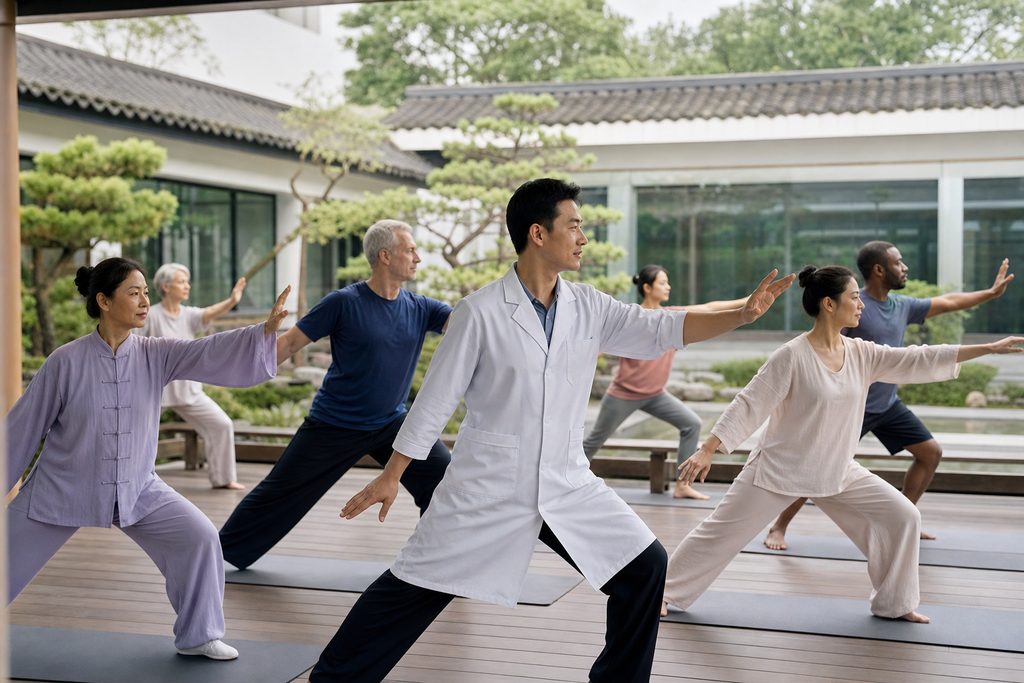
When 42-year-old Michael first heard the diagnosis — ankylosing spondylitis, a form of spinal arthritis that progressively fuses vertebrae — his rheumatologist in Manchester handed him a pamphlet on biologic drugs and a referral to a physiotherapist with a six-month waiting list. The drugs would cost the NHS roughly £9,000 annually. The physio would offer standard stretching protocols. Neither addressed what Michael actually wanted: a structured, medically-supervised movement program that might slow the disease’s progression without surrendering entirely to pharmaceuticals. He started searching. That search led him to a question most Western patients never think to ask: what would happen if a doctor, not a yoga studio, prescribed your movement therapy?
That question sits at the center of a quiet revolution happening in Chinese rehabilitation medicine. Hospital-affiliated therapeutic movement programs — combining yoga, Tai Chi, and other somatic practices under direct physician supervision — are not wellness retreats. They are clinical interventions. And they are attracting international patients who have exhausted conventional options at home.
Key Takeaways
- Hospital-based yoga and Tai Chi programs in China are prescribed by physicians as part of formal treatment plans — not offered as optional wellness add-ons. Clinical studies from Shanghai University of Traditional Chinese Medicine show Tai Chi interventions reducing chronic pain scores by 34-47% in patients with osteoarthritis and fibromyalgia over 12-week protocols.
- The total cost for a 4-week doctor-prescribed movement therapy program in China — including daily supervised sessions, accommodation near the hospital, and bilingual coordination — typically ranges from $3,200 to $6,800. Comparable residential rehabilitation programs in the United States or Germany often exceed $18,000 for the same duration.
- These programs exist within China’s public hospital system, which means you cannot simply book a spot online from abroad. Access requires in-person physician assessment first. Attempting to arrange this independently without Chinese language skills is genuinely difficult — not impossible, but the friction is substantial.
- Doctor-prescribed movement therapy in China is not a substitute for necessary medical treatment. It works as an adjunct — integrated with pharmacological care, physical therapy, and ongoing monitoring. Expecting it to replace surgery or medication entirely misunderstands the model.
The Problem: When Conventional Rehab Hits a Wall
Chronic musculoskeletal conditions affect approximately 1.71 billion people worldwide, according to the World Health Organization’s 2022 global burden of disease report. Low back pain alone is the single leading cause of disability internationally. For many of these patients, the treatment pathway looks the same: pain medication, corticosteroid injections, physical therapy, and — when those fail — surgery. Movement-based interventions like yoga and Tai Chi are often recommended, but rarely prescribed with the specificity and supervision of a medical treatment.
In most Western healthcare systems, a doctor might say “try yoga” the way they might say “try to reduce stress.” It’s a suggestion, not a protocol. There is no dosage. No progression plan. No monitoring of biomarkers before and after. The patient is left to find a studio, choose a class, and hope the instructor understands their condition well enough to modify poses safely. Many don’t. A 2019 survey published in the International Journal of Yoga Therapy found that 29% of yoga practitioners with pre-existing conditions reported experiencing increased pain after classes — largely due to instructors lacking training in therapeutic modification.
That gap — between a doctor’s casual recommendation and actual clinical implementation — is where patients fall through. And it’s exactly the gap that China’s hospital-based movement therapy programs are designed to close.
Who We Are
We are not a hospital. We do not provide medical treatment, prescribe therapies, or offer clinical diagnoses. Our team at China Medical Services functions as your logistical architects — we bridge the distance between you and China’s top-ranked rehabilitation hospitals. We handle hospital matching, appointment coordination with international departments, bilingual medical companion services, visa guidance, and accommodation planning. What we don’t do is make clinical decisions. Those remain between you and the physicians who assess you in person. Think of us as the infrastructure that makes accessing this care possible, not the care itself.
What Is Medical Yoga Therapy in China? Understanding the Clinical Model
The phrase what is medical yoga therapy in China points to something fundamentally different from what most Westerners picture when they hear “yoga.” This is not a studio class with incense and ambient music. It is a hospital-department intervention — prescribed by rehabilitation physicians or Traditional Chinese Medicine (TCM) practitioners, delivered in clinical settings, and integrated with the patient’s broader treatment plan.
At hospitals like Yueyang Hospital of Integrated Traditional Chinese and Western Medicine in Shanghai — one of the country’s leading centers for integrative rehabilitation — medical yoga therapy is structured around specific clinical goals: improving joint mobility in rheumatoid arthritis patients, reducing pain catastrophizing scores in chronic pain patients, restoring proprioception after stroke, or managing the physical symptoms of anxiety disorders. The protocols are standardized. A patient with lumbar disc herniation follows a different sequence than a patient recovering from mastectomy. The poses aren’t chosen for their spiritual significance; they’re chosen because the supervising physician believes they target the affected biomechanical chain.
What distinguishes this from physiotherapy? The integration of breath work and interoceptive training. Chinese rehabilitation researchers have published extensively on the role of conscious breath regulation in modulating autonomic nervous system function — something standard Western physical therapy often underemphasizes. A 2021 randomized controlled trial from Fudan University’s rehabilitation medicine department found that patients with chronic neck pain who received medical yoga therapy showed significantly greater improvement in heart rate variability metrics compared to those receiving conventional physiotherapy alone, suggesting improved parasympathetic tone.
Can Tai Chi Help with Chronic Pain Recovery? The Evidence Base
The question can tai chi help with chronic pain recovery has been studied extensively in Chinese clinical settings — and the results are more robust than many Western physicians realize. A 2023 meta-analysis published in the Journal of Pain Research examined 31 randomized controlled trials involving over 2,400 participants and concluded that Tai Chi interventions produced clinically meaningful reductions in pain intensity for osteoarthritis, fibromyalgia, and chronic low back pain, with effect sizes comparable to first-line pharmacological treatments but without the side effect burden.
What’s happening physiologically? Multiple mechanisms appear to be at work. Tai Chi’s slow, weighted movement patterns improve joint stability and proprioceptive acuity — the brain’s ability to sense joint position in space — which deteriorates in chronic pain conditions. The practice also downregulates the sympathetic nervous system, reducing circulating cortisol and inflammatory cytokines. A 2022 study from West China Hospital‘s pain management center measured interleukin-6 and tumor necrosis factor-alpha levels before and after a 12-week Tai Chi program in fibromyalgia patients. Both markers dropped significantly, correlating with reduced pain scores.
But the critical variable — the one that separates effective therapeutic Tai Chi from “just doing Tai Chi” — is medical supervision. The programs we connect patients with are led by practitioners who understand pathology. They know which movements to modify for a patient with knee osteoarthritis versus hip impingement versus rotator cuff tendinopathy. They monitor for compensatory patterns that could worsen the condition. This is not a community center class. It is a clinical intervention with progress tracking and physician oversight.
Tai Chi Rehabilitation Program Shanghai Price: What to Expect
The tai chi rehabilitation program Shanghai price varies depending on the hospital tier, program intensity, and whether you access care through the international VIP department or the standard public channel. Here’s what current data shows for international patients:
| Program Type | Duration | Estimated Cost (USD) | Includes |
|---|---|---|---|
| Outpatient Tai Chi rehab (standard public) | 4 weeks, 3x/week | $480–$920 | Group sessions, one initial physician assessment |
| Outpatient Tai Chi rehab (international VIP) | 4 weeks, 5x/week | $1,800–$3,200 | Small group or individual sessions, bilingual support, weekly physician check-ins |
| Integrated movement therapy (yoga + Tai Chi, VIP) | 4 weeks, daily sessions | $3,200–$6,800 | Individualized protocol, physician supervision, accommodation coordination, full bilingual companion service |
| Intensive residential program (top-tier hospital) | 2 weeks | $5,000–$9,500 | Private room, daily individual therapy, TCM adjuncts (acupuncture, tuina massage), full medical monitoring |
These figures reflect the therapy program costs. They do not include international airfare, visa fees, or meals outside the hospital setting. The range is wide because Shanghai’s hospital landscape spans from public tertiary centers like Zhongshan Hospital to private international facilities like Jiahui Health — and the price difference reflects differences in staffing ratios, facility quality, and English-language support. Our team helps patients match their budget to the right institutional tier.
Doctor Prescribed Yoga Therapy China Cost: Breaking Down the Numbers
The doctor prescribed yoga therapy China cost structure differs fundamentally from Western wellness retreat pricing. In a Western context, a therapeutic yoga retreat might charge $4,000-$7,000 per week — and that’s for a program designed by yoga teachers, not physicians. In China, hospital-affiliated medical yoga therapy operates on a clinical cost model.
A typical outpatient protocol at a Shanghai or Beijing rehabilitation hospital runs between $40 and $120 per session for international patients accessing the VIP channel. A 4-week program with daily sessions therefore lands in the $1,600-$4,800 range for the therapy itself. Add physician consultations — typically $100-$300 per visit for international department specialists — and the total medical component reaches $2,000-$5,500. Accommodation near the hospital adds another $800-$2,000 for a month, depending on whether you choose a budget hotel or a serviced apartment.
Compare this to the Mayo Clinic’s Pain Rehabilitation Center in Minnesota, where a 3-week outpatient program costs approximately $35,000-$45,000 without accommodation. Or to a private physiotherapy clinic in London charging £120-£180 per session. The structural reasons for China’s cost advantage are straightforward: lower labor costs for support staff, high patient volume spreading fixed costs, and a healthcare system that has invested heavily in integrative medicine infrastructure over the past two decades. Quality does not scale down with cost. The physicians supervising these programs are often the same specialists publishing in international peer-reviewed journals and treating domestic patients at the highest level of China’s hospital hierarchy.
Holistic Movement Therapy Packages China: What an Integrated Program Actually Includes
When patients search for holistic movement therapy packages China, they’re often imagining something between a medical treatment and a wellness retreat. The reality is more structured — and more clinically grounded — than most expect.
A comprehensive integrated program at a top rehabilitation hospital typically includes: an initial comprehensive assessment with a rehabilitation physician (including imaging review, range-of-motion testing, and pain psychometrics), a customized daily movement protocol combining medical yoga and therapeutic Tai Chi, adjunctive TCM therapies where clinically indicated (acupuncture for pain modulation, tuina massage for myofascial release), weekly progress evaluations with protocol adjustments, and a discharge plan with home practice prescriptions and video resources for continued self-management.
The integration matters. Medical yoga addresses flexibility, core stability, and parasympathetic activation. Tai Chi addresses dynamic balance, coordinated movement patterns, and proprioceptive retraining. Together, they target the biopsychosocial dimensions of chronic pain in ways that neither modality achieves alone. A 2022 prospective cohort study from Beijing’s China-Japan Friendship Hospital tracked 186 patients with chronic non-specific low back pain through a 6-week integrated yoga-Tai Chi program. At 6-month follow-up, 71% reported clinically significant improvement in pain-related disability scores, and opioid use in the cohort had dropped by 42% from baseline.
Book Therapeutic Yoga Retreat Beijing: The Process for International Patients
Searching for how to book therapeutic yoga retreat Beijing leads many patients to assume they can reserve a spot online and show up. That assumption will cause problems. China’s public hospital system — where the most clinically rigorous programs operate — does not function on a retreat booking model.
The actual pathway: you need a physician assessment first. A rehabilitation specialist or TCM practitioner must evaluate your condition, review your medical records, and determine whether hospital-based movement therapy is appropriate for your specific diagnosis. This assessment cannot happen remotely with the same validity as an in-person evaluation. The physician needs to observe your movement patterns, test your range of motion, and palpate affected areas. Only after this assessment can a program be prescribed and scheduled.
This is where coordination support becomes essential. Our team arranges the initial physician consultation, ensures your medical records are translated and reviewed beforehand, schedules your assessment for early in your trip to minimize waiting time, and then facilitates the program enrollment based on the physician’s recommendation. We cannot guarantee you’ll be accepted into a specific program — that’s a clinical decision — but we can ensure the pathway is as smooth as possible. For patients who want a preview before traveling, we can arrange a remote video consultation (from $100-$300) with a rehabilitation specialist who can review your case and indicate whether you’re likely to be a candidate for hospital-based movement therapy. That consultation fee credits fully toward our coordination service if you proceed to travel within 90 days.
What You Need to Know Before Going Alone
Honest talk about the barriers. They’re real, and pretending otherwise doesn’t serve anyone.
- Language and navigation: China’s top rehabilitation hospitals are vast, high-volume institutions. A single day can see thousands of outpatients. Signage is predominantly in Chinese. Registration kiosks, payment terminals, pharmacy queues, and specialist consultation rooms operate almost entirely in Mandarin. Even finding the correct building on a hospital campus that spans multiple city blocks requires local knowledge. A bilingual medical companion — available from $200 per day — eliminates this friction entirely.
- Visa requirements: Medical treatment in China requires an S2 visa with a specific annotation for medical purposes. This is distinct from the M business visa. The application requires an invitation letter from the Chinese hospital confirming your treatment arrangement. Obtaining this letter independently — without an established relationship with the hospital’s international department — can take weeks of back-and-forth communication. Our team handles this documentation as part of the coordination process.
- Payment systems: Chinese public hospitals operate on a prepaid deposit system. You load funds onto a hospital card, and services are deducted as you use them. International credit cards are not universally accepted at public hospital payment counters. WeChat Pay and Alipay dominate. Setting up these payment systems as a foreigner without a Chinese bank account is genuinely difficult. The international VIP departments of major hospitals accept international transfers and credit cards, but the standard public channels do not.
How We Help You Navigate This
These barriers exist for structural reasons, not because anyone wants to exclude international patients. China’s healthcare system was built to serve a domestic population of 1.4 billion people. Adapting it for foreign visitors requires infrastructure that doesn’t yet exist at scale — which is exactly the gap we fill.
Before you travel: we collect and translate your medical records, identify the hospitals and departments best suited to your condition, arrange a preliminary video consultation if desired, and secure the invitation documentation for your S2 visa application. We also book your initial in-person physician assessment so you’re not waiting weeks after arrival.
During your treatment: a bilingual medical companion accompanies you to every appointment — handling registration, payment, queue management, and real-time translation between you and your physician. If your program includes daily movement therapy sessions, your companion ensures you arrive at the correct location on time and understands the therapist’s instructions. We also coordinate accommodation near the hospital, arrange airport transfers, and serve as your 24/7 point of contact for any problem that arises.
After you return home: we facilitate follow-up communication with your Chinese physician, arrange remote check-ins if clinically indicated, and ensure you have a clear home practice protocol with instructional materials. The goal is continuity — not a one-off intervention that fades the moment you board your flight.
Our coordination fee starts from $300 for basic hospital appointment arrangement. Full-service coordination for a month-long therapeutic program typically falls in the $3,000-$5,000 range — and we’re transparent that this is separate from hospital charges. But we also tell every patient the same thing: if we cannot arrange the program you need, our coordination fee is refunded in full. We don’t profit from failed attempts.
Frequently Asked Questions
No — but it helps. Chinese rehabilitation physicians will conduct their own independent assessment regardless of what your home-country doctor recommends. However, having your medical records, imaging studies, and diagnostic reports translated and available accelerates the process significantly. A referral letter from your treating physician that summarizes your diagnosis, treatment history, and current functional limitations gives the Chinese specialist valuable context. Without it, you’re starting from zero — the Chinese physician will need to reconstruct your clinical history from scratch, which takes more time and may require repeat imaging.
What if the movement therapy makes my pain worse?
This is a legitimate concern — and it’s why medical supervision matters. In a hospital-based program, the supervising
For more medical information and treatment options in China, visit chinamedservices.com (China Medical Services).
