Bone Age Test in China: For Children — Costs, Accuracy & Top Hospitals
Key Takeaways
- A pediatric bone age X-ray at a top Chinese public hospital typically runs $30–$120 out of pocket — a fraction of the $250–$600 common in US imaging centers.
- China’s largest children’s hospitals read hundreds of these scans weekly, and many now use AI-assisted bone age software validated against the Greulich-Pyle and TW3 standards.
- The real obstacle isn’t the scan. It’s the logistics: same-day registration queues, no walk-in English service at most public hospitals, and results handed over in Chinese.
- Bone age is a diagnostic tool, not a treatment. Any decision about growth hormone or puberty management must come from a pediatric endocrinologist who examines your child in person.
The Problem: Your Child’s Growth Chart Worries You, and the Waitlist Is Measured in Months
You’ve probably heard that getting specialist pediatric care in China means compromising on quality. The reality runs the other way — but the access problem is real, and it’s the part nobody warns you about.
Here’s the squeeze. In the UK, a referral to a pediatric endocrinologist for suspected precocious puberty or short stature often sits behind a waiting list measured in months, not weeks. In parts of the US and Canada, the wait for a first endocrine appointment can stretch to 4–8 months depending on your region and insurance network. Meanwhile, a child’s growth plates don’t pause. Every month of delay is a month of bone maturation you can’t get back, and for conditions like central precocious puberty, timing genuinely changes the treatment window.
So parents start looking elsewhere. They search for faster diagnostics, for second opinions, for a way to get a clear answer about whether their child’s bone age is advanced, delayed, or normal. And they find China — where a bone age test can be done the same week you land, at a hospital that reads thousands of pediatric growth films a year.
What they don’t find, at least not easily, is a straight answer about how to actually do it. That’s what this guide is for.
Why a Bone Age Test in China Is Worth Considering
Let’s separate the scan itself from everything around it. The scan is simple, cheap, and fast. The interpretation and the follow-up care are where the real value — and the real complexity — live.
Volume and Pediatric Subspecialty Depth
China’s top children’s hospitals are enormous by Western standards. Beijing Children’s Hospital, affiliated with Capital Medical University, and Children’s Hospital of Fudan University in Shanghai are among the largest pediatric centers in the world, seeing tens of thousands of outpatient visits weekly across dozens of subspecialties. Pediatric endocrinology is a well-established division at these institutions, not a side clinic.
That volume matters for one specific reason: pattern recognition. A radiologist who reads 40 bone age films a day notices subtle maturation differences that a general radiologist reading two a week may miss. This is not a knock on Western radiologists — it’s just how expertise accumulates.
AI-Assisted Reading and Standardized Scoring
Many Chinese tertiary hospitals have adopted automated bone age assessment software, often developed in partnership with domestic AI imaging companies and validated against the Greulich-Pyle atlas and the Tanner-Whitehouse 3 (TW3) method. These tools produce a bone age estimate in seconds, which a pediatric radiologist then reviews and signs off on. The practical effect is a faster turnaround — often the same day, sometimes within hours — and a second layer of consistency on top of human reading.
Does that make Chinese bone age assessment more accurate than a good Western center? Not necessarily. Accuracy depends on the reader, the software version, and the quality of the hand radiograph. What it does mean is that the process is standardized, high-volume, and rarely delayed by equipment shortages.
The Cost Picture, Honestly
This is where China’s structural advantages show up most clearly. A single hand and wrist X-ray for bone age, read by a pediatric radiologist, is inexpensive. Prices vary by hospital tier and city, but the range below reflects what international patients commonly encounter at public tertiary hospitals and private international clinics.
| Setting | Typical Price (USD) | Turnaround |
|---|---|---|
| Public tertiary children’s hospital, standard outpatient | $30–$70 | Same day to 24 hours |
| Public hospital international / VIP department | $80–$150 | Same day, English report available |
| Private international hospital (e.g., United Family, Jiahui) | $150–$350 | Same day, English-speaking staff |
| US imaging center (for comparison) | $250–$600 | 1–3 days |
| UK private pediatric imaging (for comparison) | £150–£350 | 3–7 days |
Note the phrase “varies by hospital and case complexity.” A straightforward bone age film is cheap. If your child needs a full growth workup — IGF-1, thyroid panel, GnRH stimulation testing, pelvic ultrasound — the total climbs quickly, and those add-ons are where the meaningful clinical information usually lives.
How the Process Actually Works: From First Email to Signed Report
Here’s the part most guides skip. You cannot simply book a bone age test online at a Chinese public hospital and walk in. The system doesn’t work that way.
Step 1 — Records review (days 1–3). You send your child’s existing growth charts, prior X-rays if any, lab results, and a short summary of the concern. A pediatric endocrinology team reviews whether a bone age film is even the right next step. Sometimes it isn’t — sometimes the answer is a thyroid panel or a growth hormone stimulation test.
Step 2 — Remote consultation (days 3–10). A video consult with the pediatric specialty team lets you explain the history and hear what they’d recommend. For straightforward bone age reads, a written second opinion based on existing films is often enough and costs less.
Step 3 — Appointment coordination (1–2 weeks). If in-person evaluation makes sense, we coordinate a registration at the chosen hospital’s international or VIP department. This is the channel that offers English-speaking staff and predictable scheduling. Standard public outpatient registration is same-day and first-come, first-served — it cannot be pre-booked from abroad.
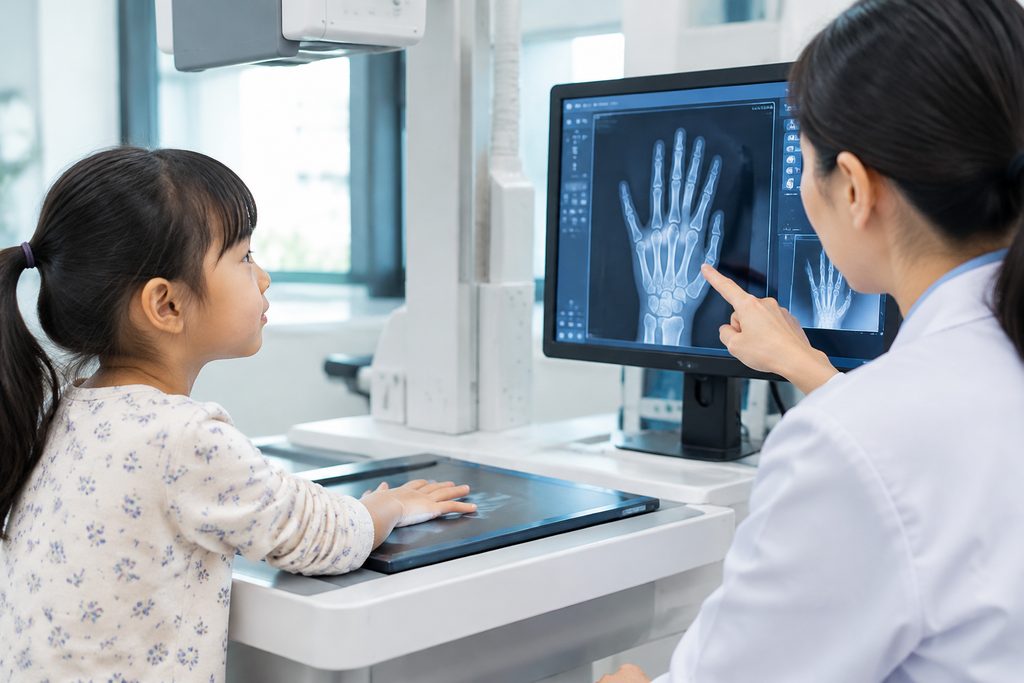
Step 4 — The visit itself. The hand and wrist X-ray takes under ten minutes. A pediatric radiologist reads it, and if endocrinology is involved, you’ll typically see the specialist the same day or the next.
Step 5 — The report. You leave with a bone age estimate, a comparison to chronological age, and a written assessment. Ask for an English version — international departments provide this routinely.
How to Judge Whether a Bone Age Assessment Is Reliable
Parents ask us this constantly, and the honest answer is: reliability depends far more on the reading than the machine.
Bone age is not a measurement like height or weight. It’s an interpretation. A radiologist compares your child’s hand film against a reference atlas — most commonly Greulich-Pyle, which matches the nearest standard plate, or TW3, which scores 20 specific bones individually and sums them. Two experienced readers using different methods on the same film can legitimately differ by 6–12 months. That’s not error. That’s the nature of the tool.
So what should you look for?
- A named method. A report that says “bone age: 9 years” without stating Greulich-Pyle or TW3 is incomplete. Ask which standard was used.
- A pediatric radiologist, not a general one. This matters more than the hospital’s overall reputation.
- Consistency over time. If you’re tracking growth, the same method and ideally the same reader should be used at each follow-up. Switching methods mid-stream creates false trends.
- Clinical correlation. A bone age number alone means little. It has to be read alongside height velocity, parental heights, pubertal staging, and hormone levels.
One more thing worth saying plainly: a bone age test does not diagnose anything by itself. An advanced bone age can suggest precocious puberty, congenital adrenal hyperplasia, or simply a constitutionally early-maturing child who is perfectly healthy. Distinguishing these requires an endocrinologist, not a scan.
Practical Considerations: Visas, Payment, and Follow-Up
If you do decide to travel, the logistics are manageable but specific.
Visa. For medical treatment in China, the applicable short-stay category is the S2 visa, which covers medical treatment and private affairs and is issued subject to the latest requirements of the Chinese embassy or consulate in your country. Accompanying family members apply under the same category. You’ll need supporting documents, typically including an invitation or appointment letter from the hospital. Note that the M visa is for commercial and trade activities and is not the correct category for medical travel. Approval is never guaranteed — plan for processing time and check your local consulate’s current requirements.
Payment. Public hospitals require prepayment; you settle at the cashier or via mobile payment, and international credit cards are accepted at international departments but not always at standard outpatient counters. Private international hospitals frequently bill insurance directly. If you’re relying on reimbursement from a Western insurer, get an itemized English invoice and a diagnosis code before you leave the country — chasing paperwork after you’ve flown home is painful.
Language. This is the practical wall. A top Chinese hospital may see 10,000+ outpatient visits in a day. Signage, registration systems, and most staff operate in Chinese. International departments solve this, at roughly 1.5–2x the standard price. Outside those departments, you’ll need interpretation, and for a pediatric visit — where your child may be frightened and you’re trying to explain a nuanced history — a bilingual medical companion is genuinely useful rather than a luxury.
Follow-up. Growth monitoring is longitudinal. Whatever is found in China needs to be handed to a pediatric endocrinologist at home who can continue tracking your child. Bring back the raw images, not just the report. Ask for DICOM files on a disc or secure download.
For a broader look at how the system is structured, our overview of China’s top-ranked hospitals explains the tiering, and our specialty rankings show which institutions lead in pediatric and endocrine care.
Frequently Asked Questions
Yes, when it’s performed at a tertiary children’s hospital or a JCI-accredited international facility and read by a pediatric radiologist using a stated method such as Greulich-Pyle or TW3. The technology and standards are the same ones used in Western centers. Reliability hinges on the reader, not the country.
A standalone hand and wrist X-ray with a radiologist’s read typically runs $30–$120 at public hospitals and $150–$350 at private international clinics. That price covers the film and the report only. Hormone panels, ultrasound, and specialist consultations are billed separately and vary by hospital and case complexity.
Not through standard public outpatient registration, which is same-day and first-come, first-served. Pre-arranged scheduling is available through hospital international or VIP departments. That’s the channel to use if you need a fixed date and English-language support.
Experienced readers using the same method on the same film typically agree within 6–12 months, and that spread is inherent to the technique rather than a sign of poor quality. Accuracy improves when the same method is used consistently across follow-up visits and when the result is interpreted alongside growth velocity and hormone data.
Then you need a pediatric endocrinologist — in China or at home — to evaluate in person. A bone age film informs that decision; it doesn’t make it. No responsible provider will prescribe growth hormone or puberty-blocking therapy on the basis of an X-ray alone.
Your Next Step
The core message is simple: a bone age test in China is fast, inexpensive, and technically sound — but the value comes from the interpretation and the endocrine context around it, not the scan itself. Go in with the right expectations and the right questions.
We’re China Medical Services. We connect international families with 340+ top-ranked hospitals across 37 cities, coordinate appointments through official international departments, and provide bilingual medical companions who handle registration, payment, wayfinding, and interpretation. We are not a hospital and we don’t provide diagnoses or treatment — that’s the medical team’s job.
If you’d like to understand your options before committing to anything, start with a conversation. No pressure, no obligation — just a clear picture of what’s possible.
For more medical information and treatment options in China, visit chinamedservices.com (China Medical Services).
