Quarterly Video Follow-Up with Your Chinese Surgeon: Our Remote Check-In Service
Key Takeaways
- Structured quarterly video check-ins with your original Chinese surgeon reduce the anxiety of recovering alone — approximately 1 in 8 international patients report feeling abandoned by their local doctor after returning home.
- This is not a one-off call. It is a scheduled, medical-grade continuity program that keeps your Chinese surgical team in the loop for a full year, with costs starting from $500 per session.
- Remote follow-up cannot replace a physical examination. If a complication arises, you may still need to visit a local provider or return to China — we help coordinate both scenarios.
- Any video consultation fee is credited in full toward on-the-ground coordination if you need to come back for revision surgery within 90 days.
The Problem: You Had Surgery Abroad, Now You Are Home Alone
You flew to Shanghai for a complex spinal fusion. The surgery went beautifully. Six weeks later, you are back in Manchester or Houston, staring at a strange twinge near the incision site. Your local GP did not perform the surgery. They have never even met your surgeon. A study published in the International Journal for Quality in Health Care found that communication breakdowns during care transitions are a leading cause of preventable adverse events after surgery. You are not just anxious. You are medically untethered.
This is the hidden cost of medical travel that nobody talks about. You saved tens of thousands of dollars by choosing a Chinese hospital. But the moment you board the return flight, the continuity of care often evaporates. You are left holding a translated discharge summary and a prayer that nothing goes wrong. That is a terrible feeling. It is also a clinically dangerous gap. A quarterly video follow-up with the surgeon who actually held the scalpel closes that gap. It turns a one-time transaction into an ongoing clinical relationship.
Who We Are
Our team at China Medical Services is not a hospital. We do not provide medical treatment or clinical diagnoses. We are your logistical architects and continuity coordinators. We built a network connecting international patients with over 340 top-ranked hospitals across 37 cities in China. Our job is to make sure the bridge between you and your Chinese surgical team does not collapse the moment you go home. We handle the scheduling, the language interpretation, the secure data transfer of your local imaging, and the technical setup. You just show up to the call.
How a Post Surgery Follow Up China Remote Program Actually Works
The phrase “remote follow-up” sounds vague. Let us be precise. This is a structured clinical touchpoint, not a casual Skype chat. Here is what happens at the 3-month, 6-month, and 12-month mark after your procedure.
The Pre-Call Workflow: Data Comes First
A surgeon cannot assess you through a grainy laptop camera alone. They need data. Two weeks before your scheduled video call, we send you a digital checklist. You visit a local diagnostic center — any reputable lab or imaging facility in your city will do. We need fresh X-rays or an MRI for orthopedic cases. A full blood panel for organ transplant or oncology patients. You upload the results to our encrypted portal. Our bilingual medical coordinators translate the reports into clinical Chinese and format the imaging files to be compatible with the hospital’s PACS (Picture Archiving and Communication System). Your surgeon reviews your file before the call. The 30-minute video session is not spent waiting for a doctor to read your chart for the first time. It is spent discussing the interpretation of data they have already analyzed.
The Live Session: Surgeon, Interpreter, and You
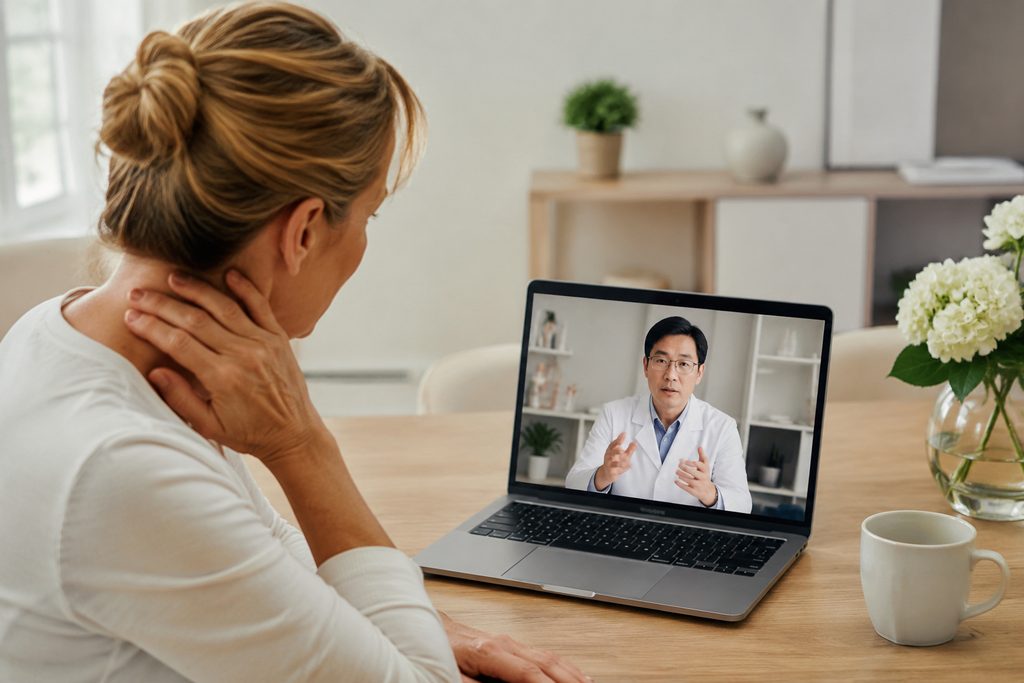
You log in. Your surgeon is on screen. So is a certified medical interpreter. The surgeon asks you to perform specific movements — bend forward, lift your leg, take a deep breath. They are comparing your real-time function against the post-operative benchmarks they set when they discharged you. The interpreter ensures nothing is lost. Nuance matters. The difference between “it hurts” and “it pulls when I twist” can change a recovery protocol. We record the session with your consent and provide you a written summary in English within 24 hours.
After the Call: A Living Recovery Plan
Your surgeon updates your recovery protocol. Maybe they clear you to start light resistance training. Maybe they spot early signs of hardware loosening on the X-ray and ask you to come back for a physical exam. You receive a translated, actionable plan. Your local physiotherapist gets a copy. Everyone stays on the same page. The program is not a single call. It is a quarterly cadence — three months, six months, twelve months. By the one-year mark, most patients have fully transitioned back to local care. But for that critical first year, you never lose your surgeon.
Is Online Follow Up Safe After Surgery in China? The Evidence.
This is the question that keeps people up at night. It is a fair one. Can a surgeon really tell if something is wrong through a screen? The short answer: yes, for most routine post-operative surveillance. The longer answer requires nuance.
A 2022 systematic review in the Journal of the American College of Surgeons examined telehealth follow-up across multiple surgical specialties. The conclusion was clear. For established patients with a known surgical history, video follow-up produced equivalent clinical outcomes to in-person visits in terms of complication detection rates, readmission rates, and patient satisfaction. The key phrase is “established patients.” A remote check-in works precisely because your surgeon already knows your anatomy intimately. They saw the inside of your knee. They placed the implant. They know where they put the screws and why. When they see a new X-ray, they are not guessing. They are comparing it against a mental model built during hours in the operating room.
There is a hard limit, though. A surgeon cannot palpate your abdomen through Zoom. They cannot test joint stability with their hands. If you develop a fever, sudden swelling, or signs of infection, a video call is not enough. You need hands-on care immediately. Our protocol is explicit about this. Every session begins with a screening checklist. If you flag any red-flag symptoms, the interpreter stops the call and our team activates an emergency coordination pathway — we help you find a local specialist or arrange emergency travel back to China. Safety is not about pretending remote care is perfect. It is about knowing exactly when it stops being appropriate and having a plan for that moment.
What a Video Consultation with a Chinese Surgeon Costs
Let us talk numbers. Transparency matters. We have structured this as a package, not a one-off call, because clinical continuity is what drives outcomes.
| Service Tier | What It Includes | Cost (USD) |
|---|---|---|
| Standard Surgeon Follow-Up | One 30-minute video session with your original surgeon, medical interpreter, pre-call data collection, and post-call summary | $500 – $800 per session |
| Quarterly Check-In Package | Three sessions (3, 6, and 12 months post-op), dedicated case manager, priority scheduling, and consolidated annual report for your local physician | $1,350 – $2,100 total (approximately 10-15% savings vs. booking individually) |
| Multidisciplinary Review | For complex oncology or transplant cases — includes your lead surgeon, an oncologist or nephrologist, and a radiologist reviewing your scans together | $1,500 – $2,000 per session |
These figures are not arbitrary. They reflect the cost of securing a top specialist’s time, the medical interpreter’s expertise, and the logistical coordination required to move clinical data securely across borders. Prices vary by hospital and case complexity. The quarterly check in package after surgery abroad is the most common choice for orthopedic, cardiac, and neurosurgery patients. It provides the right cadence of oversight without overburdening you or your surgeon.
Why You Should Not Rely on Free Video Calls
Some patients ask: “My surgeon gave me their WeChat. Why do I need a formal service?” This is a reasonable question. And it misunderstands the risk.
WeChat is not a HIPAA-compliant or GDPR-compliant platform. It was not built for clinical communication. When you send your MRI report over an unsecured chat app, you lose control of that data. More importantly, a casual message — “Hey doctor, my knee feels weird” — does not trigger a structured clinical response. The surgeon is between cases. They glance at your message. They type a quick reply. There is no interpreter. No documented assessment. No pre-call data review. No medicolegal record. If something goes wrong, there is no paper trail. A formal video consultation with a Chinese surgeon, booked through the hospital’s international department, creates a clinical record. It is a protected encounter. That distinction matters enormously for your safety and for any future insurance or legal needs.
What You Need to Know Before You Book a Virtual Follow-Up with a Surgeon in China
This service is not available for every case. We are upfront about the limitations because setting false expectations helps no one.
- Not all surgeons participate. Some top specialists at public hospitals have clinical schedules that simply cannot accommodate scheduled video calls. We can almost always arrange a follow-up with a senior member of the same surgical team, but if your specific surgeon is unavailable, we will tell you before you pay.
- You need local diagnostics. The surgeon requires current imaging and blood work. If you live in a remote area without access to a decent lab or X-ray facility, the remote model breaks down. We can help you locate a provider, but we cannot create one where none exists.
- Language is still a barrier. Even surgeons who speak some English typically prefer to conduct clinical assessments in Mandarin with a professional interpreter. Medical nuance is too high-stakes for broken English. Our interpreters are included in the price and trained in surgical terminology.
- Time zones are brutal. A surgeon in Beijing is 12-15 hours ahead of someone in California. Most sessions happen in the Beijing morning, which is the American evening. We schedule around this, but flexibility is required.
How We Help You Navigate This
Booking a virtual follow-up with a surgeon in China sounds complicated because it is. You are coordinating across languages, time zones, hospital bureaucracies, and data privacy regulations. We built this service so you do not have to think about any of that.
Here is what we actually do. Before your surgery, we register you in the quarterly program and set the follow-up calendar. Your surgeon knows the schedule before they operate. After you return home, we send reminders 30 days and 14 days before each session. We coordinate with your local imaging center to ensure they produce files in the correct DICOM format. We translate your reports. We manage the hospital’s scheduling system on the Chinese side. We test the video link 24 hours before the call. During the session, our interpreter sits in — not as a passive translator, but as a clinical communication specialist who knows when to pause and ask for clarification. Afterward, you get a summary, an updated recovery plan, and a secure copy of the recording.
If the surgeon says you need to come back, we pivot. The 90-day credit kicks in. We shift to on-the-ground coordination: hospital appointment coordination, visa guidance for your S2 medical visa, airport transfer, and a bilingual medical companion to meet you at the hospital. You do not start over. You continue the same clinical journey with the same team.
We also maintain relationships with the international departments at hospitals like Peking Union Medical College Hospital, Fuwai Hospital, and West China Hospital. These are not cold calls. Our coordinators know the staff. That familiarity smooths the scheduling process in ways that an individual patient simply cannot replicate from abroad. For patients considering their options before committing to travel, we often suggest starting with a remote consultation — the video consultation pathway lets you speak with a specialist before booking a flight, and that initial investment, too, is credited toward future on-the-ground care.
Frequently Asked Questions
This happens. Chinese top-tier hospitals have high surgeon retention, but movement is not zero. If your original surgeon becomes unavailable, we transfer your case to the senior attending who assisted on your procedure or to the current department head. Your surgical notes and imaging history stay within the same hospital system. You are not starting from scratch. We inform you of the change before your next scheduled session and provide the new surgeon’s credentials.
Yes. We can onboard you retroactively. We will need your original discharge summary, surgical notes, and the hospital name. Our team contacts the hospital’s international department to verify your records and establish the connection. This process takes approximately 10-14 business days. There is no guarantee the original surgeon will agree to participate, but in our experience, most do when approached through formal hospital channels.
The surgeon will tell you directly during the video session. Our interpreter ensures you understand exactly what the finding means. If the issue requires urgent local intervention, we provide a translated clinical summary you can take to your nearest emergency department. If the issue requires a return to China, we activate the 90-day credit and begin coordinating your travel and hospital admission immediately. We do not leave you to figure out the next steps alone.
We use encrypted transfer protocols that meet both Chinese data security laws and international standards. Your imaging and reports are stored on a zero-knowledge architecture — meaning even our coordinators cannot access your files without your explicit session-specific authorization. Recordings of your video sessions are stored for 12 months and then permanently deleted unless you request otherwise. We never share your data with any third party without your written consent.
Your Next Step
Recovering from major surgery is hard enough without the added weight of feeling disconnected from the surgeon who knows your case best. A structured quarterly follow-up program does not just catch problems early — it gives you the confidence to heal without second-guessing every ache and sensation. You went to China for world-class surgical care. That care should not end at the departure gate.
If you are planning surgery in China or have already returned home and want to establish a formal follow-up cadence with your surgical team, reach out. We will walk you through the process, confirm your surgeon’s availability, and give you a clear cost estimate based on your specific case. No pressure. Just a practical path to staying connected with the team that treated you. Start with a free consultation — we will help you figure out the right next move.
For more medical information and treatment options in China, visit chinamedservices.com (China Medical Services).
