Why Myanmar Patients Come to China for Neurosurgery: Brain and Spine Full Companion
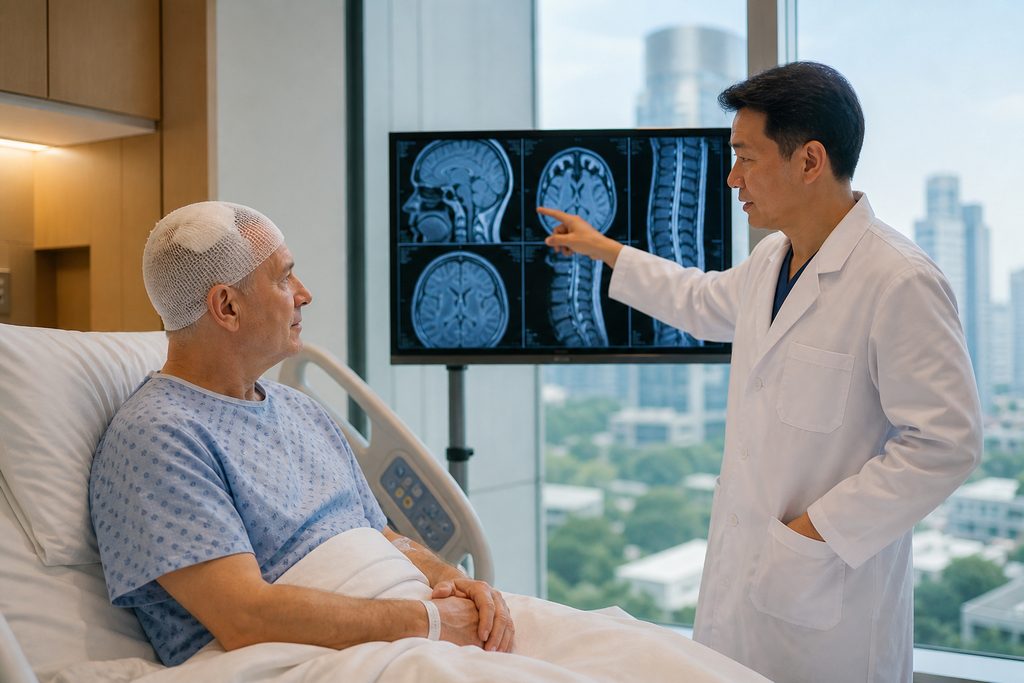
The Short Answer: Access, Volume, and a Fraction of the Wait
Myanmar patients are crossing into China for neurosurgery because the math is hard to ignore. A complex brain tumor resection that might mean a 12-month wait in a strained public system can be scheduled in weeks through a Chinese hospital’s international VIP channel. The brain tumor surgery cost China for Myanmar patients typically runs 60-70% less than equivalent private care in Bangkok or Singapore. Safety outcomes at top-tier Chinese neurosurgery centers now track closely with Western benchmarks. But the real draw is not just price. It is the sheer case volume. A neurosurgeon at a major Shanghai or Beijing center may perform 300 tumor resections a year. That repetition breeds a level of intraoperative judgment that is hard to replicate in lower-volume settings. The caveat: this path works for patients who are stable enough to travel and who have a clear diagnosis already in hand. It is not an emergency evacuation route.
Who This Is Right For — and Who It Is Not
The patients who benefit most from planning a neurosurgical journey to China share a specific profile. They have imaging and a confirmed diagnosis, but face a long queue at home or want a second opinion before committing to a high-stakes procedure. They are mobile, accompanied, and have a support system that can handle the logistics of a 3-6 week stay abroad.
A good candidate typically presents with:
- A diagnosed brain tumor (meningioma, glioma, pituitary adenoma) or spinal condition (disc herniation, stenosis, spinal tumor) confirmed by MRI and biopsy where applicable.
- Stable clinical status — they can board a commercial flight without acute deterioration.
- A realistic expectation: they are seeking high-volume surgical expertise and a managed care pathway, not a miracle cure for a glioblastoma that has exhausted all standard protocols.
This path is not suitable for everyone. Patients with rapidly progressing neurological deficits who cannot safely wait 2-3 weeks for coordination should seek emergency care locally. Those with unstable cardiac or respiratory comorbidities that make long-haul travel dangerous need clearance from their primary team first. And patients seeking experimental therapies not backed by peer-reviewed data will find Chinese academic hospitals conservative in their protocols — these are evidence-driven institutions, not last-resort clinics.
The Options, Compared
Myanmar patients weighing neurosurgery abroad are typically choosing between three corridors: remaining in Yangon or Mandalay, traveling to Bangkok, or crossing into China. The table below lays out the real trade-offs.
| Factor | Myanmar (Private) | Thailand (Private Hospital) | China (Public VIP/International Dept) |
|---|---|---|---|
| Brain tumor resection cost | $8,000 – $15,000 | $25,000 – $45,000 | $18,000 – $32,000 |
| Complex spine surgery cost | $10,000 – $18,000 | $30,000 – $55,000 | $22,000 – $38,000 |
| Wait time (post-diagnosis to surgery) | 2 – 6 months | 2 – 4 weeks | 2 – 4 weeks (VIP channel) |
| Annual surgeon case volume (tumor) | 20 – 50 | 50 – 120 | 150 – 350+ |
| Language support for Myanmar patients | Native | English (some Burmese translators) | English (bilingual companion required for Mandarin) |
| Post-op ICU standards | Variable | JCI-accredited | JCI or China Class A tertiary |
Thailand offers the smoothest English-language experience and JCI accreditation at every step. But the cost gap is substantial. China sits in a sweet spot: surgical pricing closer to Myanmar’s private tier but with case volumes and technology that rival or exceed Bangkok’s top centers. The trade-off is language complexity — one that a bilingual medical companion solves, which is why the full-companion model has become the default for Myanmar families making this trip.
What “Full Companion” Actually Means for a Neurosurgery Trip
The phrase “full companion” gets thrown around in medical tourism marketing. For a neurosurgical case, it needs to mean something specific, or the patient lands alone in a Mandarin-speaking hospital with a craniotomy scheduled for Tuesday. Here is what the service layer actually covers when done properly.
A pre-departure phase handles the heavy paperwork: translation of all MRI reports, biopsy slides, and clinical summaries into Chinese medical terminology. The hospital’s neurosurgery department reviews these before the patient books a flight. This is not a travel agent function — it is a clinical triage step that determines whether the case is accepted and which sub-specialist takes it. Skull base tumors go to one team. Spinal cord tumors to another. Pituitary adenomas to a neuroendoscopy group. Getting this match right before arrival is the single highest-value part of the coordination.
On the ground, the companion handles registration, payment deposits, queue management for imaging, and real-time interpretation during the surgical consent process. A craniotomy consent discussion is not a phrasebook conversation. The surgeon needs to explain the approach, the risks to eloquent cortex, the probability of gross total resection, and the contingency plans for intraoperative findings. The companion translates not just words but nuance. Post-operatively, they bridge the gap between the ICU nursing team and the family, translating vital sign updates, medication changes, and discharge instructions. They also handle the practicalities: pharmacy runs, dietary requests, and the mountain of documentation needed for insurance reimbursement back home.
Without this layer, a Myanmar family is functionally deaf and mute inside one of the world’s busiest hospitals. With it, the experience shifts from disorienting to manageable.
What It Costs: The Real Numbers for Myanmar Families
Surgical pricing in China is not a fixed menu. It varies by hospital tier, the surgeon’s seniority, the complexity of the case, and whether the patient uses the standard public channel or the international VIP department. The figures below reflect what Myanmar patients actually encounter when booking through a coordination service that accesses the international departments of Fudan-ranked hospitals.
For a standard craniotomy and tumor resection (meningioma or low-grade glioma), the hospital’s surgical package — including operating theater, anesthesia, surgeon fees, ICU stay, and ward bed for 7-10 days — ranges from $18,000 to $32,000. A transsphenoidal endoscopic approach for a pituitary adenoma, which avoids opening the skull, runs lower: $14,000 to $22,000. Complex spine instrumentation with titanium implants and multi-level fusion sits at $22,000 to $38,000, driven heavily by the cost of the hardware.
These are hospital-side costs only. The coordination and companion service layer adds another dimension. A written second opinion from a top-tier neurosurgeon, based on existing scans and reports, costs from $300 to $500. A video consultation with the surgical team before travel runs $500 to $800. The on-the-ground bilingual medical companion starts at $300 per day for full-day coverage. A VIP end-to-end coordination package — which bundles hospital matching, appointment scheduling, companion services, airport transfers, and logistical support for the entire stay — ranges from $5,000 to $8,000. The key conversion mechanism: any consultation fee paid is credited in full toward the coordination service if the patient proceeds to surgery within 90 days. That means the initial diagnostic investment is not sunk cost. It rolls into the care journey.
What drives variance: the need for intraoperative neuromonitoring adds cost. A longer ICU stay due to comorbidities adds cost. The choice between a standard ward and a private VIP suite changes the daily bed rate significantly. And the specific hospital matters — a neurosurgery center in Shanghai or Beijing will price differently than one in Guangzhou or Chengdu.
Safety: The Question Every Myanmar Family Asks First
“Is brain surgery safe in China for international patients” is not a naive question. It is the right question. The answer requires separating the institution from the aggregate statistics. China has over 35,000 hospitals. The safety profile of a county-level facility bears no resemblance to that of a top-tier academic neurosurgery center. Our database covers 340+ hospitals that sit in the top 5% nationally, ranked by the Fudan University hospital rankings and, in some cases, holding JCI accreditation. These are the only institutions a foreign neurosurgery patient should consider.
At these centers, the safety infrastructure is concrete. Intraoperative MRI suites allow surgeons to verify the extent of tumor resection before closing the skull, reducing the need for repeat surgery. Neuro-navigation systems integrate preoperative functional MRI and diffusion tensor imaging to map critical white matter tracts, lowering the risk of postoperative deficit. Dedicated neurosurgical ICUs are staffed by intensivists who manage cerebral perfusion pressure and intracranial pressure with protocols that mirror those in North American and European centers. Infection rates for clean neurosurgical cases at top Chinese hospitals run under 2%, consistent with international benchmarks.
The volume argument matters for safety. A surgeon who performs 50 glioma resections a year operates with a different level of intraoperative pattern recognition than one who performs 10. Chinese neurosurgery departments at major centers are high-throughput by global standards. This does not guarantee a better outcome for any individual patient. But it shifts the probability in ways that are well-documented in the surgical literature: higher institutional volume correlates with lower mortality for complex cancer resections. That correlation holds across health systems.
Practical Considerations: Visas, Records, and the Return to Yangon
The logistics of a neurosurgical trip from Myanmar to China are not trivial. They are manageable with planning.
Visa category. Medical treatment in China requires an S2 visa, which is a short-stay visa for private affairs including medical visits. The accompanying family member applies for the same S2 category. The hospital’s international department issues an invitation letter and a treatment confirmation document that must accompany the visa application. Processing at the Chinese embassy in Yangon typically takes 4-7 business days. Do not apply for an M visa — that is for commercial and trade activities and will be rejected for a medical purpose.
Medical records. The hospital will require: a referral letter or clinical summary from the treating neurologist or neurosurgeon in Myanmar, the original MRI and CT scan files on CD or USB (not just the printed report), histopathology slides and the pathology report if a biopsy has already been performed, and a list of all current medications with generic names. Everything must be translated into Chinese. The coordination service handles this translation as part of the pre-departure workflow.
Payment. Chinese public hospitals operate on a prepayment model. The international department will estimate the surgical package cost and require a deposit before admission. This deposit is typically paid via wire transfer or, increasingly, by international credit card. Private international hospitals in China may offer direct insurance billing, but the top neurosurgery centers are public institutions — patients pay upfront and seek reimbursement from their insurer afterward.
Follow-up after returning to Myanmar. This is the part most patients underestimate. A craniotomy patient needs a wound check at 7-10 days, a postoperative MRI at 3 months, and ongoing communication with the surgical team if neurological symptoms change. The Chinese surgical team will provide a detailed discharge summary in English and Chinese, with explicit instructions for the follow-up physician in Yangon. Some centers offer telemedicine follow-up consultations at 1 month and 3 months post-discharge, included in the surgical package. The patient’s local neurologist in Myanmar becomes the long-term surveillance partner. The China-based team remains available for urgent questions via the coordination service, but day-to-day recovery management happens at home.
Frequently Asked Questions
Yes, but not through the standard public registration system. Public hospital outpatient clinics require in-person registration on the day of the visit, and surgery is only scheduled after a face-to-face consultation. The international VIP channel works differently. The coordination service submits translated records to the department, the neurosurgery team reviews them and confirms they will accept the case, and a surgical slot is tentatively reserved. The patient then travels for a pre-operative consultation and final clearance. This is the model that makes book brain and spine surgery China for Myanmar citizens a realistic process rather than a speculative trip. The patient arrives with a plan, not just a hope.
The phrase “best neurosurgeon in Shanghai for foreign patients” implies a single name. The reality is more useful: Shanghai has several neurosurgery departments with international patient pathways, each with sub-specialist teams. Huashan Hospital’s neurosurgery department is one of the highest-volume centers globally, with dedicated teams for skull base, vascular, and spinal neurosurgery. Zhongshan Hospital and Ruijin Hospital also run strong programs. The right surgeon depends on the pathology — a pituitary specialist is not the same as a spine tumor specialist. The coordination service matches the case to the sub-specialty team, not to a single famous name. Foreign patients access these surgeons through the hospital’s international medical center, which provides English-language administrative support and VIP ward facilities.
Top Chinese neurosurgery centers manage complications with the same resources they use for primary surgery: 24-hour neurosurgical ICU coverage, in-house interventional neuroradiology for post-operative bleeding, and rehabilitation medicine departments that begin mobilization early. The financial question is harder. The initial surgical package includes standard post-operative care and management of common complications like transient neurological deficit or wound infection. A catastrophic complication — a major stroke, uncontrolled intracranial hypertension requiring decompressive craniectomy — extends the ICU stay and adds significant cost. Patients should have contingency funds or insurance coverage for an additional $10,000 to $20,000 in unexpected hospital costs. This is not unique to China. It is true of neurosurgery anywhere. The difference is that the absolute dollar amount of a complication in China is still lower than the baseline cost of an uncomplicated case in many other destinations.
The term “spine surgery medical tourism packages China” suggests an all-inclusive holiday with a laminectomy. That is not how high-acuity neurosurgical care works. What exists are coordinated care bundles: the hospital’s surgical fee, implant costs, anesthesia, ICU, ward stay, and post-operative imaging are grouped into a single hospital quote. The coordination service layers on top: visa support, airport transfers, bilingual companion, accommodation recommendations near the hospital, and post-discharge follow-up coordination. These are modular. A patient can take the full bundle or select only the components they need. What does not exist is a fixed-price “spine package” that ignores the specifics of the pathology. A single-level microdiscectomy and a multi-level fusion with instrumentation are not the same procedure and cannot be the same price. Every quote is case-specific.
Your Next Step
A neurosurgical decision is not made on a website. It is made after a specialist has reviewed your scans and told you what is possible. Our team does not provide medical advice and we are not a hospital. We are a coordination service that connects Myanmar patients with the neurosurgery departments best matched to their specific diagnosis, handles the language and logistical barrier, and ensures you arrive to a prepared team rather than a waiting room. If you have imaging and a diagnosis and want to understand whether a Chinese neurosurgery pathway makes sense for your case, the next step is a free consultation. We will review your situation, explain the options, and give you an honest assessment — including whether staying in Myanmar or going elsewhere is the better call. That conversation costs nothing and commits you to nothing. You can start it at our patient coordination page.
You came here with a difficult question. We hope this article gave you a clearer framework for answering it. Whatever path you choose, move forward with good information and a steady hand.
For more medical information and treatment options in China, visit chinamedservices.com (China Medical Services).
