CT Scan Radiation: Exact Doses, Real Risks, and China Cost Comparison
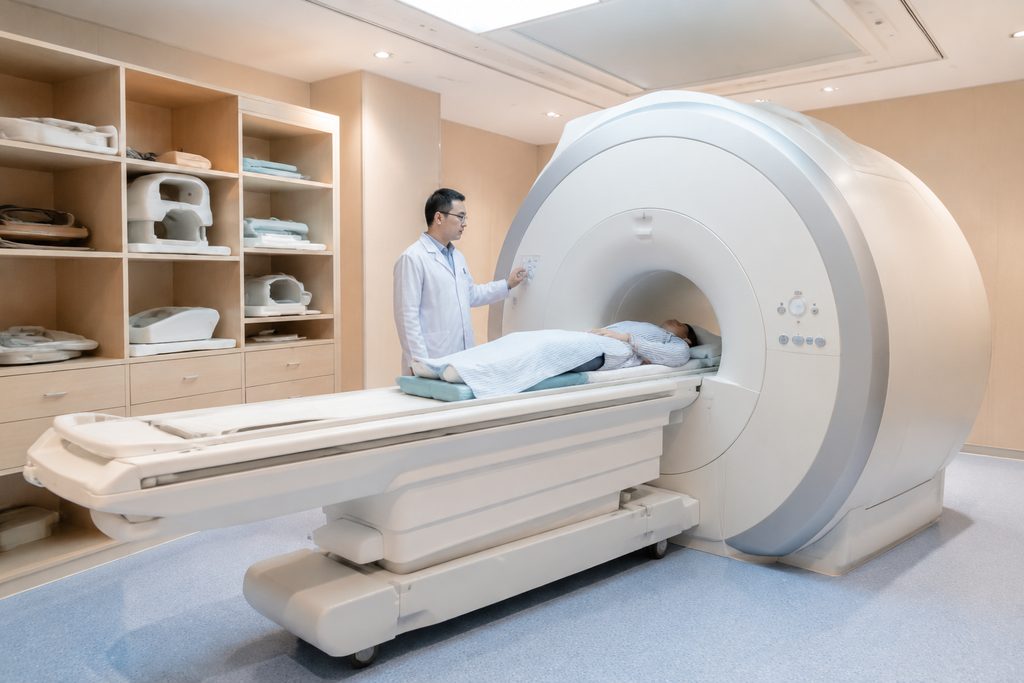
How Much Radiation Is in a CT Scan? Understanding Doses, Risks, and the Real ct scan cost China
According to the National Council on Radiation Protection and Measurements, the average American’s annual radiation exposure from medical imaging has risen nearly sixfold since the 1980s. A single CT scan of the abdomen delivers roughly 10 millisieverts (mSv) — about three years’ worth of natural background radiation, compressed into seconds. If you are weighing a scan abroad, the ct scan cost China question matters, but the radiation dose question matters more.
We help international patients navigate Chinese healthcare every day. The first question is rarely about price. It is about safety. How much radiation is in a CT scan? Is it dangerous? How does a chest CT compare to a head CT? These are the right questions to ask before you book anything, anywhere.
Key Takeaways
- A typical CT scan delivers between 1 and 15 mSv depending on the body part — a chest CT is about 7 mSv, a head CT about 2 mSv, and a CT angiogram up to 15 mSv.
- For context, a standard chest X-ray delivers 0.1 mSv, a transatlantic flight delivers about 0.04 mSv, and natural background radiation is about 3 mSv per year.
- The radiation dose ct scan vs x ray comparison is not close: a CT scan can deliver 50 to 150 times the radiation of a conventional X-ray of the same region.
- Low-dose protocols now reduce radiation by 40% to 70% for many scans — and Chinese hospitals increasingly use them for lung cancer screening and pediatric imaging.
- CT scan radiation is not dangerous in the way most people fear — the lifetime cancer risk from one scan is very small, but repeated unnecessary scans add up.
The Problem: Radiation Anxiety Meets Confusing Numbers
A radiologist at a top-tier Chinese hospital may interpret 50 to 100 CT scans per day. That is not an exaggeration — it is the reality of large public hospitals in Beijing, Shanghai, and Guangzhou. Compare that to a typical US radiologist reading 20 to 40 studies daily. Volume does not guarantee quality, but it does build pattern recognition. A radiologist who has seen 10,000 chest CTs has a different eye than one who has seen 2,000.
This matters for dose interpretation too. Experienced radiologists are more likely to flag when a scan was over-dosed or when a repeat scan is unnecessary. They see the technical parameters every day.
Low-Dose Protocols Are Now Standard in Major Centers
Chinese hospitals have adopted low-dose CT protocols aggressively, particularly for lung cancer screening. A low dose ct scan Shanghai price is typically lower than a standard-dose scan — and the radiation exposure can be reduced to 1 to 2 mSv for a chest CT, down from 7 mSv. That is a 70% to 85% reduction.
The technology is not exotic. It involves adjusting tube current, using iterative reconstruction software, and limiting scan length. But it requires a facility that has invested in the software and a radiology department that has trained its technicians. The top hospitals in our network — which includes 340+ top-ranked hospitals across 37 cities — have done both.
Cost Advantage Without Quality Compromise
Let us address the obvious objection. A CT scan in China costs less. Does that mean lower quality? No. The reasons are structural. Chinese hospitals operate at enormous scale. Equipment costs are amortized across far more patients. Labor costs are lower. Malpractice insurance is a fraction of US levels. None of that affects image quality or diagnostic accuracy.
A chest CT without contrast in the United States typically costs $500 to $1,500. The same scan at a top Chinese public hospital costs between $80 and $250. At a private international hospital in Shanghai, it might run $200 to $500. The ct scan cost China differential is real, and it holds across nearly every imaging modality.
Radiation Dose by Scan Type: What the Numbers Actually Mean
Different body parts absorb different doses. A head CT delivers far less radiation than an abdominal CT because the head is smaller and the organs are less dense. Here is what the published literature — primarily from the American Association of Physicists in Medicine and the International Commission on Radiological Protection — shows for typical effective doses:
| Scan Type | Typical Effective Dose (mSv) | Equivalent Chest X-Rays | Equivalent Background Radiation |
|---|---|---|---|
| Chest X-ray (single view) | 0.1 | 1 | 12 days |
| Head CT | 2 | 20 | 8 months |
| Chest CT (standard dose) | 7 | 70 | 2.3 years |
| Chest CT (low-dose protocol) | 1–2 | 10–20 | 4–8 months |
| Abdomen/Pelvis CT | 10 | 100 | 3.3 years |
| Coronary CT Angiography | 12–15 | 120–150 | 4–5 years |
| Full-Body CT (screening, not recommended) | 20–30 | 200–300 | 7–10 years |
The radiation dose ct scan vs x ray comparison is stark. One abdominal CT equals roughly 100 chest X-rays. One coronary CT angiogram equals 150. That does not mean CT scans are dangerous — it means they should be used deliberately.
Is ct scan radiation dangerous? The honest answer is nuanced. For a single, medically indicated scan, the risk is very small. The linear no-threshold model used by radiation protection agencies assumes any dose carries some risk, but the risk at 10 mSv is on the order of 1 in 2,000 for fatal cancer. For comparison, the natural lifetime cancer risk is about 1 in 3. The scan adds a tiny increment to a large baseline.
The danger is not one scan. It is cumulative exposure from repeated scans, especially in younger patients. Children are more radiosensitive than adults. A 2021 study in JAMA Pediatrics estimated that 1 in 1,000 children who receive a single abdominal CT before age 10 will develop a radiation-induced cancer later in life. That is not negligible. It is a reason to ask questions.
How to Decide Whether a CT Scan Is Worth the Radiation
The right question is not “how much radiation is in a CT scan” in the abstract. It is: what will this scan change about my care? If the answer is nothing — if the result would not alter treatment — the scan is not worth the dose. If the answer is that it would rule out a life-threatening condition or guide a necessary procedure, the dose is justified.
Here is a practical framework we use when helping patients evaluate imaging plans:
- Ask what the scan will rule in or rule out. If your doctor cannot answer this clearly, push back. A CT scan for vague abdominal pain without a working diagnosis is often low-yield.
- Ask if ultrasound or MRI could answer the same question. Neither uses ionizing radiation. For many soft-tissue and musculoskeletal questions, MRI is superior anyway.
- Ask if a low-dose protocol is available. For chest CTs, lung cancer screening, and many follow-up scans, low-dose is now the standard of care. If the facility does not offer it, that is a red flag.
- Keep your own imaging record. If you have had three CT scans in two years at three different hospitals, no single doctor knows your cumulative dose. Track it yourself.
And one more thing: full-body CT screening in healthy people is not recommended by any major medical organization. The American College of Radiology, the FDA, and the UK’s National Health Service all advise against it. The radiation dose is high, the false-positive rate is significant, and there is no evidence it saves lives. If someone offers you a “full-body cancer scan” as a wellness product, walk away.
Practical Considerations: Getting a CT Scan in China
If you are considering a CT scan as part of medical travel to China — or if you are already in China and need imaging — here is what actually matters on the ground.
Documentation. Chinese hospitals will want to see any prior imaging and reports. Bring CDs or digital files, not just printed reports. Radiologists often want to compare current and prior scans directly. If you have had a previous CT of the same body part, bring it.
Visa. Medical treatment in China falls under the S2 visa category for short stays, with supporting documentation from the hospital. The M visa is for commercial and trade activities and is not appropriate for medical travel. Family members accompanying a patient also apply for S2 visas. Requirements vary by embassy, so verify current rules before booking anything.
Payment. Public hospitals in China generally require prepayment at the time of service. Credit cards are accepted at international departments, but cash or Chinese mobile payment is often needed in standard outpatient settings. Private international hospitals like United Family or Jiahui accept international credit cards and often bill insurers directly. Expect to pay $80 to $250 for a standard CT at a public hospital, $200 to $500 at a private international facility.
Language. A top-tier public hospital in Beijing may see 10,000 outpatients per day. Signage is increasingly bilingual in major centers, but the flow is not designed for non-Chinese speakers. Registration, payment, queue numbers, and report pickup all involve Chinese-language steps. This is not a reason to avoid Chinese hospitals — it is a reason to plan for interpretation support.
Report turnaround. In most Chinese hospitals, the scan itself takes 10 to 15 minutes. The radiology report is typically available within 2 to 24 hours, depending on the hospital and scan complexity. If you need the report same-day, ask before booking.
Follow-up after returning home. Chinese radiology reports are increasingly written in English at international departments, but standard reports are in Chinese. If you plan to share results with a doctor back home, request an English translation or have the report translated professionally. The images themselves are universal — DICOM files open on any system.
Frequently Asked Questions
How much radiation is in a CT scan compared to an X-ray?
A CT scan delivers 50 to 150 times the radiation of a conventional X-ray of the same body region. A chest X-ray is about 0.1 mSv. A chest CT is about 7 mSv. The radiation dose ct scan vs x ray difference is significant because CT uses a rotating X-ray tube that captures hundreds of images in a single pass.
Is ct scan radiation dangerous enough to avoid a medically necessary scan?
No. The lifetime cancer risk from a single 10 mSv CT scan is roughly 1 in 2,000. That is small compared to the risk of missing a pulmonary embolism, a brain bleed, or an operable tumor. The danger is unnecessary repetition, not one justified scan. Ask what the scan will change about your care. If the answer is meaningful, get the scan.
What does a low dose ct scan Shanghai price look like?
A low-dose chest CT at a top Shanghai public hospital typically costs between $80 and $200. At a private international hospital, expect $250 to $500. Low-dose protocols reduce radiation by 40% to 70% and are now standard for lung cancer screening. Prices vary by hospital and case complexity, so confirm before booking.
Can I get a CT scan in China as a foreigner without a doctor’s referral?
In most cases, you need a physician’s order. Chinese hospitals do not generally offer walk-in self-referred CT scans in their standard outpatient departments. Some private international hospitals and health screening centers offer imaging packages that include CT, but these are typically wellness products. For a medically indicated scan, bring a referral or see a physician at the hospital first.
Is ct scan medical tourism China a real option for imaging alone?
Yes, but it is more common as part of a broader medical visit. Imaging is rarely the sole reason patients travel to China — it is usually bundled with a specialist consultation, a second opinion, or a procedure. The cost savings on imaging are real, but they are most meaningful when combined with other services. A chest CT that costs $1,200 in the US might cost $150 in China, but the flight and logistics only make sense if imaging is part of a larger plan.
Your Next Step
Radiation dose is a question of physics. Whether a scan is worth it is a question of medicine. Both deserve clear answers before you proceed. We help international patients understand their imaging options, connect with appropriate specialists, and navigate Chinese hospitals without the language and logistics burden. We are not a hospital and we do not provide diagnoses — we are the coordination layer between you and the medical expertise you need.
If you are weighing a CT scan in China, start with a conversation. Explore our directory of top-ranked Chinese hospitals or learn how our patient coordination services work. No pressure. Just clear information and a path forward.
For more medical information and treatment options in China, visit chinamedservices.com (China Medical Services).
