Eye Surgery in Hangzhou China: Full Local Companion Service Guide
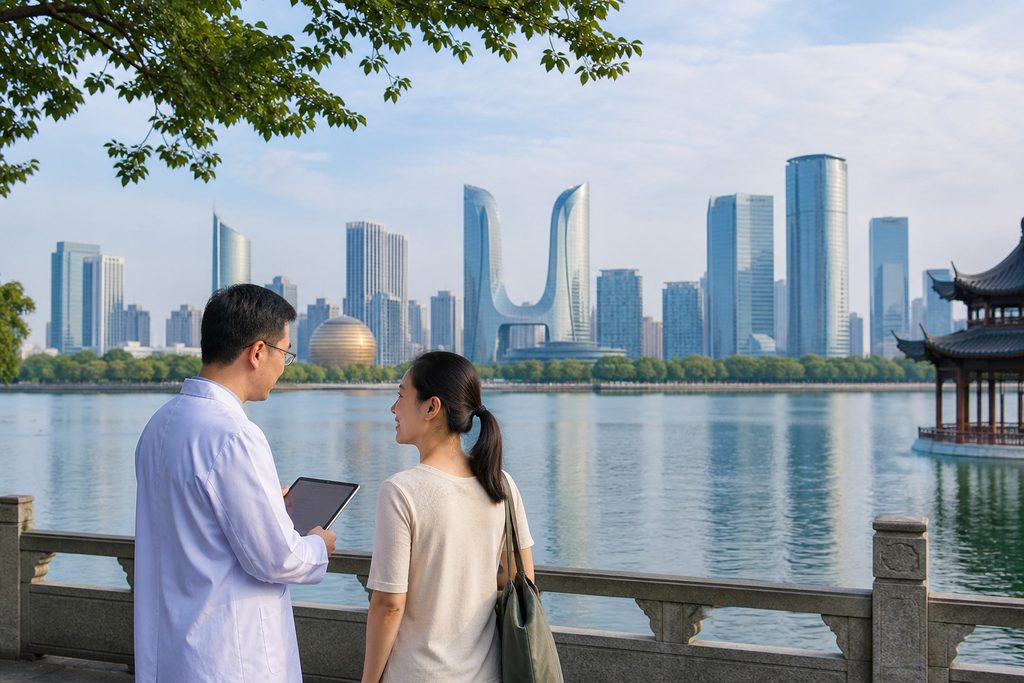
You have probably seen the numbers. A procedure quoted at $5,500 per eye back home listed at under $1,800 in China. The immediate reaction is skepticism. Something must be missing. The facilities must be dated. The post-operative care must be lacking. But the reality of modern Chinese ophthalmology, particularly in a city like Hangzhou, dismantles that assumption quickly. The gap is not about clinical quality. It is about systemic efficiency, labor costs, and the sheer volume of procedures performed. Our team has walked through the doors of these hospitals. We have translated pre-surgery checklists and sat in recovery rooms. The equipment is the same German and Swiss laser platform you would see in Munich or Houston. The surgeons are often handling a caseload in one month that a Western specialist sees in a year. What you pay for at home is the administrative overhead, the malpractice insurance layer, and the fragmented referral chain. None of that touches the laser. Understanding how to access this alternative without getting lost in translation is what changes the outcome.
How This Actually Works, Step by Step
The process breaks down into a sequence that protects you from arriving unprepared. Nobody flies across the world hoping the hospital has a slot. The sequence starts remotely.
You send your existing eye examination records. A refraction history, corneal topography if you have it, a slit-lamp report, and your prescription stability over the past two years. We translate these documents into clinical Chinese. Our team submits them to the international patient center of your selected hospital in Hangzhou. A specialist reviews the package. You receive a written assessment. It confirms whether you are a candidate, which technique is indicated, and what the preliminary eye surgery cost Hangzhou China would be. This is not a binding quote—final pricing depends on the in-person screening. But it eliminates the risk of arriving only to discover a contraindication.
Once the remote evaluation clears you, the practical timeline locks in. We coordinate a date range for your in-person comprehensive exam. You apply for an S2 short-term private affairs visa, citing medical treatment as the purpose. The hospital issues a formal invitation letter and treatment confirmation to support the application. You book flights. We arrange airport pickup and a hotel or serviced apartment within a short walk of the hospital.
On your first hospital day, a bilingual medical companion meets you at the entrance. They carry your translated records, handle registration, pay the temporary hospital card deposit, and guide you to the ophthalmology floor. The surgeon conducts a full dilated exam and finalizes the surgical plan. Surgery is typically scheduled within 24 to 72 hours after this clearance, depending on the hospital’s laser schedule. The companion stays through every step: the consent form review, the pre-op wash, the procedure itself, and the post-op observation. You are never left alone to navigate a Chinese-language queue or a payment terminal.
Why Hangzhou Has Become a Focal Point for Ophthalmology Medical Tourism
Hangzhou does not shout about its medical infrastructure the way Shanghai or Beijing does. That quietness hides a concentration of elite ophthalmology resources. The city is home to a top-tier university hospital whose eye center ranks consistently in the national top-10 for ophthalmology. This is not a private clinic renting a floor in a commercial tower. It is a full-spectrum academic department handling everything from routine SMILE and LASIK to complex vitreoretinal surgery. The volume is staggering. A single surgeon may perform 40 refractive procedures in a day. That repetition breeds a level of intraoperative calm that is hard to replicate in a lower-volume setting.
For international patients, the draw is twofold. The clinical standard matches any Western academic center. But the infrastructure around the patient—the language barrier, the payment system, the sheer physical scale of a Chinese public hospital—is daunting without a guide. That is where the ophthalmology medical tourism China prices advantage becomes real only if the logistics are solved. A laser procedure that costs $2,200 per eye in Seoul or $4,800 in Los Angeles sits at roughly $1,200 to $1,800 in Hangzhou. The savings are not from cutting corners. They come from a system designed for high throughput and a local cost base that makes premium care accessible. The companion layer adds a few hundred dollars. The net result still runs thousands below Western pricing.
A Realistic Timeline
This is what a typical refractive surgery journey to Hangzhou looks like, counting from the day you decide to send your records.
| Stage | What Happens | Typical Duration |
|---|---|---|
| Remote Evaluation | You send records; we translate and submit; specialist reviews and issues a written second opinion | 5–10 business days |
| Visa Preparation | Hospital issues invitation letter; you apply for S2 visa at your local Chinese embassy/consulate | 1–3 weeks (varies by country) |
| Travel Coordination | Flights booked; hotel near hospital confirmed; airport transfer arranged | Concurrent with visa processing |
| Arrival & In-Person Exam | Comprehensive eye exam, dilation, topography, final surgical clearance | Day 1 (half-day) |
| Surgery | Procedure performed; typically SMILE, LASIK, or ICL implantation | Day 2 or 3 (procedure itself: 15–30 minutes per eye) |
| Immediate Recovery | 24-hour post-op check; eye shield removal; visual acuity test | Day 3 or 4 |
| Extended Observation | Additional follow-up at 1 week post-op; final clearance to fly | Day 7–10 |
| Return Home | Depart Hangzhou; continue follow-up with your local optometrist | Day 10–14 |
The timeline stretches if you need a specific surgeon whose schedule is packed. Public hospital experts see hundreds of patients weekly. The international channel usually secures a slot within the window shown above, but flexibility on your travel dates helps. Also, if your cornea shows irregular topography during the in-person exam, the surgeon may switch the technique. That can shift the date by a day while the appropriate laser is prepared.
What Can Go Wrong — and What Happens Then
No honest guide skips the failure modes. Things do go sideways, even with elite surgeons. The question is what recourse exists.
The most common hiccup is a change in surgical plan after the in-person exam. A patient cleared remotely for SMILE may show borderline corneal thickness on the actual Pentacam scan. The surgeon then recommends PRK or a different flap thickness. This is not a bait-and-switch. It is a higher standard of screening catching what a remote review cannot. Our companion explains the change in real time, translates the surgeon’s reasoning, and gives you space to decide. You can proceed with the new plan or decline entirely. If you decline, the surgical deposit is refunded per hospital policy. You are out the travel cost, which is a real loss. That is the risk you carry.
A more serious failure is a surgical complication. Diffuse lamellar keratitis, epithelial ingrowth, or a decentered ablation. These are rare but documented in every large refractive surgery dataset globally. The Hangzhou hospitals we work with have the full toolkit to manage these: cross-linking capability, therapeutic contact lenses, steroid protocols, and access to a corneal subspecialist within the same department. Your companion ensures you see the right sub-specialist immediately, not a triage nurse who tells you to wait. If the complication requires extended stay, we re-coordinate accommodations and visa extension. The companion stays on your case until the acute phase resolves.
The third failure mode is less clinical: a visa rejection. S2 visas are generally straightforward when supported by a legitimate hospital invitation, but embassies retain full discretion. If your visa is denied, any coordination fee already paid is refunded. The written second opinion remains yours. You have not lost the clinical insight, only the travel plan.
How to Evaluate an Eye Hospital in Hangzhou for International Patients
Choosing where to book eye surgery Hangzhou medical companion support requires a filter that goes beyond marketing brochures. We apply three criteria internally. You can use the same lens.
First, check whether the ophthalmology department appears in the Fudan Hospital Ranking specialty list. This is China’s most authoritative hospital evaluation. A department ranked in the national top-10 for ophthalmology has passed a rigorous peer-review process. Hangzhou has one such department. Its surgeons publish in international journals and present at AAO and ESCRS meetings. That matters more than a glossy website.
Second, look at the laser platform generation. You want a femtosecond laser that is the current or previous generation model—think Zeiss VisuMax 800 or the equivalent Alcon or Schwind system. Older platforms are not unsafe, but the newer ones offer faster suction times and more refined centration. Ask directly: “Which laser model will be used for my procedure?” The answer should be specific and verifiable.
Third, assess the pre-operative screening protocol. A hospital that does corneal topography, pachymetry, dilated fundus exam, and tear film assessment before clearing you is serious. A hospital that clears you based on a quick autorefraction alone is not. The best eye hospital Hangzhou international patients can access will run a 90-minute workup before the surgeon even sees you. That thoroughness is the safety net.
The cost of this thoroughness is embedded in the procedure fee. You are not paying extra for each test. But you are paying for access to a system that runs them as standard. The eye surgery abroad full service package China model works because it bundles the clinical rigor with the logistical hand-holding. You are not buying just a laser slot. You are buying the translation of every consent form, the companion physically walking you to the topography room, and the post-op explanation delivered in English at your bedside.
Practical Considerations: Records, Visa, Payment, and Follow-Up
The logistics are not difficult if you prepare them in order.
Medical records must be recent. A refraction done within three months, a topography within six months, and a stable prescription for at least two years. If you wear contact lenses, you stop soft lenses two weeks before the in-person exam and rigid lenses four weeks before. The surgeon needs your cornea in its natural shape. Send everything as high-resolution PDFs. Phone photos of a printout are not adequate for diagnostic review.
The visa category is S2. You state the purpose as private medical treatment. The supporting documents include the hospital invitation letter, a treatment confirmation, and proof of accommodation. Our team provides the hospital documents. You handle the embassy submission. Processing times vary by country. Budget a month from submission to passport return if you want zero stress.
Payment is upfront in Chinese yuan. The hospital international department accepts wire transfers, UnionPay, and major credit cards. Some accept international insurance for direct billing if the policy covers elective procedures abroad, but most refractive surgery is self-pay. The eye surgery cost Hangzhou China typically runs between $1,200 and $2,200 per eye depending on technique and surgeon seniority. The companion service fee is separate and paid to us, from $300 per day. The total package still undercuts Western pricing by a factor of three to five.
Follow-up at home is essential. You need a local optometrist who agrees in advance to see you at one week, one month, three months, and six months post-op. The Hangzhou surgeon provides a detailed discharge summary in English and Chinese. Your local provider reads it and continues the monitoring. This handoff is planned before you travel. Do not arrive home and then start searching for an optometrist willing to take over someone else’s surgery.
Frequently Asked Questions
Clinical safety data from top-tier Chinese ophthalmology centers shows complication rates on par with international benchmarks. A 2019 study in the Journal of Cataract & Refractive Surgery analyzing over 100,000 SMILE procedures across multiple Chinese centers reported a lenticule extraction complication rate of 0.8%, consistent with global figures. The safety question is less about the laser and more about the screening protocol and surgeon experience. A department performing thousands of procedures annually, using current-generation equipment and a rigorous pre-op workup, operates at a safety level comparable to any Western academic center. The variable is not the country. It is the specific hospital.
The eye surgery cost Hangzhou China is consistently lower than in Singapore, South Korea, or Thailand for equivalent laser platforms. SMILE in Hangzhou runs $1,200–$1,800 per eye. The same procedure in Seoul starts around $2,200. In Singapore, $3,000. In the United States, $4,500 and up. The differential holds across ICL implantation and cataract surgery with premium lenses. The lower cost reflects China’s domestic pricing structure, not a discount on quality. Adding a full companion service brings the total to roughly $2,000–$2,500 per eye, still well below other medical tourism hubs.
The Hangzhou surgeon provides a complete operative report and a recommended follow-up schedule. You arrange a local optometrist or ophthalmologist in advance to handle post-op care. If a complication arises that requires the original surgeon’s input, we facilitate a video consultation with the Hangzhou team. Your local provider and the Chinese surgeon communicate directly through our translation support. The follow-up video consultation is typically $100–$300. It is not free, but it preserves continuity of care across borders.
You can, but the friction is high. Public hospital registration is in Chinese. The payment terminals display only Chinese characters. The consent form is a multi-page legal document in Chinese. The nurses giving pre-op instructions speak Mandarin. You can certainly find a friend or use a translation app. But in a high-stakes setting where misunderstanding a post-op drop schedule can affect your corneal healing, the risk of miscommunication is real. The companion is not a luxury add-on. It is the interface between you and a system not designed for non-Chinese speakers.
Your Next Step
The decision to travel for eye surgery is never purely financial. It is a calculation of trust, time, and tolerance for complexity. What we have seen repeatedly is that the clinical quality in Hangzhou exceeds expectations, while the logistical friction without a guide is exactly as hard as people fear. Our role is narrow. We do not perform surgery. We do not offer medical advice. We connect you with the right ophthalmology department, translate your records, secure the appointment, and place a bilingual companion at your side from the moment you enter the hospital until you are cleared to fly home. If you want to understand whether your specific case fits, send your records for a remote evaluation. The written second opinion comes back in plain English. You lose nothing by looking. Start with a free consultation and we will walk you through what is possible.
The promise of Chinese ophthalmology is not magic. It is volume, technology, and a cost structure that makes premium care accessible. Hangzhou happens to house one of the best examples of that promise. Getting there safely is just a matter of having the right person next to you in the waiting room.
For more medical information and treatment options in China, visit chinamedservices.com (China Medical Services).
