Is Gamma Knife Right for My Brain Tumor? Costs, Safety, and China Options
Roughly 1 in 4 brain tumors discovered on imaging turns out to be benign. That is a staggering number — hundreds of thousands of people each year suddenly facing a question they never expected to ask: is Gamma Knife right for my brain tumor? The answer depends on tumor type, size, location, and your overall health. The gamma knife cost China also factors in heavily for patients weighing treatment at home versus abroad.
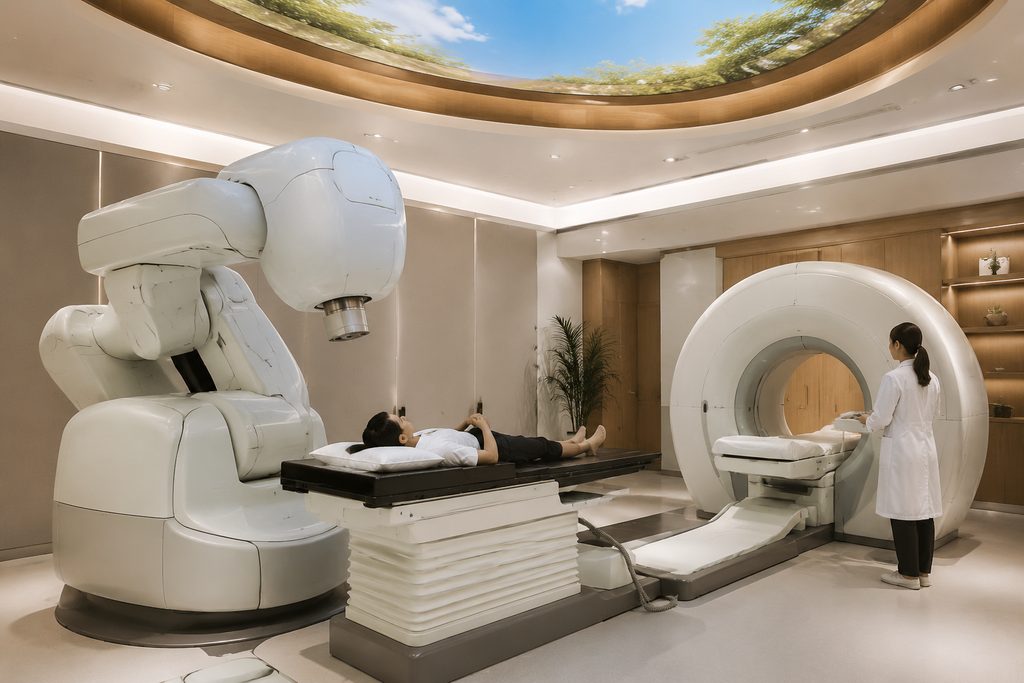
Gamma Knife is not actually a knife. It delivers 192 or 201 focused beams of gamma radiation to a precise point inside the skull. Each beam is weak enough to spare healthy tissue. Where they converge, the dose is high enough to destroy tumor cells or stop them from growing. The procedure has been used since the late 1960s, with over 1.5 million patients treated worldwide. Long-term control rates for small vestibular schwannomas (acoustic neuromas) exceed 90% at 10 years in multiple published series.
But the technology is only as good as the team behind it. And that is where China enters the conversation. Major centers in Shanghai, Beijing, and Guangzhou now operate the latest Leksell Gamma Knife Icon and Perfexion systems. These are the same machines used at leading Western centers. The difference often comes down to cost, wait times, and the coordination required to access care as an international patient.
This article walks through what actually happens when you pursue Gamma Knife treatment in China. We cover the real sequence of steps, what the evidence says about safety, a realistic timeline, what can go wrong, and how to evaluate a hospital. Our team at China Medical Services has guided patients through this process, and we explain it here without hype.
How This Actually Works, Step by Step
You do not simply land in Shanghai and walk into a Gamma Knife suite. The path from where you are now to a completed treatment involves several distinct stages. Each one takes time. Knowing the sequence helps you plan realistically.
First, you send your existing imaging and reports. That means the actual MRI or CT files — not just the written summary. Chinese neurosurgeons want to see the raw DICOM data. Your biopsy report, if you have one, also matters. We coordinate the secure transfer of these files to the relevant department at a shortlisted hospital.
Second, a Chinese neurosurgery or radiation oncology team reviews your case. They assess tumor size, location, proximity to critical structures like the brainstem or optic nerves, and your history. This review typically takes 3 to 7 working days. You receive a written opinion stating whether Gamma Knife is appropriate, what alternative treatments exist, and what they recommend.
Third, if the team confirms suitability, you move to scheduling. This is where the international patient pathway differs from a local one. Public hospitals in China do not allow overseas patients to book outpatient visits or procedures online in advance. You need either a hospital international department or a coordination service that works through official channels. The appointment lead time for a Gamma Knife consultation at a top Shanghai center is usually 1 to 3 weeks once your records are accepted.
Fourth, you travel to China. The applicable visa for medical treatment is the S2 visa, issued for short-term private affairs including medical care. Accompanying family members also apply for S2. Processing time varies by embassy and your nationality — budget 2 to 4 weeks. You will need an invitation letter and supporting documents from the treating hospital.
Fifth, you have the in-person consultation, then the Gamma Knife procedure itself. The treatment session usually takes 30 minutes to 2 hours depending on the number of isocenters and whether a frame or mask is used. Most patients go home the same day or the next morning.
Sixth, you return home and enter the follow-up phase. Gamma Knife does not remove a tumor. It stops or slows growth. The real measure of success comes 6 to 24 months later on repeat imaging.
Is Gamma Knife Safe for Brain Tumors? What the Evidence Shows
The short answer: for appropriately selected tumors, yes. The long answer requires understanding what “safe” means in radiosurgery. Every treatment carries risk. The question is whether the risk profile beats the alternatives — open surgery or watchful waiting.
Published data from the International Gamma Knife Research Consortium and individual high-volume centers shows excellent tumor control rates. For vestibular schwannomas smaller than 3 cm, 5-year control rates run 92% to 97%. For brain metastases, local control at 1 year is roughly 80% to 90% depending on histology and dose. For meningiomas, 10-year progression-free survival exceeds 85% in most series.
But safety also means side effects. The most common acute issues are mild headache, fatigue, and pin-site soreness when a stereotactic frame is used. These resolve within days. Delayed effects — occurring months to years later — include radiation necrosis (reported in 2% to 5% of cases), new cranial nerve deficits, and, rarely, secondary tumors. The risk of radiation-induced malignancy is estimated at less than 0.1% over 20 years.
One honest caveat: most published outcome data comes from Western and Japanese centers. Chinese hospitals have high case volumes, particularly for brain metastases and acoustic neuromas, but peer-reviewed outcome publications from Chinese centers are fewer. That does not mean outcomes are worse. It means you should ask a hospital directly about its own case volume, follow-up protocol, and complication rates before committing.
So, is Gamma Knife safe for brain tumors? For small, well-defined lesions in accessible locations, the risk-benefit ratio is strongly favorable. For tumors larger than 3 cm, or those pressing hard on the optic apparatus, the safety equation shifts. A thorough remote review by an experienced radiosurgery team is the only way to know where you stand.
Best Gamma Knife Hospital Shanghai: How to Evaluate Your Options
Shanghai is home to several centers with current-generation Gamma Knife technology. The question “best gamma knife hospital Shanghai” does not have a single answer. It depends on your tumor type and what you value most.
Huashan Hospital, affiliated with Fudan University, operates one of the largest neurosurgery departments in China. Its Gamma Knife center has treated tens of thousands of patients since the 1990s. The hospital consistently ranks among China’s top 10 for neurosurgery in the Fudan specialty reputation rankings. For acoustic neuromas and skull-base tumors, Huashan’s case volume is difficult to match anywhere in Asia.
Zhongshan Hospital, also affiliated with Fudan University, is another strong option. Its radiation oncology and neurosurgery departments collaborate closely on radiosurgery cases. Shanghai’s broader medical ecosystem includes multiple other hospitals with Gamma Knife capability, including Ruijin Hospital and Changhai Hospital.
What separates a good Gamma Knife center from an average one? Three things. First, case volume — centers treating 300 or more patients per year have refined their workflows and physics QA. Second, multidisciplinary review — the best centers discuss each case with neurosurgeons, radiation oncologists, and medical physicists together. Third, follow-up discipline — a center that tracks patients at 6, 12, and 24 months and adjusts protocols based on outcomes is a center you can trust.
You can explore our database of top-ranked Chinese hospitals to compare neurosurgery and radiation oncology departments across cities. The Fudan specialty rankings provide a useful reference point, though they do not capture every factor that matters for an individual patient.
A Realistic Timeline
People consistently underestimate the time between first inquiry and completed Gamma Knife treatment. Here is what actually happens, based on the coordination work we do for international patients.
| Stage | What Happens | Typical Duration |
|---|---|---|
| Day 1–7 | You collect and send imaging files, reports, and history | 1 week |
| Day 7–14 | Hospital team reviews your case remotely | 3–7 working days |
| Week 2–3 | Written opinion received; you decide whether to proceed | Your decision time |
| Week 3–6 | Appointment scheduling through hospital international department | 1–3 weeks |
| Week 4–8 | S2 visa application and processing | 2–4 weeks |
| Week 6–10 | Travel to China, in-person consultation, imaging | 2–4 days on the ground |
| Week 6–10 | Gamma Knife procedure | Same day or overnight |
| Month 3–6 | First follow-up MRI at home | 3–6 months post-treatment |
| Month 12–24 | Definitive assessment of tumor response | 12–24 months post-treatment |
Notice the two waiting periods people forget: document translation and visa processing. If your records are not in English or Chinese, translation adds 3 to 5 days. And embassy appointment availability for the S2 visa can stretch beyond 4 weeks during peak seasons. Plan for a total of 6 to 10 weeks from first inquiry to treatment day.
What Can Go Wrong — and What Happens Then
Honesty matters more than comfort here. Several things can derail the process. Knowing them in advance gives you recourse.
The remote review may determine you are not a candidate. This happens in roughly 20% to 30% of cases we see. The tumor may be too large. It may be too close to the optic chiasm. The diagnosis may be unclear and require a biopsy first. If this happens, you have not wasted a trip — you have spent a few hundred dollars to learn that flying to Shanghai would have been a mistake. The written opinion usually includes alternative recommendations.
The hospital may require additional imaging before scheduling. Some centers insist on a fresh MRI within 30 days of treatment. If your home MRI is older, you will need to arrange one on arrival. That adds a day or two to your stay.
Visa delays happen. Embassy processing times fluctuate. In rare cases, an S2 application is rejected because the hospital invitation letter lacks specific wording. Working with a hospital international department that knows the exact documentation requirements reduces this risk substantially.
Treatment-day complications are uncommon but real. Frame placement can cause vasovagal reactions in anxious patients. The team manages this with medication and monitoring. If the tumor location makes frame placement difficult, the center may switch to a mask-based approach on the newer Icon system. That flexibility is one reason to choose a center with current-generation equipment.
Post-treatment swelling can occur 3 to 6 months after treatment. Some patients experience transient worsening of symptoms — hearing loss, facial numbness, or balance issues — before improvement. This is called pseudoprogression and affects roughly 10% to 15% of acoustic neuroma patients. It usually resolves with a short course of steroids. Your home neurologist can manage this, but you should have a clear line of communication back to the treating center.
Gamma Knife vs Surgery for Acoustic Neuroma China: Making the Call
Acoustic neuroma — properly called vestibular schwannoma — is the tumor type where the Gamma Knife versus surgery debate is most active. Both approaches have strong evidence behind them. The right choice depends on tumor size, hearing status, age, and personal preference.
For tumors under 2.5 cm, Gamma Knife offers tumor control rates equivalent to complete surgical resection in most published series — around 95% at 5 years. The advantage is avoiding open brain surgery: no craniotomy, no general anesthesia, no hospital stay beyond 24 hours. The disadvantage is that the tumor remains in place. You live with it, monitored by annual MRIs.
Surgery offers the possibility of complete removal. For young patients with large tumors causing brainstem compression, surgery is usually the first choice. But surgery carries risks: facial nerve weakness in 10% to 30% of cases depending on tumor size and surgical approach, hearing loss in 50% to 70%, cerebrospinal fluid leak in 5% to 10%, and a recovery period measured in weeks to months.
In China, the cost differential is stark. Microsurgical resection of an acoustic neuroma at a top Chinese hospital typically runs $15,000 to $30,000 for international patients. Gamma Knife treatment is substantially less — usually $8,000 to $15,000 including imaging, physics planning, and the procedure itself. Compare that to $40,000 to $80,000 for Gamma Knife in the United States, and the gamma knife cost China becomes a significant factor for uninsured or underinsured patients.
Age matters too. A 35-year-old with a 2.8 cm tumor and good hearing may reasonably choose surgery for the chance at a cure. A 72-year-old with a 2.0 cm tumor and moderate hearing loss is often better served by Gamma Knife — the tumor will likely never cause problems in their lifetime. These are the conversations you should have with a neurosurgeon who performs both procedures, not just one.
How Long Does Gamma Knife Take to Work?
This is the question every patient asks, and the answer disappoints some people. Gamma Knife does not work immediately. It works through a biological process that unfolds over months.
The radiation damages tumor cell DNA. When those cells attempt to divide, they die. Tumor cells divide at different rates. Fast-growing tumors like brain metastases show response sooner — often visible shrinkage on MRI within 3 to 6 months. Slow-growing tumors like meningiomas and acoustic neuromas may not show measurable shrinkage for 12 to 24 months. In many cases, the tumor never shrinks at all. It simply stops growing.
That is the key distinction. Treatment success is defined as tumor control — no growth — not necessarily tumor disappearance. For acoustic neuromas, transient swelling at 3 to 6 months is common and does not indicate treatment failure. The definitive judgment comes at the 2-year mark in most protocols.
So how long does Gamma Knife take to work? For symptom relief, some patients notice improvement within weeks as pressure effects ease. For measurable tumor response, expect 6 to 24 months depending on histology. Anyone promising faster results is not being honest with you.
Practical Considerations: Records, Visa, Payment, and Follow-Up
Getting the logistics right matters as much as choosing the right hospital. Here is what actually applies when you book gamma knife treatment China as an international patient.
Your imaging must be current and complete. Most centers require a contrast-enhanced MRI within 30 to 60 days of treatment. Send the DICOM files, not screenshots or printed films. If you have prior imaging showing tumor growth over time, include that too — it helps the team assess aggressiveness.
The S2 visa is the correct category for medical treatment. You will need an invitation letter from the treating hospital, proof of accommodation, and evidence of sufficient funds. Family members traveling with you apply for their own S2 visas. Processing times vary by country. Start early.
Payment at Chinese public hospitals is generally required upfront. International departments accept wire transfers and major credit cards. Private international hospitals in China may offer direct insurance billing — here is our overview of private hospital options — but most Gamma Knife centers are in public institutions where you pay first and claim reimbursement from your insurer later. Check with your insurance provider before traveling. Some policies exclude treatment abroad entirely. Others require pre-authorization.
Language is the practical barrier most patients underestimate. Chinese public hospitals are enormous. A single outpatient building can see 10,000 patients a day. Signage is often bilingual in international departments, but the moment you step outside that bubble, nothing is in English. A bilingual medical companion — someone who handles registration, payment queues, and translation — changes the experience from overwhelming to manageable. It is not a luxury. It is the difference between navigating the system and being lost in it.
Follow-up after you return home is non-negotiable. You need an MRI at 6 months, 12 months, and 24 months. Your local neurologist can read these scans, but the treating center should also review them. Most Chinese Gamma Knife centers accept follow-up imaging by email or through their international department. Establish that communication channel before you leave.
Frequently Asked Questions
No. The procedure itself is painless. If a stereotactic frame is used, you receive local anesthetic at the pin sites. You may feel pressure during frame placement, but not pain. Some patients experience mild headache afterward, which resolves within a day or two.
Can I fly home immediately after Gamma Knife treatment?
Most patients can fly within 24 to 48 hours. The treating team will advise based on your specific case. If you have significant brainstem compression or new symptoms, they may recommend a longer observation period. Plan for at least 2 to 3 days in
For more medical information and treatment options in China, visit chinamedservices.com (China Medical Services).
