Treadmill Test in China: Booking Guide for International Patients
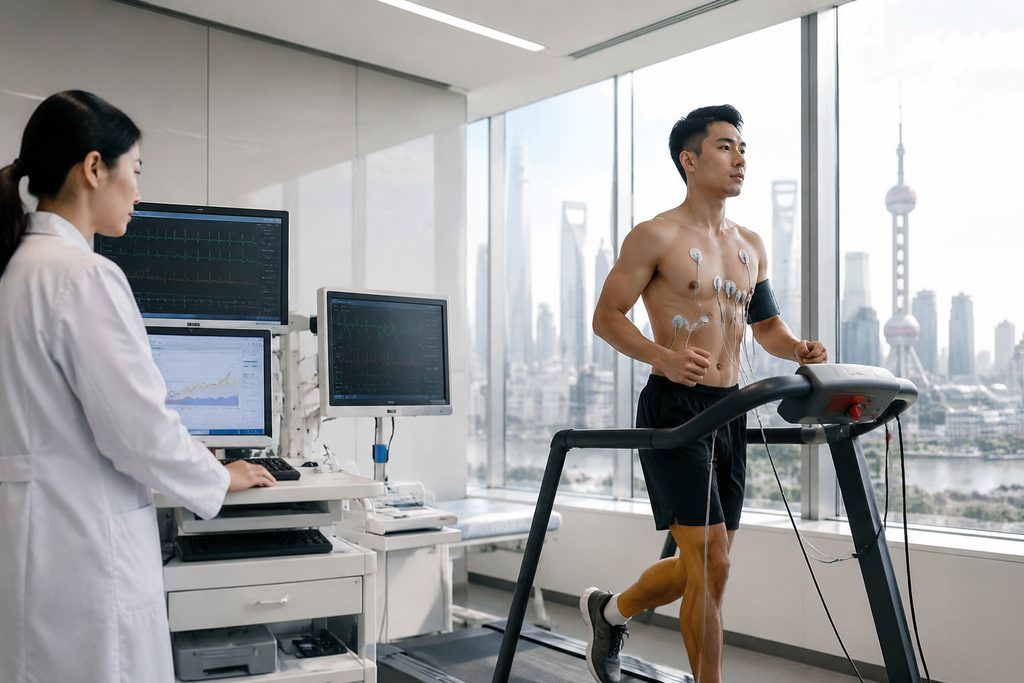
Key Takeaways
- A treadmill test at a top-tier Chinese public hospital typically runs $80–250 out of pocket, versus $1,000–2,500 in the United States for a comparable exercise stress ECG.
- China’s leading cardiac centers handle extraordinary volumes — Fuwai Hospital in Beijing performs more than 14,000 cardiac surgeries a year, and its diagnostic labs run on the same scale.
- The hard part is not the test itself. Public hospital outpatient slots cannot be reserved from overseas in advance, and walk-in registration without Mandarin is genuinely difficult.
- Understanding the difference between a screening stress test and a diagnostic one — and knowing which visa category applies — prevents most of the problems international patients run into.
The Problem: A Cardiac Stress Test Shouldn’t Take Six Weeks to Book
In the United Kingdom, the median wait for a routine cardiac diagnostic test has stretched past six weeks in many NHS trusts, and private alternatives often quote £600–1,200 for an exercise tolerance test alone. In the United States, a simple treadmill stress test with ECG monitoring averages $1,200–2,500 before insurance, and a stress echocardiogram can top $3,000.
For a patient with chest tightness, unexplained breathlessness, or a family history of early heart disease, six weeks of waiting is not a neutral delay. It is six weeks of not knowing. That uncertainty has a real cost — and it is one of the reasons a growing number of international patients now look seriously at the treadmill test cost China hospitals publish, which sits in a completely different range.
But here is the part most articles skip. China’s healthcare system is not built around the assumption that a foreigner will book online, pay by card, and show up. It is built around volume, queues, and Mandarin. Knowing that up front is the difference between a smooth trip and a wasted one.
Why China Delivers Fast, Affordable Cardiac Diagnostics
China’s top hospitals are not smaller versions of Western hospitals. They are larger — often dramatically so. A single major center may see more outpatients in a day than a mid-sized American hospital sees in a month. That scale changes what is possible.
Clinical Volume That Compresses Scheduling
Fuwai Hospital in Beijing is the highest-volume cardiac surgery center in the world, with more than 14,000 cardiac operations annually. Zhongshan Hospital Fudan University in Shanghai and West China Hospital in Chengdu operate at comparable scale in their specialties. Diagnostic departments at these institutions run multiple treadmill and stress-echo rooms simultaneously, often from early morning into the evening.
The practical result: a test that takes weeks to schedule elsewhere can frequently be arranged within days once you are registered in the system. Not guaranteed — but common.
Equipment and Protocols That Match International Standards
Top-tier Chinese cardiac centers use the same GE, Philips, and Siemens stress-testing systems found in Western hospitals, and follow the standard Bruce protocol for treadmill testing. Reports are typically issued with ECG tracings, blood pressure response, heart rate recovery data, and a cardiologist’s interpretation. Many international departments provide English-language reports on request.
Cost Structure, Explained Honestly
Lower prices in China do not come from cutting corners on the test. They come from labor economics, high patient throughput that spreads equipment costs across far more procedures, and a public-hospital pricing framework that keeps diagnostic fees low. A cardiologist reading 40 stress tests a day in Shanghai is not less qualified than one reading eight in Ohio — the economics are simply different.
| Test / Setting | Typical Cost (USD) | Notes |
|---|---|---|
| Treadmill stress test, Chinese public tertiary hospital | $80–250 | Includes ECG monitoring and cardiologist interpretation |
| Treadmill stress test, private international hospital (Beijing/Shanghai) | $400–900 | English-speaking staff, direct insurance billing common |
| Stress echocardiogram, public tertiary hospital | $150–400 | Adds ultrasound imaging during exercise |
| Cardiac checkup package (ECG + stress test + echo + labs) | $500–1,500 | Varies widely by hospital and inclusions |
| Same test in the United States | $1,200–2,500 | Pre-insurance; stress echo higher |
| Same test privately in the UK | $750–1,500 | Private hospital pricing |
Prices vary by hospital and case complexity, and a stress test is sometimes bundled into a broader cardiac evaluation rather than billed alone. Always confirm the itemized quote before you commit.
How the Booking Process Actually Works, Step by Step
This is where expectations need to be calibrated. Chinese public hospitals generally do not allow overseas patients to reserve a routine outpatient slot in advance. Registration happens on the day, in person, and surgical or interventional procedures require an in-person consultation first. That is the rule, not a service gap.
The workaround is the international department or VIP channel, which many top hospitals operate. These departments offer senior specialists, English-speaking coordinators, and the ability to schedule ahead. Pricing runs roughly 1.5–2 times the standard channel. For a diagnostic test, that premium is usually modest in absolute terms.
A realistic sequence looks like this:
- Days 1–3: Send existing reports — prior ECGs, echo results, medication list, symptom history — for a written review by the relevant cardiology team.
- Days 3–7: A video consultation clarifies whether a treadmill test is even the right test, or whether stress echo, CT coronary angiography, or a plain resting ECG is more appropriate.
- Week 2: Appointment coordination through the hospital’s international department. You receive a confirmed date, the department location, and a list of what to bring.
- Test day: Arrive fasting or as instructed, bring your passport, register, complete the test (usually 30–60 minutes including prep and recovery), and receive preliminary results the same day.
- Follow-up: Formal written report typically within 1–3 working days; English translation available at most international departments.
If you are considering a broader workup, our guide to specialty rankings across 45 departments shows which hospitals lead in cardiology city by city.
Choosing Between a Public Tertiary Hospital and a Private International Hospital
Both are legitimate. They serve different patients.
A public tertiary hospital — the kind listed on the Fudan-ranked top hospitals directory — gives you access to the highest clinical volume and the deepest subspecialty expertise in China. The trade-off is crowds, queues, and a system that assumes you read Chinese. The international department softens this considerably, but it is still a public hospital.
A private international hospital such as United Family, Jiahui, Parkway, or Raffles offers a Western-style experience: English-speaking physicians, appointment-based scheduling, direct insurance billing, and shorter waits. You pay for that. A treadmill test that costs $120 at a public hospital may cost $600–900 privately.
One more consideration: a treadmill test is only meaningful in context. If your symptoms suggest unstable angina, exercise testing may be contraindicated and a different pathway is needed. That determination belongs to a cardiologist, not to a booking form.
Practical Considerations: Visa, Payment, Records, and Safety
Visa category. For medical treatment in China, the applicable short-stay category is the S2 visa, issued for private affairs including medical treatment. Family members accompanying you apply under the same category. The M visa is for commercial and trade activities and is not the correct category for medical travel. Requirements are set by the Chinese embassy or consulate in your country and can change — verify current rules and required hospital documentation before applying. Approval is never guaranteed.
Payment. Public hospitals require prepayment; you pay out of pocket and seek reimbursement from your insurer afterward. Private international hospitals frequently bill insurers directly, but confirm network status before booking. International credit cards are accepted at most international departments; standard outpatient cashiers may not accept foreign cards.
Records. Bring a printed copy of your medical history, current medications, prior cardiac imaging, and any previous stress test results. Digital files on a phone are useful; paper is safer. If your records are not in English or Chinese, arrange translation in advance.
Safety. Is treadmill test safe in China? The test itself carries the same small risks everywhere — roughly 1 in 10,000 exercise tests involves a serious cardiac event, according to widely cited cardiology literature. What matters is that the facility has resuscitation equipment, physician supervision, and a clear emergency protocol. Top Chinese cardiac centers meet these standards. Low-volume clinics of uncertain provenance may not.
After you go home. Ask for the full report with ECG tracings, not just a summary line. Your own cardiologist will need the raw data to compare against future studies.
Frequently Asked Questions
The test itself is usually 10–15 minutes of walking on the treadmill, plus preparation and a recovery monitoring period. Budget 45–90 minutes total at the hospital, including registration. At busy public hospitals, add waiting time.
Not through the standard outpatient channel — those slots are same-day, in person. Booking ahead is possible through a hospital’s international or VIP department, or through a coordination service that works with those departments. Expect to pay a coordination fee, and understand that no service can guarantee a specific specialist or date.
Sometimes, but rarely automatically. Most Western insurers require prior authorization for elective diagnostics abroad and reimburse at out-of-network rates. Get written pre-approval if you intend to claim. Given the low absolute cost, many patients simply pay out of pocket and keep the receipt.
This is the question worth asking before you fly. A responsible plan includes knowing which hospital you would want for follow-up, whether your budget can absorb an extended stay, and how your insurance handles a diagnosis made abroad. If the test is abnormal, you will typically be referred for further imaging or a cardiology consultation — and you should decide in advance whether you would pursue that in China or at home.
Your Next Step
A treadmill test is a small, low-risk diagnostic step that can clarify a lot — and in China, it costs a fraction of what it does in the US or UK. The complexity is not the medicine. It is the navigation.
Our team at China Medical Services helps international patients understand their options, arrange written second opinions and video consultations with Chinese cardiac teams, and coordinate hospital appointments when travel makes sense. We are not a hospital and we do not diagnose or treat. We handle the logistics so your cardiologist can focus on your heart.
If you would like a clear picture of what a cardiac evaluation in China would involve for your situation, start with a free consultation — no obligation, and no pressure to travel.
This article is for general information only and does not constitute medical advice. A treadmill test is not appropriate for everyone; exercise testing should be ordered and supervised by a qualified physician. Costs cited are indicative ranges and vary by hospital and case complexity. Visa rules are set by Chinese authorities and subject to change — confirm current requirements with the relevant embassy or consulate.
For more medical information and treatment options in China, visit chinamedservices.com (China Medical Services).
