Exercise After Heart Surgery: A Safe Return to Movement and Cardiac Rehab
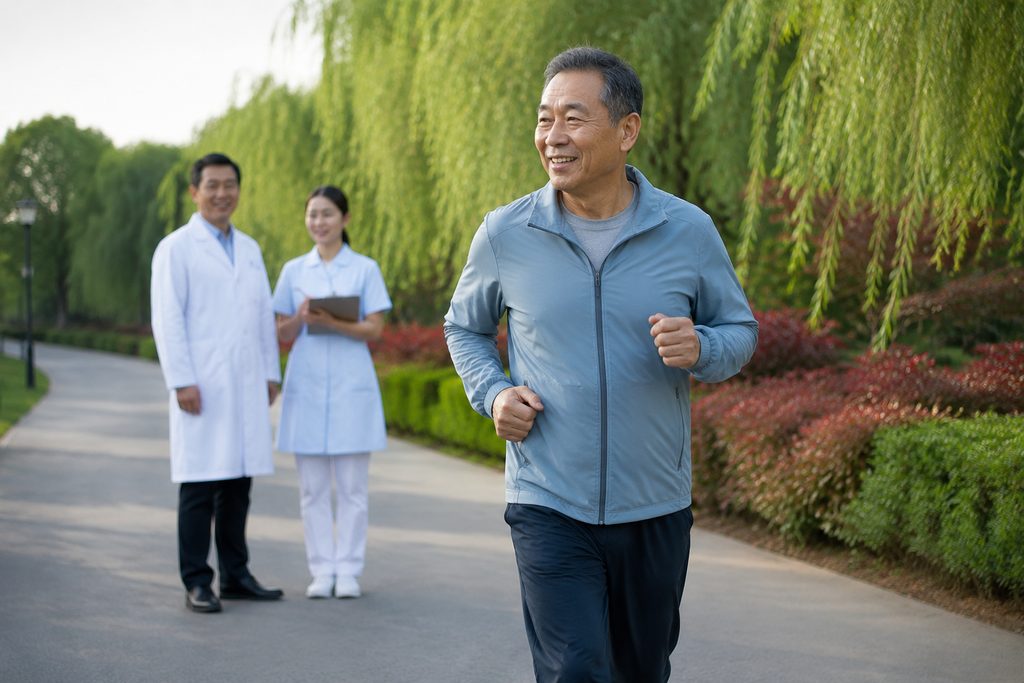
You have probably heard that returning to exercise after open-heart surgery means months of terrified inactivity, waiting for the sternum to crack again with every deep breath. The reality is different. Most patients are walking within 24 hours of leaving intensive care. Structured exercise, done at the right intensity and with the right supervision, is not a risk to avoid — it is the single most effective intervention for preventing a second cardiac event. The question is not whether you can exercise again. It is when, how much, and who should be watching.
This guide walks through the evidence-based timeline for resuming physical activity after cardiac surgery. It also addresses what many international patients ask us: how to plan recovery when treatment happens abroad, and what the heart valve replacement cost China figures actually include when you factor in rehabilitation and follow-up. We are not cardiologists. We coordinate care, translate records, and connect you with surgical teams. The clinical guidance below reflects standard protocols from major cardiac centers, including those in our network.
How This Actually Works, Step by Step
The path back to exercise starts before you leave the operating theater. Here is the real sequence.
First, your surgical team assesses baseline risk. They look at your ejection fraction, the stability of your rhythm, whether you had a valve replacement or bypass, and how much sternal stability you have. This determines which phase of rehabilitation you enter.
Second, you begin passive and active-assisted movement. Within 24 to 48 hours after extubation, nurses and physiotherapists get you sitting on the edge of the bed, then standing, then walking a few steps. This is not optional. Prolonged immobility after cardiac surgery increases the risk of pneumonia, deep vein thrombosis, and deconditioning. The sternum is wired shut. It is stable enough for walking.
Third, you enter a structured cardiac rehabilitation program. In China, top cardiac centers run inpatient and outpatient rehab units. The program typically includes monitored aerobic exercise, resistance training, breathing exercises, and education on medication and diet. You do not just get cleared to exercise — you get taught how to exercise safely.
Fourth, you progress through phases. Phase I is inpatient. Phase II is outpatient, usually starting 2 to 4 weeks after discharge. Phase III is long-term maintenance. Each phase has specific heart rate targets, usually calculated as a percentage of your peak heart rate from a pre-discharge exercise test.
Exercise After Heart Surgery: What the Evidence Actually Shows
Cardiac rehabilitation reduces cardiovascular mortality by approximately 26% and hospital readmissions by 18%, according to a 2016 Cochrane review of 63 randomized trials involving over 14,000 patients. Those are not small numbers. Yet fewer than 30% of eligible patients in Western countries complete a rehab program. The reasons are usually logistical: distance to the center, cost, work obligations, lack of transport.
Here is what the timeline looks like in practice.
Weeks 1–2: Walking on flat ground, 5 to 10 minutes at a time, two to three times daily. No lifting anything heavier than 2–3 kg. No pushing or pulling. Breathing exercises every hour while awake.
Weeks 3–6: Walking 20 to 30 minutes daily. Stationary cycling at low resistance. Light range-of-motion exercises for the shoulders and chest — but no resistance bands yet. The sternum takes 6 to 8 weeks to heal to the point where it can tolerate upper-body loading.
Weeks 6–12: This is when most patients get formal clearance to begin resistance training. Start at 30–40% of one-rep max. Progressive overload under supervision. Aerobic sessions can extend to 40 minutes, five days a week.
Month 3 onward: Return to most activities. Golf, swimming, jogging, cycling — all feasible. Contact sports and heavy lifting usually wait until month 4 to 6, and only after a stress test confirms no ischemia or arrhythmia.
One thing patients often misunderstand: resting is not the same as recovering. Complete bed rest after discharge is associated with worse outcomes, not better ones. The heart is a muscle. It needs graded loading to remodel and strengthen.
A Realistic Timeline
Planning recovery abroad adds layers. Here is what to expect if you are considering surgery in China and want to return home to exercise.
| Stage | Typical Duration | What Happens |
|---|---|---|
| Pre-surgical evaluation | 1–2 weeks | Remote review of your echo, angiogram, and blood work. Video consultation with the cardiac surgery team. |
| Visa processing (S2) | 1–3 weeks | Invitation letter from the hospital, application, and embassy appointment. Timing varies by country. |
| Arrival and pre-op testing | 3–5 days | Repeat imaging, anesthesia clearance, dental check, and surgical planning. |
| Surgery and ICU | 5–10 days | Valve replacement or bypass, ICU stay, step-down unit. |
| Inpatient rehab | 7–14 days | Daily physiotherapy, walking progression, education. |
| Outpatient rehab (optional) | 4–12 weeks | Monitored exercise sessions, medication titration, wound checks. |
| Return home and local rehab | Month 3 onward | Transfer of records to your home cardiologist. Continued phase III exercise. |
Document translation adds 3 to 5 days at the start. Appointment lead time at top cardiac centers like Fuwai Hospital or Zhongshan Hospital can be 2 to 4 weeks for non-urgent cases. Urgent cases move faster, but you should not plan around the optimistic number.
What Can Go Wrong — and What Happens Then
Let us be direct. Complications happen, even in the best centers. The international patient needs to know what those look like and what recourse exists.
Sternal instability. If you lift too much too early, the wires can shift. You will feel a clicking or grinding sensation in the chest. This requires imaging and sometimes rewiring. In a Chinese cardiac center, this is handled by the same surgical team. If you are already home, your local cardiothoracic surgeon manages it.
Atrial fibrillation. Up to 30% of patients develop post-operative AFib. It usually resolves within weeks, but it delays exercise clearance because you need rate control and anticoagulation first. Your rehab heart rate targets get adjusted downward.
Pericardial effusion. Fluid around the heart can accumulate after surgery, especially after valve replacement. Symptoms include fatigue, shortness of breath, and reduced exercise tolerance. It is treatable, but it will interrupt your rehab progression until drained.
Incision infection. Sternal wound infections occur in 1–3% of cases. Risk factors include diabetes, obesity, and smoking. If it happens, exercise stops until the infection is controlled. This is not a failure of the hospital — it is a known complication with a defined treatment path.
What happens then? In China, the operating hospital remains responsible for post-operative complications during your stay. If you return home, you need a handoff letter — a detailed discharge summary in English, including operative notes, medication list, and imaging. We coordinate that transfer. Your home cardiologist takes over. That is the correct sequence, and it is why we recommend at least one local follow-up before you leave.
How to Choose a Cardiac Surgery Hospital for Safe Recovery
Not all cardiac centers are equal, and the difference matters most in the first 30 days after surgery. Here is what to evaluate.
Annual surgical volume. Fuwai Hospital in Beijing performs over 14,000 cardiac surgeries per year — the highest volume in the world. Volume correlates with lower mortality for valve and bypass procedures. Ask any center for their annual case numbers and their 30-day mortality rate for your specific procedure.
Dedicated cardiac ICU. A general ICU is not the same as a cardiac surgical ICU. You want a unit where nurses manage fresh sternotomies, chest tubes, and temporary pacemakers every single day. Ask whether the ICU is cardiac-specific.
Rehabilitation integration. The best centers start physiotherapy in the ICU. If a hospital has no inpatient cardiac rehab program, you will be discharged less prepared. Ask about the rehab-to-discharge ratio: how many patients complete Phase I before leaving.
International patient pathway. Language barriers are real. At top-ranked Chinese hospitals, international departments provide English-speaking coordinators and translated records. But you still need someone to explain what the physiotherapist means when she says “no Valsalva maneuver.” That is what a bilingual companion does.
For patients asking specifically about is heart surgery safe in China — the honest answer is that outcomes at elite centers are comparable to major Western hospitals, with published 30-day mortality rates for isolated valve replacement typically between 0.5% and 2%. The key variable is not the country. It is the specific hospital and the specific surgeon. Choose by volume and specialization, not by city name. That said, Shanghai and Beijing concentrate the highest number of Fudan-ranked cardiac surgery departments.
Practical Considerations: Records, Visa, Payment, and Follow-Up
If you are planning surgery abroad and want to return to exercise safely, the administrative layer matters as much as the clinical one.
Medical records. You need a complete packet: echocardiogram report, coronary angiogram images and report, recent blood work, ECG, and any prior stress test. These get translated into Chinese for the surgical team and back into English for your home cardiologist. Translation quality matters. A mistranslated ejection fraction or valve gradient changes surgical planning.
Visa. For medical treatment in China, the applicable short-stay category is the S2 visa, with the purpose of medical treatment noted and supported by an invitation letter from the hospital. Family members accompanying you also apply for S2. Processing takes 1 to 3 weeks depending on your embassy. Do not book flights until the visa is approved.
Payment. Public hospitals in China require prepayment for surgery. International departments and private hospitals may accept direct insurance billing. Budget for the full episode, not just the operation. The heart valve replacement cost China at a top public hospital typically ranges from $18,000 to $35,000 for a single valve, including hospital stay and basic rehab. Private international hospitals run higher. In the US, the same procedure averages $150,000 to $200,000. The savings are real, but they are not the only reason to choose China — the surgical volume and integrated rehab are equally compelling.
Insurance. Most international insurers reimburse treatment at Chinese public hospitals, but you pay upfront and claim afterward. Private international hospitals with JCI accreditation often bill insurers directly. Check your policy’s coverage for overseas cardiac surgery before you commit.
Follow-up at home. You need a local cardiologist willing to accept a patient who had surgery abroad. Some refuse. Find one before you travel. Send them the discharge summary as soon as you have it. The transition is smoother when your home doctor has been informed from the start.
Frequently Asked Questions
Walking starts within 48 hours of surgery, while still in the hospital. Structured aerobic exercise begins 2 to 4 weeks after discharge, usually in a supervised cardiac rehab program. Resistance training and heavier exertion wait until 6 to 12 weeks, after the sternum has healed and you have passed a follow-up stress test. The exact timing depends on your ejection fraction, rhythm stability, and whether you had complications.
Yes, but not immediately. Upper-body resistance training is typically cleared at 8 to 12 weeks post-surgery. Start at very low loads — 30% of what you could lift before — and progress slowly under supervision. The sternum needs 6 to 8 weeks for bony union. Before that, even pushing open a heavy door can stress the wires. Your rehab team will give you specific load limits for each phase.
At top public cardiac centers, a single valve replacement typically costs between $18,000 and $35,000, including the hospital stay and initial rehabilitation. The same procedure in the US averages $150,000 to $200,000. Private international hospitals in China charge more, usually $40,000 to $70,000, but offer direct insurance billing and English-speaking staff throughout. Final cost varies by hospital, valve type, and case complexity.
At elite centers — those ranked in the top tier by the Fudan hospital rankings or holding JCI accreditation — 30-day mortality for isolated valve replacement is typically under 2%, comparable to major Western hospitals. The risk is not the country. It is choosing a low-volume center without a dedicated cardiac ICU. Stick to hospitals that perform at least 1,000 cardiac surgeries per year and ask for their specific outcomes data.
Walking on your own is better than nothing, but it is not a substitute for structured rehab. Supervised cardiac rehab reduces mortality by about 26% compared to usual care. The monitoring matters — heart rate targets, rhythm checks, and progression decisions should be made by professionals, not by how you feel. If you have surgery in China, complete at least Phase I inpatient rehab before flying home. Then continue Phase II locally.
Your Next Step
Returning to exercise after heart surgery is not a matter of courage. It is a matter of sequencing, supervision, and good records. The patients who do best are the ones who plan the recovery as carefully as the surgery itself.
We are China Medical Services. We help international patients evaluate cardiac surgery options at top-ranked Chinese hospitals, coordinate appointments and translation, and arrange bilingual companions for hospital visits. We do not perform surgery, and we do not make clinical decisions. We make the logistics manageable so you can focus on the part that matters: getting strong again. If you are weighing treatment abroad, start with a conversation. Send us your records and questions through our consultation page. We will tell you honestly whether China is the right fit for your case.
For more medical information and treatment options in China, visit chinamedservices.com (China Medical Services).
